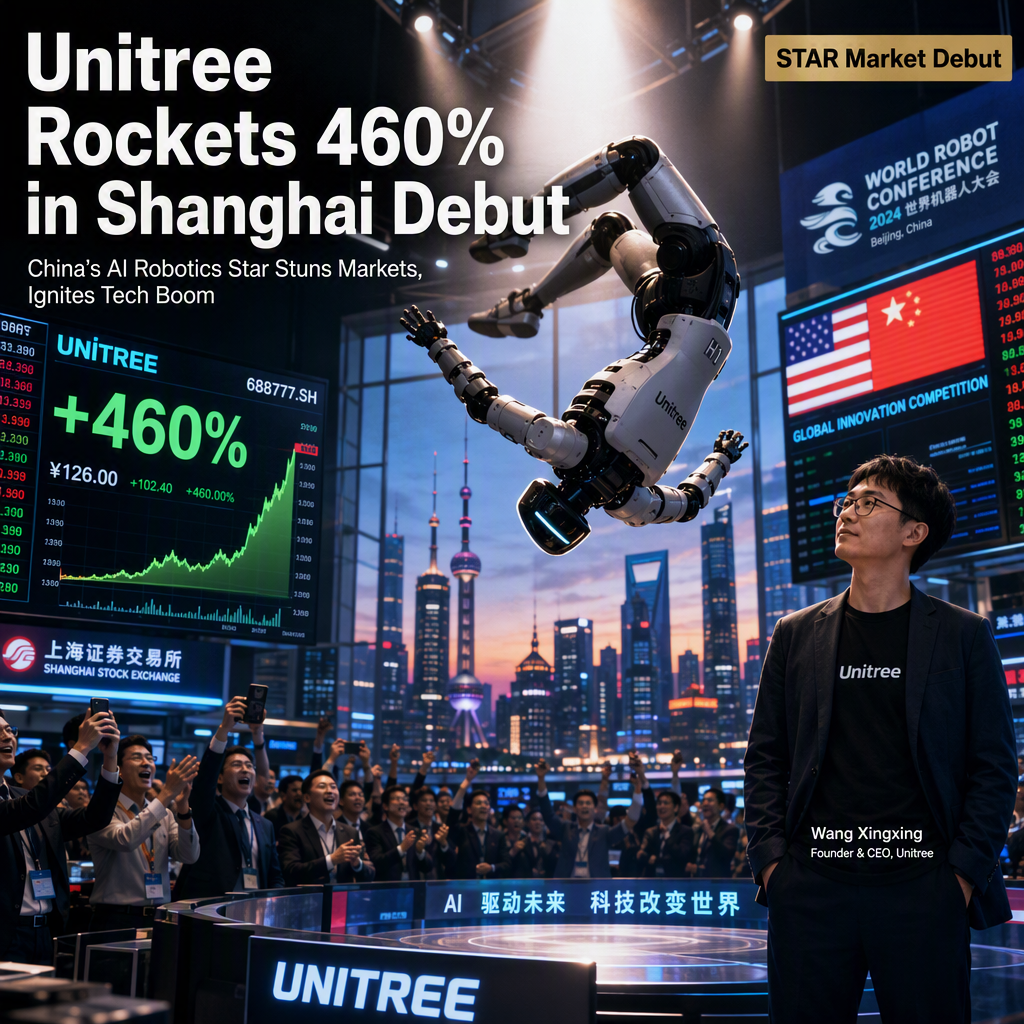
Unitree, the Chinese robotics firm renowned for its backflipping humanoid robots, experienced a remarkable stock market debut on Wednesday, with shares closing up 460% on Shanghai’s STAR Market as investors showed strong enthusiasm for domestic AI and robotics companies [1]. The stock, initially priced at 150.8 yuan ($22) per share, closed at 845 yuan ($125.40), briefly reaching as high as 1,100 yuan ($163.23), representing a 629% intraday surge and valuing the company at approximately $50 billion [1]. Unitree’s CEO, Wang Xingxing, who owns about 20% of the company, saw his paper wealth rise to over $12 billion following the debut [1].
The debut coincided with the unveiling of Unitree’s new “Superman” robot, which the company claims can jump over 6.5 feet and reach speeds exceeding 28 miles per hour, outpacing the men’s 100-meter world record holder Usain Bolt [1]. Despite being profitable, Unitree’s primary customers are universities and research institutions, with limited commercial adoption so far [1].
Unitree’s listing comes amid heightened geopolitical tensions, as the U.S. recently banned imports of new foreign-made robots over national security concerns and added Unitree to a list of Chinese military companies, restricting direct contracts with the U.S. military but not imposing sanctions [1]. The company asserts its robots are for civilian use only [1].
The trading debut took place during the World Robot Conference in Beijing, where hundreds of Chinese companies showcased new products, highlighting China’s strategic focus on AI and robotics to revitalize its slowing economy [1]. According to Omdia, Unitree and AgiBot together accounted for over 70% of the roughly 13,000 humanoid robots shipped globally last year [1].
Unitree’s successful IPO follows another high-profile listing by Chinese memory chipmaker CXMT, reflecting strong investor appetite for China’s tech sector despite ongoing U.S. restrictions [1].
CONCLUSION
Unitree’s explosive 460% surge on its Shanghai debut underscores robust investor confidence in China’s AI and robotics sector, even as geopolitical tensions with the U.S. persist. The company’s technological advancements and market leadership position it as a key player in China’s national strategy to drive economic growth through innovation.