
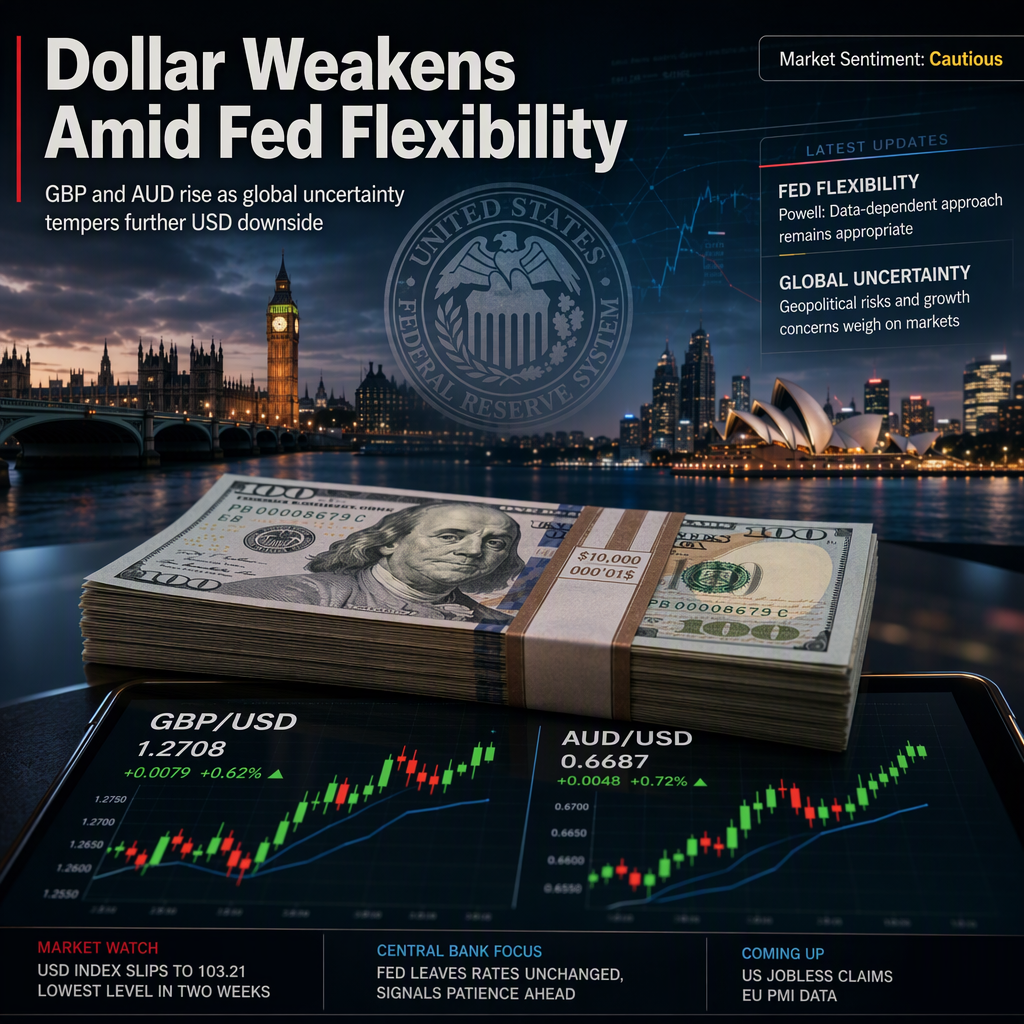
The US Dollar (USD) weakened against both the British Pound (GBP) and the Australian Dollar (AUD) during early Asian trading hours on Friday, following comments from Federal Reserve (Fed) officials that signaled a flexible approach to future interest rate hikes. Fed Governor Christopher Waller stated that while additional rate hikes will likely be needed to bring inflation down to the Fed's 2% target, there is 'flexibility' regarding the pace of increases, and he left open the possibility of a pause at the upcoming October meeting [1]. Markets are now pricing in a 17.7% chance of a 25 basis point rate hike at the Fed's October policy meeting, down from 38% a week ago, according to the CME FedWatch tool. However, the probability of a hike at the December meeting remains high at 83% [1].
The GBP/USD pair strengthened to around 1.3240, with traders also focusing on renewed UK fiscal concerns. The UK's long-term borrowing costs recently reached their highest level since the 1990s, and attention is turning to Finance Minister John Healey's first budget on October 28. The UK chancellor has described the fiscal outlook as 'challenging' for the country's largest lenders but has not indicated whether higher taxes for banks will be introduced [1]. UOB Group strategists now expect GBP to trade in a lower range of 1.3140 to 1.3280, noting that a sustained decline below 1.3140 is unlikely [1].
Similarly, the AUD/USD pair edged higher, trading above the mid-0.6900s and up just over 0.10% for the day, as the USD remained subdued. The move was supported by a corrective decline in US Treasury yields following strong demand at a 30-year bond auction and by President Donald Trump's statement that the US would not resume military strikes on Iran before the November 3 midterm congressional election, which helped ease inflation concerns and kept crude oil prices in check [2]. However, ongoing geopolitical risks, including the US-Iran standoff and fighting involving Iran-backed Houthis and Saudi Arabia, continue to provide some support to the safe-haven Greenback [2].
UOB Group strategists for AUD/USD now expect the pair to consolidate within a 0.6935 to 0.6975 range, downplaying the likelihood of a sustained decline despite recent volatility [2]. Technical analysis indicates that the AUD/USD remains capped by resistance at 0.6983 and 0.7032, with initial support at 0.6905 [2].
Both articles highlight that while the USD is currently weaker, the Fed's ongoing hawkish stance and global uncertainties could limit further downside for the currency. Market participants are advised to remain cautious and await further data, such as the Michigan Consumer Sentiment Index, before making directional bets [1][2].
CONCLUSION
The US Dollar's recent weakness against the British Pound and Australian Dollar is driven by softer Fed rhetoric and global uncertainties, but the potential for further Fed tightening remains. Both GBP/USD and AUD/USD are expected to trade within defined ranges in the near term, with limited scope for sustained moves. Market sentiment is cautious as traders await upcoming economic data and monitor geopolitical developments.