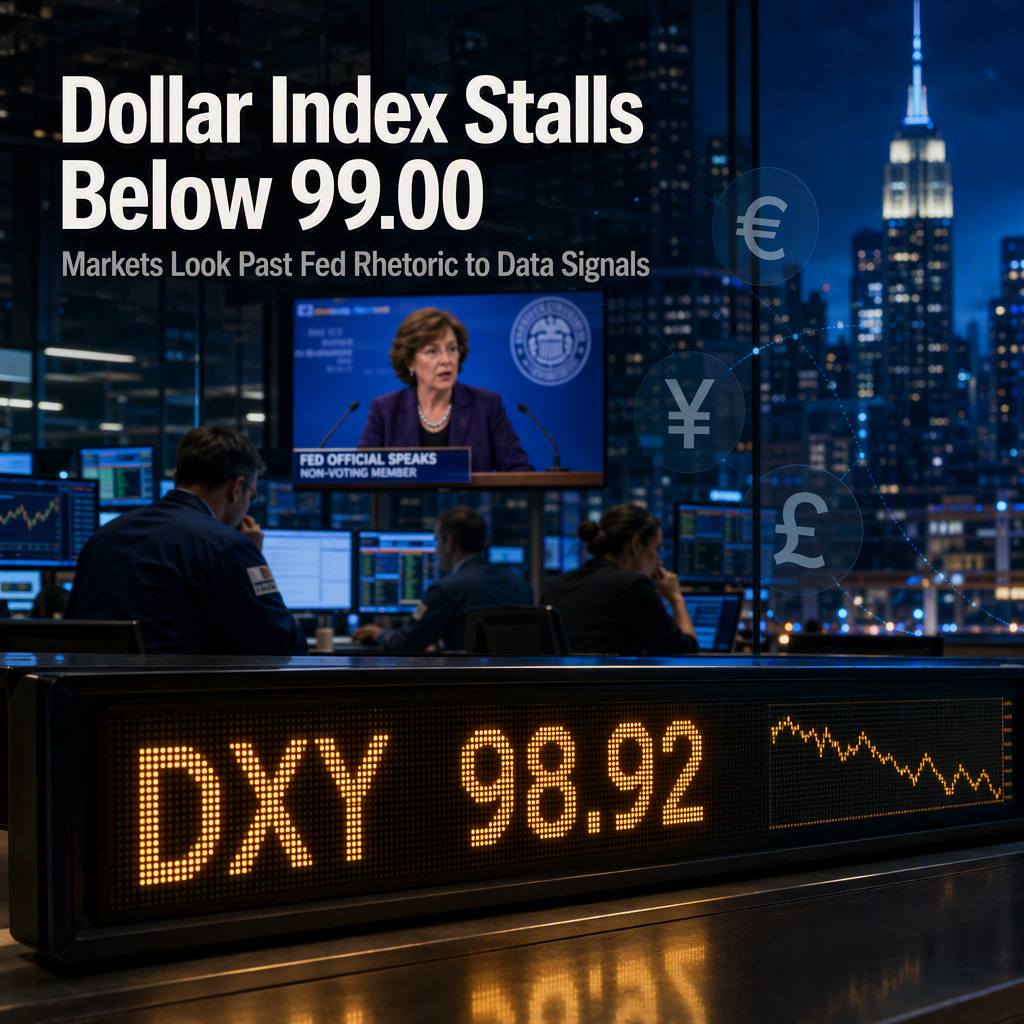
The US Dollar Index (DXY) remained subdued, trading just below the 99.00 mark, as market participants largely ignored hawkish commentary from non-voting Federal Reserve regional presidents and instead focused on upcoming economic data releases and policy signals from voting members of the Federal Open Market Committee (FOMC) [1][2]. Despite a conditional hold statement from a non-voting Fed president, the Dollar Index showed minimal movement, with trading bands narrowing and the market showing little reaction to speeches from officials without voting power [1].
Recent FOMC minutes indicated that while several participants were prepared to tighten policy further, the actual voting tally remained at 9-3, with only three of the four voting regional presidents dissenting for a quarter-point increase on July 29 [1]. Futures markets have repriced expectations for a September rate hike, with the probability dropping to about one in three from nearly two-thirds following a series of softer economic data, including a contraction in payrolls, a cooler inflation print, and disappointing retail sales [1].
On Tuesday, US economic releases continued to align with the market's dovish repricing: new home sales fell 10.5% month-over-month in July to an annual rate near 607,000, while inventory rose toward 488,000 units. Consumer confidence also eased to 89.4 in August, with the expectations index dropping to 68.2, well below the 80 threshold often seen as a recession signal. These figures provided little support for a tighter monetary policy stance [1].
Currency markets reflected this sentiment, with the US Dollar showing modest changes against major peers. The Dollar was strongest against the Japanese Yen (+0.06%) but weaker against the Euro (-0.09%) and British Pound (-0.11%) [2]. EUR/USD held firm near 1.1675 after positive German data, and GBP/USD hovered just below 1.3650, supported by persistent UK inflation and robust business surveys [2]. Meanwhile, the USD/JPY pair edged higher, staying above the 159.00 level [2].
Looking ahead, traders are awaiting a heavy slate of US data releases and Fed Chair Kevin Warsh's address at Jackson Hole on Friday, with the Treasury's bond-buyback plans also weighing on the currency [2]. The market appears to be discounting Fed rhetoric in favor of concrete economic data, as the gap between stated preferences and actual policy actions has led to a repricing of the Dollar's value [1][2].
CONCLUSION
The US Dollar Index's stagnation below 99.00 reflects a market that is prioritizing economic data over non-voting Fed commentary, with recent releases pointing to softer conditions and reduced expectations for further tightening. As traders await key US data and Fed Chair Warsh's upcoming speech, the Dollar remains on the back foot, with market sentiment leaning dovish and the impact of policy rhetoric diminished.