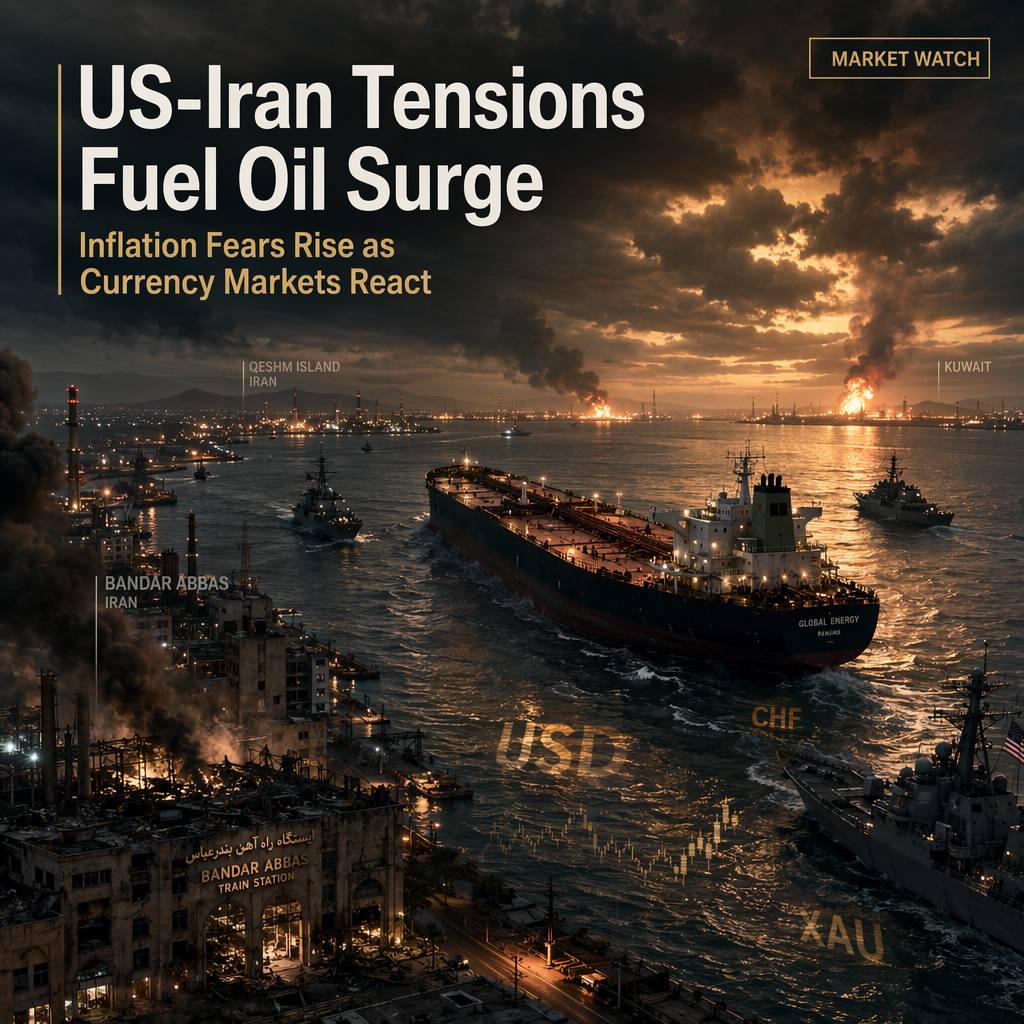
Escalating conflict between the United States and Iran has intensified market volatility, with both sides exchanging fire and Iran expanding its military campaign beyond conventional targets, including civilian infrastructure in Bandar Abbas such as power facilities and a train station [1]. Iran retaliated with missile and drone attacks targeting US-allied Gulf nations, and tensions have risen around the Strait of Hormuz, where the US intercepted commercial vessels attempting to breach its naval blockade [1]. Reuters reported that Iran has instructed Yemen’s Houthi militia to prepare to close the Red Sea oil route if the US strikes Iranian power infrastructure, posing a significant threat to global energy supplies [1][2]. Explosions were reported in Bandar Abbas, Qeshm, Ahvaz, Kuwait, and Basra, further amplifying geopolitical risks [2].
These developments have pushed crude oil prices to a one-month high, with prices jumping over 10% this week, reviving concerns about energy-driven inflation [1]. The heightened inflation fears have reinforced expectations that the US Federal Reserve may keep interest rates higher for longer, supporting the US Dollar (USD) and weighing on non-yielding assets like gold (XAU/USD) [1]. Gold recovered from its monthly low during the Asian session on Friday but remains constrained by the hawkish Fed outlook and firm USD [1].
US economic data released this week showed mixed signals. The US Labor Department reported that initial jobless claims dropped to a seasonally adjusted 208,000 for the week ended July 11, below consensus estimates and at a two-month low, highlighting labor market resilience [1][2]. The Philadelphia Fed Manufacturing Index surged from 10.3 to 41.4 in July, its highest since November 2021, indicating rapid regional factory activity and continued price pressures [1]. However, US consumer inflation increased less than expected in June, and producer prices unexpectedly fell, prompting traders to scale back expectations of near-term Fed rate hikes [2]. Markets have largely ruled out a Fed rate hike this month, though expectations remain split for September [2].
Fed officials provided mixed signals: Dallas Fed President Lorie Logan called for modestly higher interest rates, citing insufficient progress on inflation, while Fed Vice Chair Philip Jefferson stated he would be open to raising rates if inflation does not improve soon [1]. According to the CME Group's FedWatch Tool, traders are currently pricing in a nearly 75% chance of a 25-basis-point Fed rate hike by year-end [1].
In currency markets, the USD/CHF pair held steady around 0.8090 during Asian hours on Friday, with the Swiss Franc (CHF) potentially gaining support as a safe-haven asset amid escalating Middle East hostilities [2]. The Swiss National Bank left its policy rate unchanged at 0% in June, but meeting minutes acknowledged that geopolitical tensions have increased near-term inflation risks [2].
CONCLUSION
Rising US-Iran tensions have driven oil prices sharply higher, stoking inflation fears and influencing expectations for future Federal Reserve policy moves. While gold and the Swiss Franc have seen safe-haven interest, the US Dollar remains supported by resilient labor data and hawkish Fed commentary. Markets remain highly sensitive to further geopolitical developments and central bank signals.