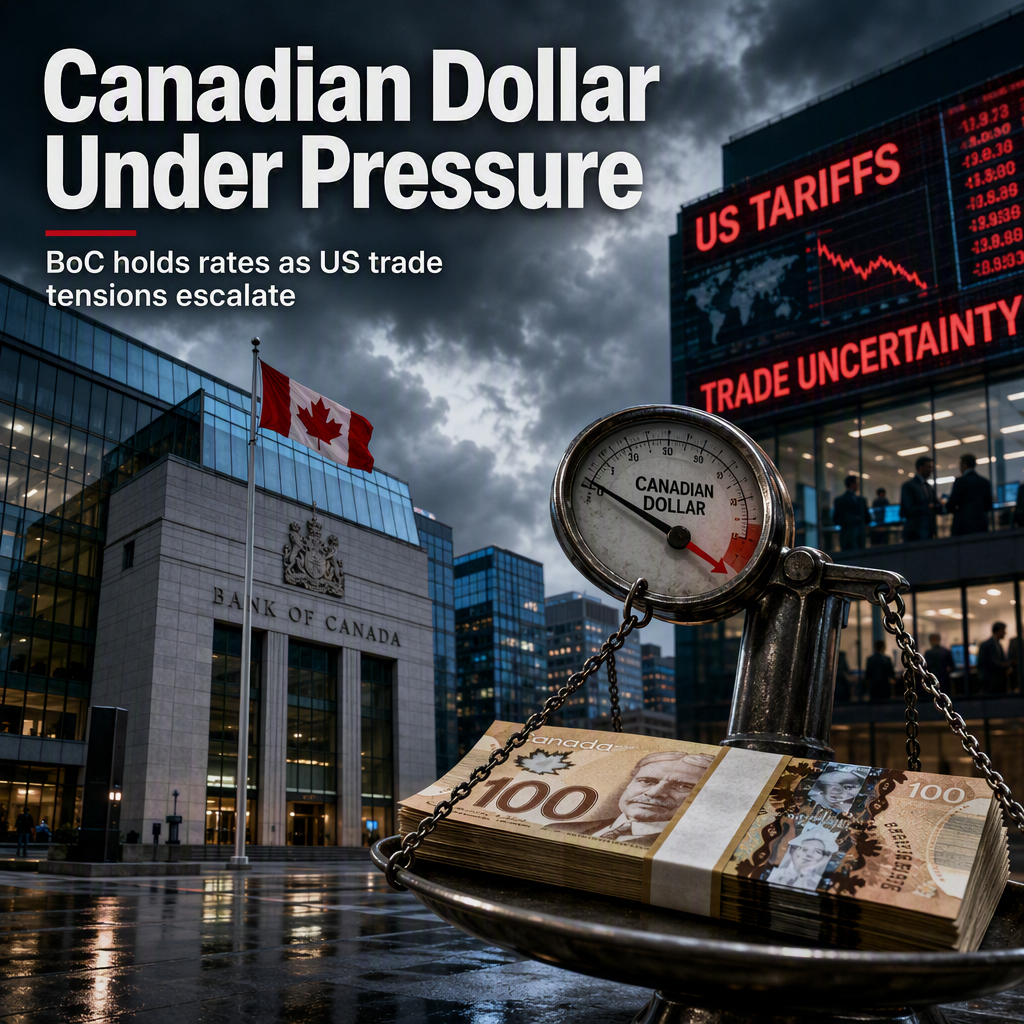
The Canadian Dollar (CAD) has come under renewed pressure as the Bank of Canada (BoC) maintains its benchmark policy rate at 2.25%, a decision influenced by both rising inflation and escalating trade tensions with the United States [1][2][3]. The BoC's steady stance comes after headline inflation in Canada rose to 3.0% year-on-year in July, up from 2.8% in June, while core inflation remains anchored at 1.9%, just below the 2.0% target [1][2][3]. Canadian GDP growth accelerated to 0.8% in the second quarter, up from 0.1% in the first quarter, with annualized growth cited at 3.3% [1][3].
The recent imposition of 50% US tariffs on a wide range of Canadian goods, followed by Canadian retaliatory tariffs set to take effect on September 8 and impacting over $20 billion in goods, has injected significant uncertainty into the economic outlook [3]. According to strategists at Societe Generale, the USD/CAD currency pair has rebounded from recent lows near 1.3730, but faces a critical resistance zone at 1.3990/1.4030. Failure to break above this level could see the broader decline in USD/CAD continue, with 1.3840 as initial support [1][2]. However, ING and Societe Generale analysts note that unless trade tensions deepen further, upside for USD/CAD may be capped near 1.4000 [1].
Market participants are pricing in the possibility of two to three BoC rate hikes over the next 12 months, in line with US expectations, though Bank of America and Goldman Sachs both suggest the BoC is likely to remain cautious and keep rates on hold in the near term due to heightened trade uncertainty [2][3]. Goldman Sachs estimates that the new tariffs could shave 0.3 percentage points off GDP growth and add 0.3 percentage points to inflation in Canada [3]. Analysts emphasize that while the BoC is prepared to adjust policy as needed, the central bank is likely to reiterate a cautious tone and highlight the high degree of uncertainty stemming from the trade dispute [3].
Societe Generale and ING strategists further argue that the current yield differential of 133 basis points between Canada and the US must narrow to justify sustained CAD strength, and that the BoC's patient stance is supported by projections for both growth and inflation to average around 2% through 2027 and 2028 [1][2]. The technical outlook for USD/CAD remains at an inflection point, with the pair's direction hinging on the resolution of trade tensions and the BoC's future policy moves [1][2].
CONCLUSION
The Bank of Canada's decision to hold rates steady amid rising inflation and escalating US-Canada trade tensions has put the Canadian Dollar under pressure, with analysts highlighting significant downside risks if trade hostilities intensify. While markets are pricing in potential rate hikes, most economists expect the BoC to remain cautious in the near term. The USD/CAD pair is at a technical and fundamental crossroads, with its trajectory dependent on both monetary policy and the evolving trade landscape.