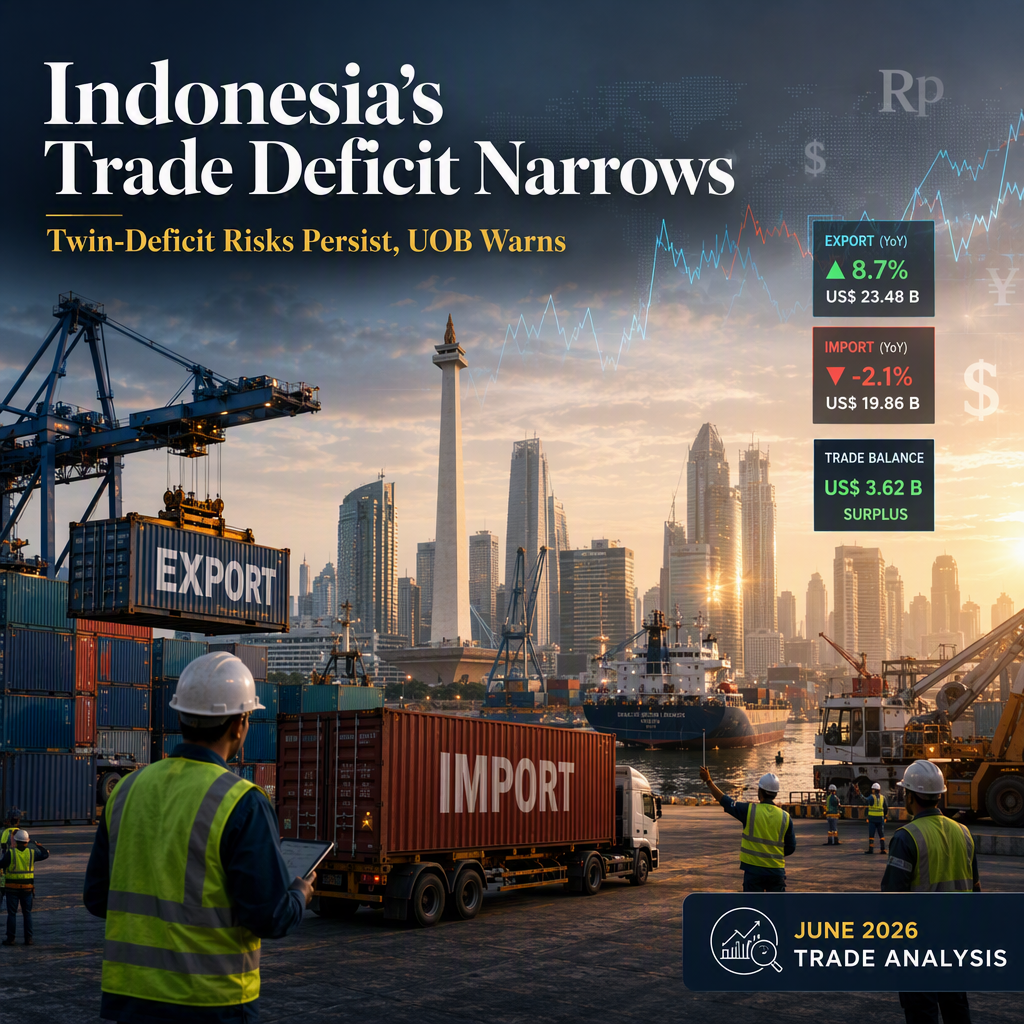
UOB economists Enrico Tanuwidjaja and Vincentius Ming Shen analyzed Indonesia's June 2026 trade data, noting that the country's trade deficit narrowed during the period. This improvement was attributed to stronger non-oil and gas exports, which helped offset rapid growth in imports [1]. Despite this positive development, the economists highlighted emerging risks, specifically the possibility of a near-term twin deficit scenario, where both the current account and fiscal balances come under pressure simultaneously [1].
The report emphasized that Indonesia's external position remains vulnerable to geopolitical developments and fluctuations in energy markets [1]. However, the economists argued that ongoing downstream industrialization and energy-security initiatives are expected to bolster the country's structural resilience over the longer term. These measures should enhance external sustainability and reduce Indonesia's reliance on volatile commodity cycles [1].
From a macroeconomic perspective, UOB's analysts suggested that the recent trade deficit should not be viewed entirely negatively. They pointed out that a significant portion of the import surge is linked to capital formation and industrial development, which are supportive of Indonesia's long-term growth prospects [1].
CONCLUSION
Indonesia's June 2026 trade data shows a narrowing deficit, driven by robust non-oil and gas exports, but near-term risks remain due to potential twin deficits. UOB economists see long-term structural support from industrial and energy initiatives, suggesting that current import growth may benefit future economic expansion.