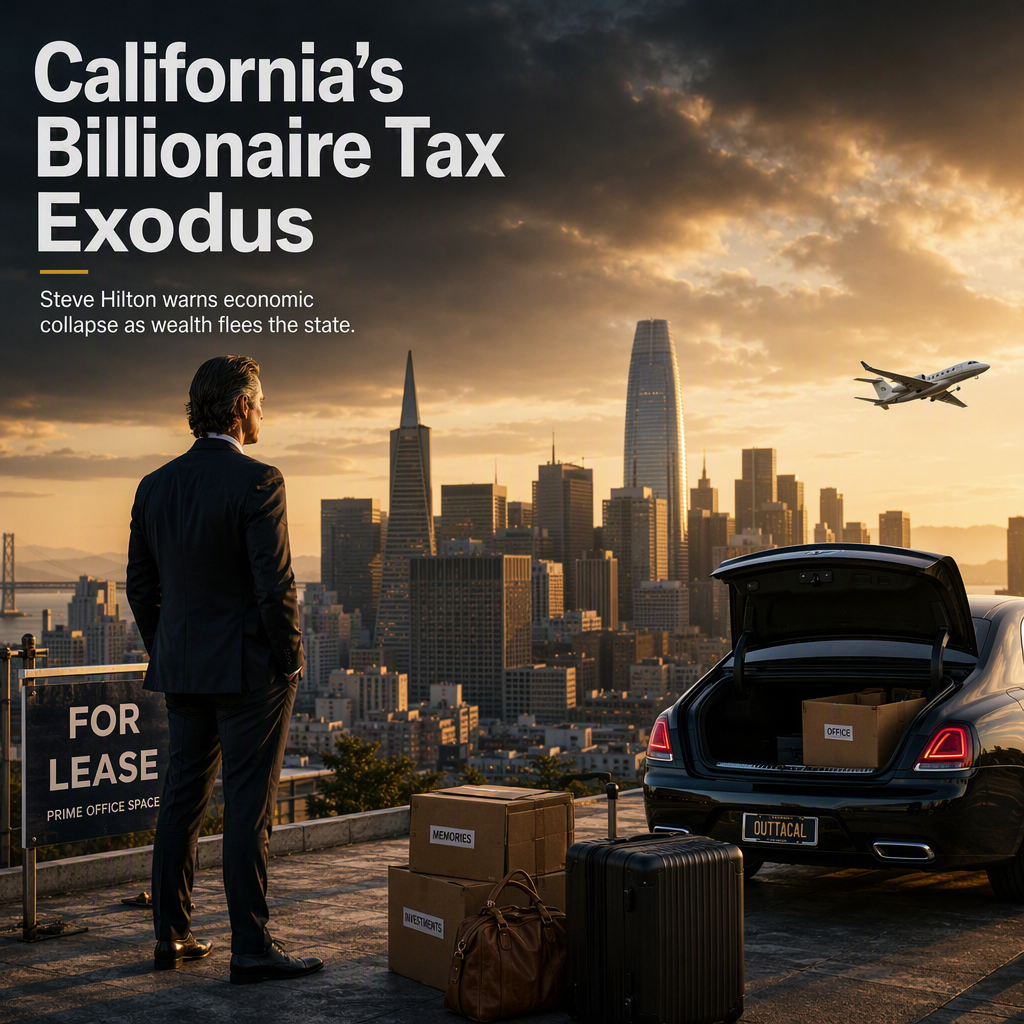
California Republican gubernatorial candidate Steve Hilton has issued a stark warning regarding a proposed billionaire tax in California, stating that the measure could 'absolutely collapse' the state's economy if enacted [1]. Hilton argued that California is already experiencing significant losses in businesses, investment, and tax revenue, attributing these trends to high costs and the existing tax burden [1]. He claimed that the mere threat of the billionaire tax has already cost California billions of dollars in lost tax revenue due to wealthy individuals relocating out of the state [1].
Supporters of the proposed tax believe that California's wealthiest residents should contribute more to the state's finances. However, opponents, including Hilton, contend that the current tax structure is already prompting both individuals and companies to leave California, further eroding the tax base [1]. Hilton emphasized that top earners already pay a substantial portion of the state's income taxes and questioned whether increasing taxes would lead to improved public services [1].
Beyond the billionaire tax, Hilton highlighted additional challenges facing California's economy, such as rising labor costs, energy prices, and regulatory burdens. He argued that repeated minimum wage increases have created a 'doom loop,' escalating business costs that are ultimately passed on to consumers [1]. According to Hilton, these factors are causing businesses to reduce hiring, increase automation, or exit the state altogether due to unsustainable operating costs [1].
As an alternative, Hilton advocated for lower taxes, reduced government spending, and fewer regulations, suggesting these policies would attract employers, boost investment, and enhance affordability for California residents [1].
CONCLUSION
Steve Hilton's warnings underscore concerns that a proposed billionaire tax could exacerbate California's economic challenges, potentially accelerating the exodus of wealth and businesses from the state. The debate highlights deep divisions over tax policy and its impact on competitiveness, with Hilton advocating for lower taxes and deregulation as a path to economic recovery.