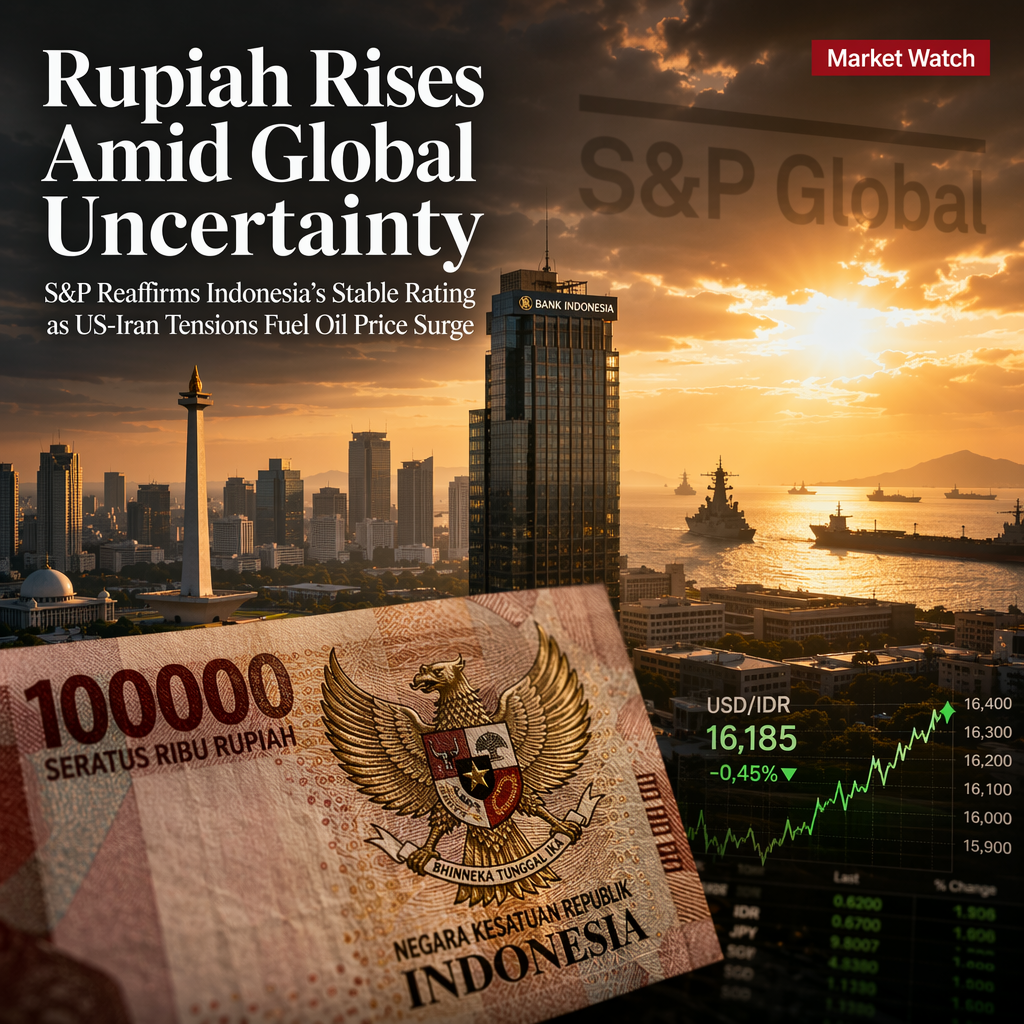
The Indonesian Rupiah (IDR) appreciated for the second consecutive day, with the USD/IDR pair trading around 18,110 during Asian hours on Wednesday, following S&P Global Ratings' reaffirmation of Indonesia’s investment-grade credit rating with a stable outlook [1]. S&P Global noted that recent fiscal and external pressures, including elevated oil prices and rupiah depreciation, are likely temporary [1]. Bank Indonesia provided additional support for the currency by implementing a 100-basis-point rate hike between May and June and pledging to use all available monetary tools to stabilize the rupiah [1].
The US Dollar (USD) continued to lose ground after softer-than-expected US inflation data, which increased market hopes for a less hawkish stance from the US Federal Reserve (Fed) [1]. The US Consumer Price Index (CPI) inflation eased to 3.5% year-over-year in June, down from a three-year high of 4.2% in May and below the market consensus of 3.8%. On a monthly basis, headline CPI declined by 0.4% in June, contrasting with a 0.5% increase in May [1].
Despite the weakening USD, rising safe-haven demand due to renewed tensions between the United States and Iran could limit further downside for the Greenback [1]. The US Central Command (CENTCOM) confirmed additional military strikes against Iran, targeting dozens of military sites along the Iranian coast and near the Strait of Hormuz, which handles nearly 20% of the world's energy supply [1]. The operation involved US fighter jets, drones, and naval vessels launching precision munitions at Iranian missile and drone installations [1].
The renewed Hormuz tensions have driven up oil prices, fueling inflation concerns and potentially prolonging higher interest rates by the Federal Reserve. The CME FedWatch Tool indicates that markets are now pricing in a roughly 50% chance of a Federal Reserve rate hike in September [1].
CONCLUSION
The Indonesian Rupiah's recent strength is supported by S&P Global's stable rating and decisive action from Bank Indonesia. However, global market sentiment remains cautious due to US-Iran tensions and rising oil prices, which could influence inflation and Federal Reserve policy. The outlook for USD/IDR will depend on further developments in geopolitical risks and US monetary policy.