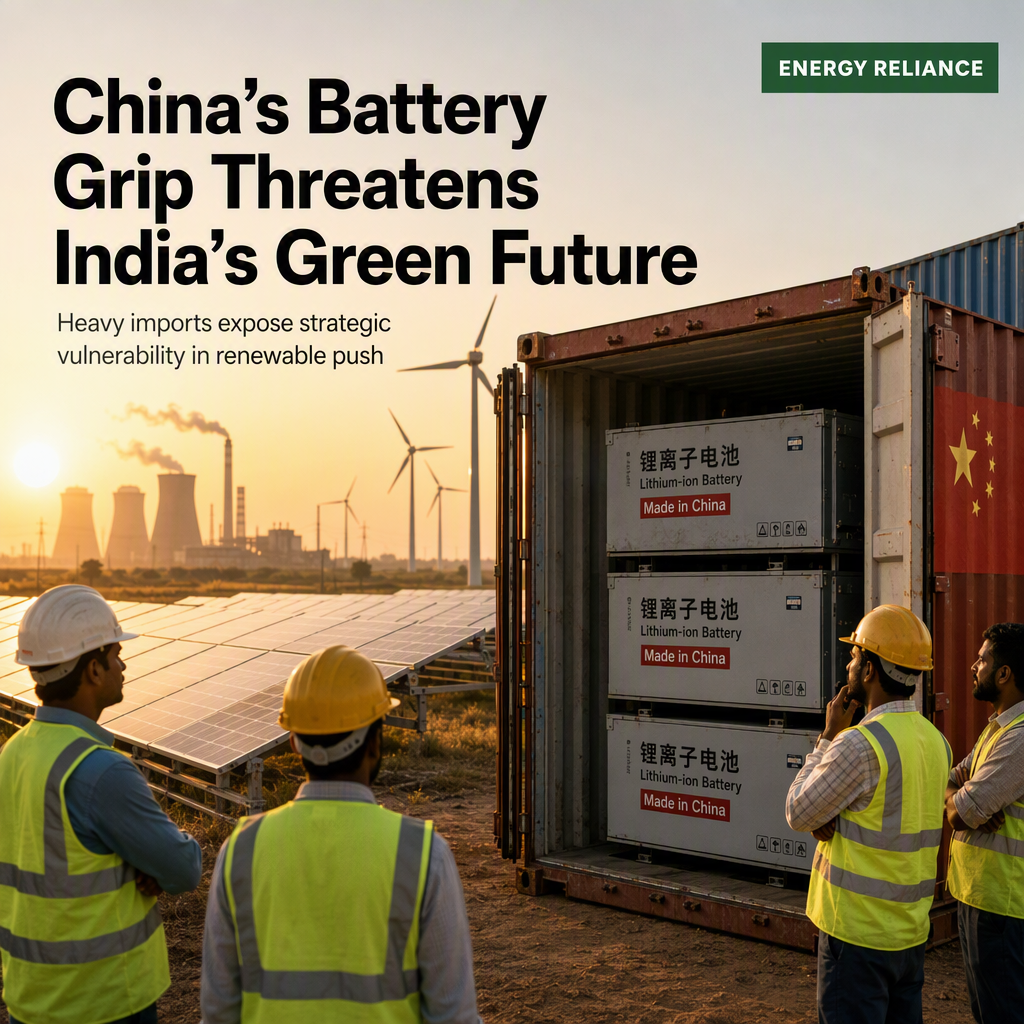
India is aggressively pursuing a self-reliant green energy ecosystem, aiming to expand its renewable energy capacity and reduce dependence on coal. However, the country faces a significant challenge due to its heavy reliance on imported batteries, with nearly 80% sourced from China and the remaining 20% from other Asian countries such as South Korea and Taiwan [1]. India's domestic battery manufacturing accounts for less than 1% of its estimated 260 gigawatt-hour demand pipeline based on competitive tenders in 2026, highlighting a substantial gap in local production capacity [1].
Despite rapid growth in renewable energy, with solar and wind power plants now comprising more than 40% of India's total electricity generation capacity, nearly 70% of power generated in the financial year ending March 2026 was still coal-based, while just over 15% came from solar and wind projects [1]. Experts cited by CNBC emphasize that while green energy is available, its supply is unreliable without robust battery-based energy storage solutions, which are currently dominated by Chinese imports [1].
To address reliability issues, India's Central Electricity Authority recently proposed draft regulations requiring all new government solar and wind projects commissioned after July next year to include battery storage for dispatching green power as needed [1]. While this move is expected to improve the reliability of renewable energy supply, it is also likely to deepen India's reliance on Chinese batteries in the absence of significant local manufacturing capacity [1].
Industry analysts, including Ankita Chauhan from Wood Mackenzie, note that China's dominance in battery manufacturing gives it a 'critical advantage' over India and has been used as a geopolitical tool in trade negotiations [1]. The situation underscores the strategic vulnerability in India's green energy ambitions and the urgent need to develop a domestic battery manufacturing ecosystem [1].
CONCLUSION
India's push for renewable energy is hampered by its dependence on Chinese battery imports, which threatens its goal of energy self-reliance. Without significant investment in domestic battery manufacturing, India's efforts to expand green energy and reduce coal reliance may inadvertently strengthen its reliance on China.