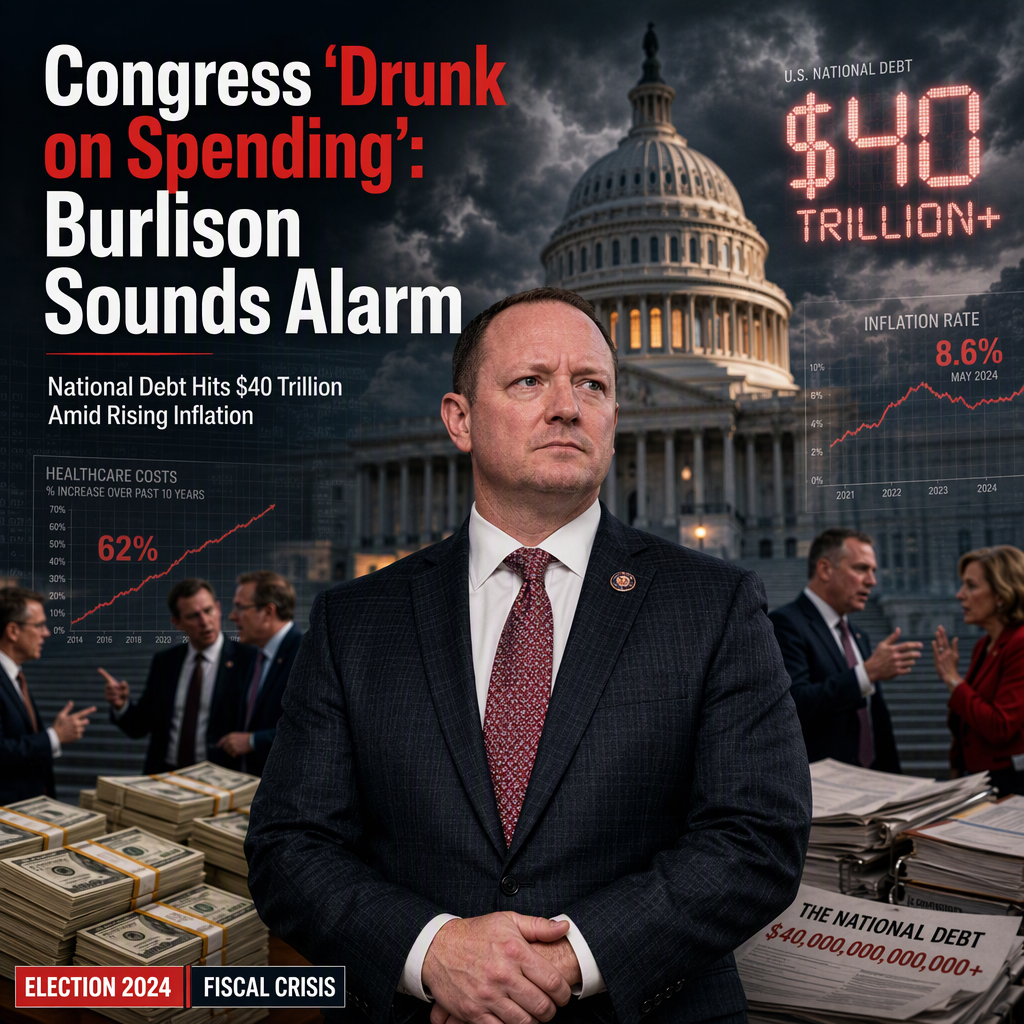
Missouri Rep. Eric Burlison has sharply criticized his colleagues in Congress, including members of his own Republican party, for what he describes as reckless government spending that has contributed to the national debt surpassing $40 trillion [1]. In an interview with Fox News Digital, Burlison stated, 'Most of my colleagues like to spend money…they like to spend other people's money. They're drunk on spending other people's money, even Republicans, unfortunately, and there's few people up here like myself who were willing to make significant spending reductions' [1].
Burlison highlighted the challenges faced in securing spending cuts, noting that even within his own party, there was resistance to reducing expenditures in the 'Big, Beautiful Bill.' He warned that the consequences of continued overspending are already manifesting in uncontrollable inflation and soaring interest rates, stating, 'All of these sins of overspending are haunting us. And now we're seeing…inflation that we can't control. We're seeing the interest rates go through the roof. At some point, you can't keep borrowing money…Sadly, my colleagues that weren't willing to cut spending are going to be forced to cut spending' [1].
Focusing on healthcare as a primary driver of affordability issues, Burlison cited that the average American family paid $6,000 a year for insurance premiums for a family of four in 2000, compared to $27,000 today. He emphasized that if healthcare costs had tracked normal inflation, the current figure would be only $11,000 per year [1]. Burlison's office has proposed the 'Great American healthcare plan' and another bill addressing housing affordability, but he expressed frustration at the lack of action from party leadership over the past two years [1].
As the midterm elections approach, Burlison suggested that the GOP faces a messaging problem regarding affordability, despite efforts to position themselves as the party of fiscal responsibility [1].
CONCLUSION
Rep. Burlison's remarks underscore growing concerns about the impact of government overspending on inflation, interest rates, and affordability for American families. With the national debt exceeding $40 trillion and healthcare costs rising sharply, the political and economic implications remain significant as the midterm elections near.