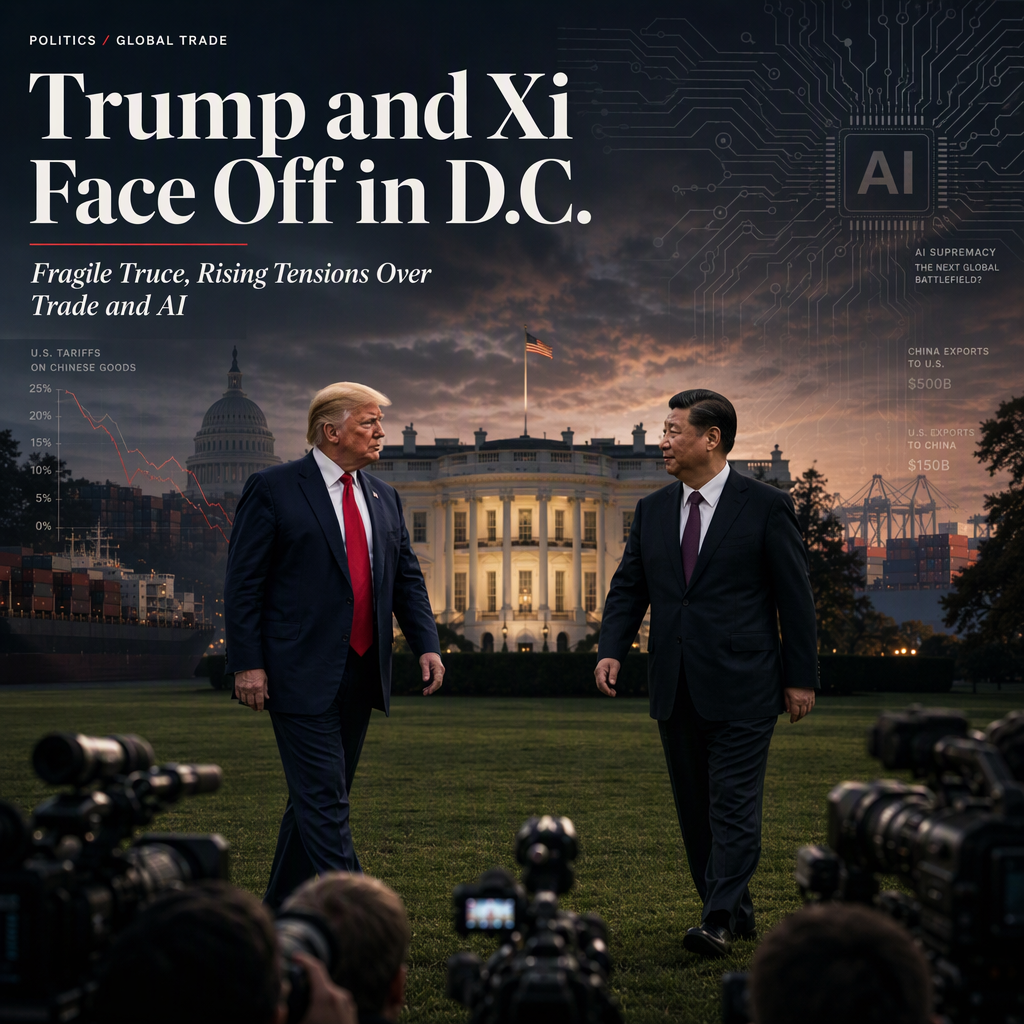
President Donald Trump and Chinese leader Xi Jinping are scheduled to meet in Washington this week to discuss strengthening their fragile trade truce, with the summit taking place less than six weeks before the U.S. election cycle concludes—a period marked by heightened focus on Americans' cost of living concerns and declining polling numbers for Trump on economic issues [1]. The leaders are expected to address a range of contentious topics, including artificial intelligence, tariffs, sanctions related to the Iran war, export controls, and rare earths, all of which continue to fuel ongoing U.S.-China tensions [1].
Despite gestures of goodwill ahead of the summit, both sides have continued to exchange accusations and retaliatory trade actions. Treasury Secretary Scott Bessent emphasized the 'great respect' between Trump and Xi, which he believes positively influences broader U.S.-China negotiations. However, Bessent also noted that 'some deliverables have not been completely fulfilled' by China under the trade agreement reached in Busan, South Korea, nearly a year ago [1].
The U.S.-China trade relationship has seen significant volatility, with last year's trade war resulting in U.S. tariffs on Chinese imports peaking at 145% and Beijing's retaliatory duties reaching 125%. These tariffs were reduced in May 2025 following a temporary deal brokered in Switzerland, which was later extended in August. The subsequent Busan agreement led to further de-escalation, including China's suspension of export controls on rare earths and commitments to purchase U.S. goods [1].
Analysts have expressed concerns about the top-down nature of the diplomatic process, with Claire Reade of the Center for Strategic and International Studies noting that 'a number of inconsistent viewpoints seem to be jostling each other,' as Trump dictates the overarching approach while allowing more negative actions to occur at the margins [1]. The outcome of the summit is seen as critical, with Trump having a strong incentive to secure an economic deal that could bolster his standing ahead of the election [1].
CONCLUSION
The upcoming Trump-Xi summit in Washington is set against a backdrop of fragile trade relations, unresolved commitments, and escalating tensions over AI, tariffs, and Iran. With significant market implications and political stakes, the meeting's outcome could shape the trajectory of U.S.-China economic ties and influence the U.S. election landscape.