
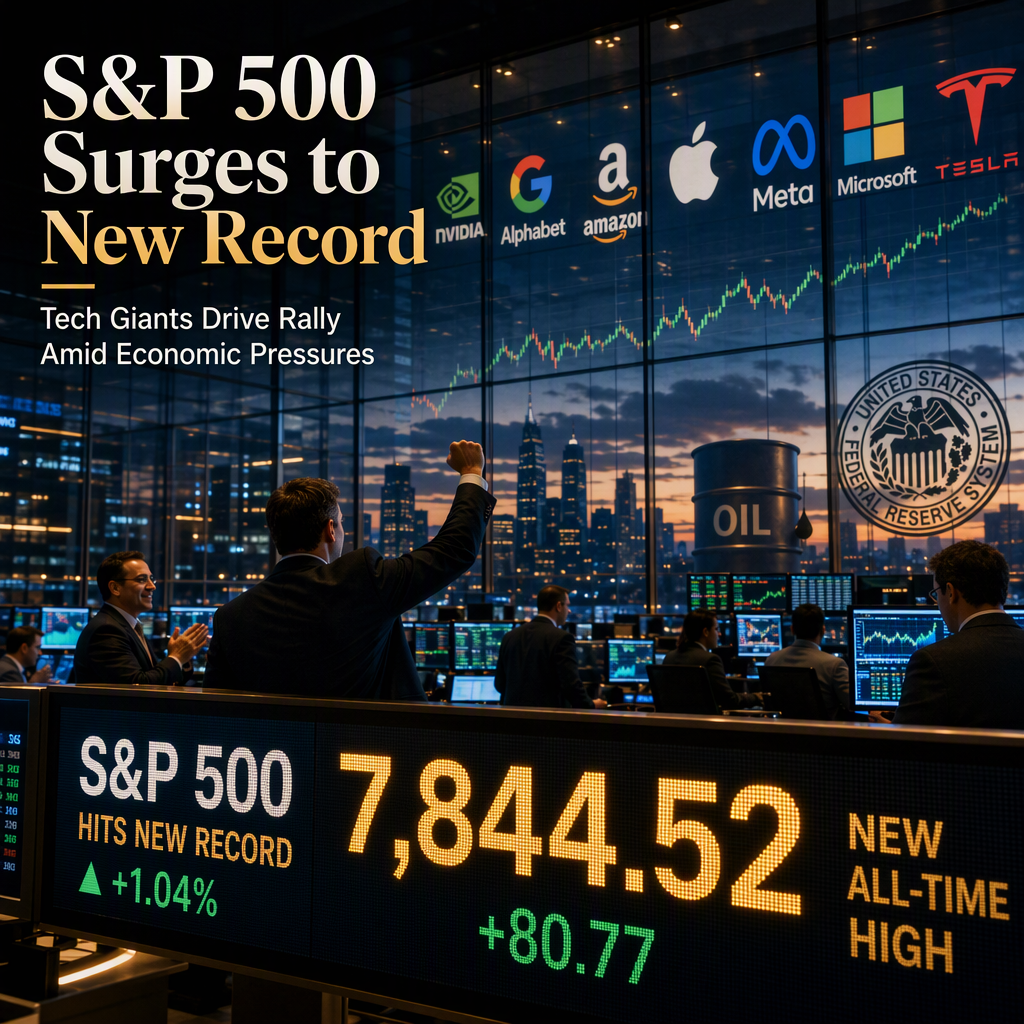
The S&P 500 reached a new all-time intraday high on Tuesday, touching 7,844.52 and surpassing its previous August 13 peak of 7,830. The index also closed above 7,800 for the first time, marking a significant milestone following months of market turbulence caused by oil shocks, rising borrowing costs, and the potential start of a Federal Reserve rate hiking cycle [1]. This record-setting rally occurred just one day after the 10-year Treasury yield climbed to a new 2022 high, hovering around 5.31%. The Federal Reserve had raised its benchmark rate in mid-September for the first time in over three years and signaled further increases ahead [1].
Oil prices have been volatile, with crude surpassing $100 a barrel in early March due to the Iran conflict disrupting supplies through the Strait of Hormuz. After dipping below $70, oil rebounded above $100 in early September [1]. Despite these macroeconomic headwinds, the S&P 500's rally has been driven by robust corporate profits and a narrow group of technology stocks. Shawn Snyder, economic strategist at Potomac Fund Management, noted that the stock market remains resilient as long as profits persist, even in a mixed economic environment [1].
The rally has been led by the so-called 'Magnificent 7'—Nvidia, Alphabet, Amazon, Apple, Meta, Microsoft, and Tesla—which now account for more than 34% of the S&P 500's market capitalization. JJ Kinahan of Cboe Global Markets emphasized that the daily movements of these few stocks heavily influence the direction of both the S&P 500 and the Nasdaq, which also reached record territory [1]. Tech companies are investing significantly in data centers and computing infrastructure, fueling demand for chips and equipment. Amazon, for example, projected about $200 billion in capital expenditures across its businesses in 2026, targeting opportunities in AI, chips, and robotics [1].
Investor enthusiasm for technology was further highlighted in June when SpaceX raised $75 billion in the largest IPO ever and began trading on June 12, demonstrating continued support for growth companies despite higher energy prices and borrowing costs [1]. Looking forward, Snyder cautioned that the current 'weakening' market breadth could persist if inflation does not ease or if there is no clear signal from the Federal Reserve regarding the end of rate hikes [1].
CONCLUSION
The S&P 500's new record underscores the market's resilience, driven by strong tech sector performance and investor optimism despite macroeconomic challenges. However, concerns remain about narrow market leadership and the potential impact of persistent inflation and further rate hikes. Market participants are advised to monitor inflation trends and Federal Reserve signals closely.