
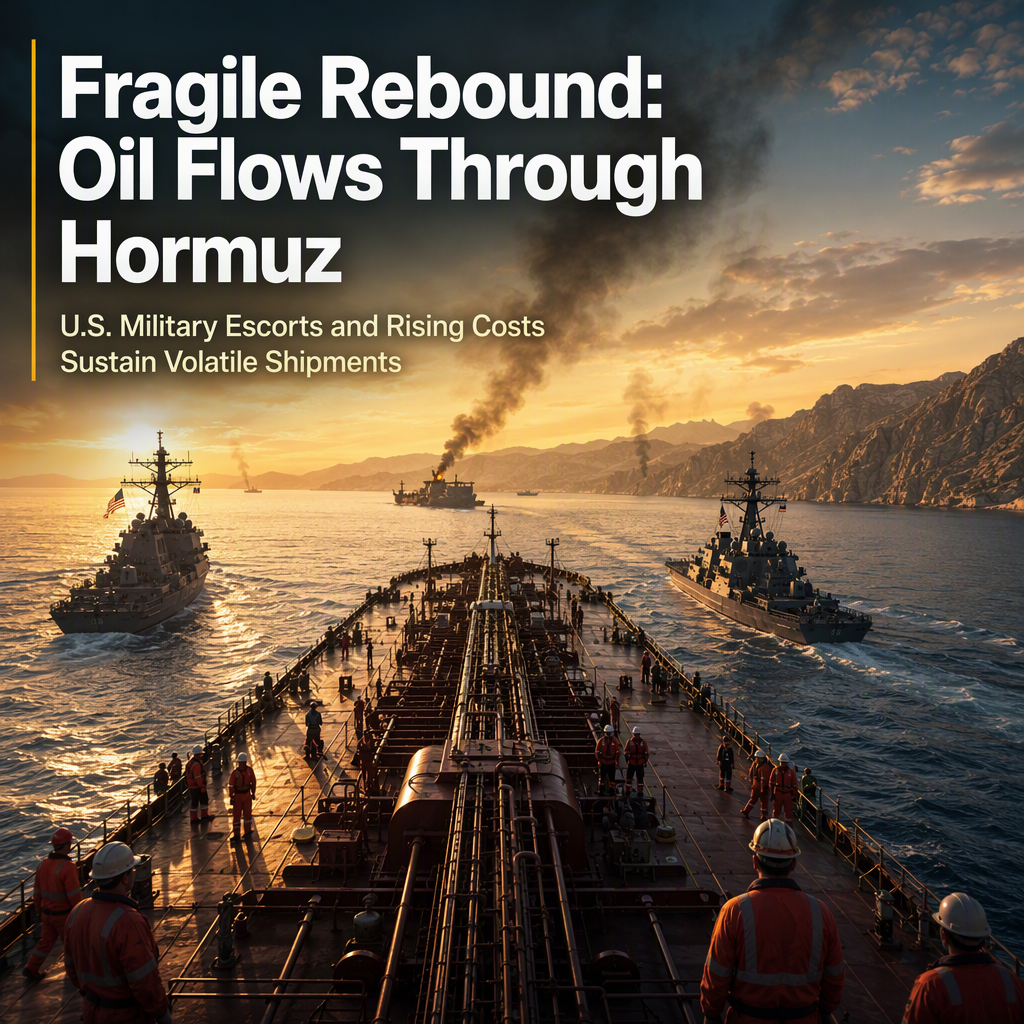
Crude oil exports through the Strait of Hormuz have recently rebounded, but this recovery is under significant threat due to an escalation in Iranian attacks on tankers transiting the region. According to the Joint Maritime Information Center, nearly 20 commercial ships, mostly tankers, have been attacked over the past month while sailing through the Strait of Hormuz, the Persian Gulf, or off the coast of Oman [1]. Michelle Wiese Bockmann, a senior maritime intelligence analyst at Windward, reported that Iran attacked roughly two ships for every 100 vessels crossing the strait in the third quarter [1].
The current increase in oil flows is largely attributed to a major U.S. military commitment, which has established a southern shipping route along the coast of Oman to protect tankers. However, this security comes at a high cost, both financially and in terms of the safety of tanker crews. Bob McNally, president of Rapidan Energy, emphasized that the U.S. military commitment, ship-to-ship transfers, and heightened tanker rates make this system financially unsustainable, stating, 'Nobody in Washington thinks this is sustainable financially' [1].
To mitigate the risk of attacks, many tankers are now using a shuttle system, transferring crude in the Gulf of Oman to ships bound for Asia. While this reduces exposure to Iranian attacks, it requires more vessels and increases operational inefficiency [1].
Crude oil shipments through Hormuz remain volatile, with daily volumes sometimes matching or exceeding prewar levels, but often falling short. For the week ended Saturday, shipments averaged about 10.3 million barrels per day (bpd), which is approximately 23% below the prewar baseline of 13.5 million bpd, according to Kpler data. Windward estimates current flows at 9-10 million bpd, compared to a prewar baseline of 14.5 million bpd [1]. Despite the recent ramp-up in flows due to the U.S.-secured route, the sustainability of this rebound is uncertain without a negotiated settlement or capitulation by Tehran [1].
The ongoing security risks and high costs associated with maintaining oil exports through the Strait of Hormuz have significant implications for global energy markets, with the potential for further disruptions if the situation deteriorates or if the U.S. military presence is reduced [1].
CONCLUSION
The rebound in oil exports through the Strait of Hormuz is fragile, heavily reliant on U.S. military protection and costly operational measures. Without a diplomatic resolution or a change in Iran's posture, the sustainability of current export levels remains in doubt, posing ongoing risks to global oil supply and market stability.