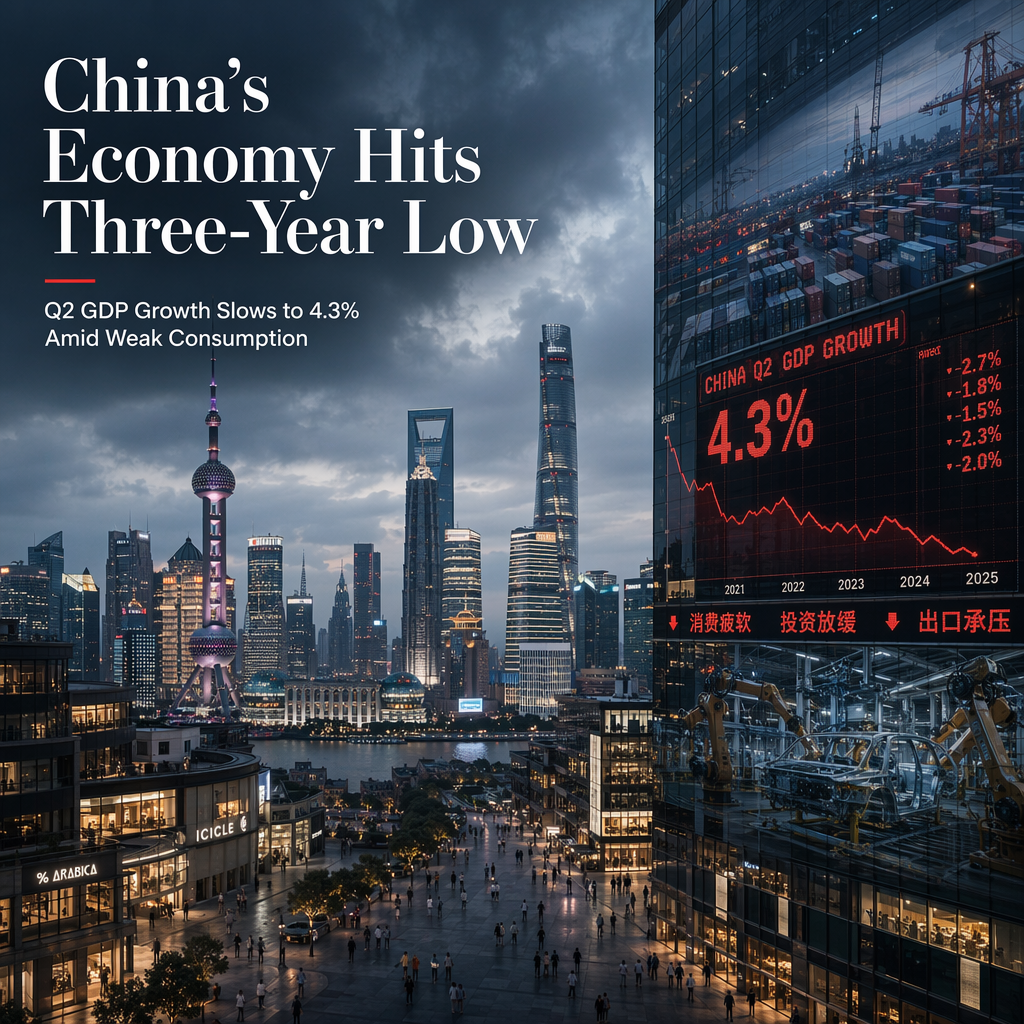
China's economy experienced a notable slowdown in the second quarter of 2026, with GDP growth reported at 4.3%, the slowest pace in over three years [1]. This deceleration follows a strong start to the year and highlights the fragile state of the Chinese economy, particularly as weak domestic consumption weighed heavily on overall performance [1]. Despite ongoing trade tensions with the U.S. and instability in the Middle East, these external factors have not yet inflicted the severe damage that some had anticipated [1].
Industrial production provided some support, rising 5.4% in the first half of 2026, driven by robust activity in the robotics and semiconductor sectors [1]. However, policymakers and market participants remain concerned about the sustainability of the recovery, with the outlook now hinging on whether exports can remain strong in the second half of the year [1]. Any significant decline in external demand could further pressure the already fragile domestic economy [1].
China’s Deputy Head of the National Bureau of Statistics (NBS) commented that the economy remains resilient despite the Q2 slowdown, attributing the deceleration mainly to short-term and external factors [2]. The NBS official emphasized that China’s CPI and PPI remain within reasonable ranges, which is notable given the global context of rising prices [2]. The official also stated that the first half's GDP growth lays a good foundation for achieving the full-year growth target and highlighted sufficient energy supplies, stable production, and controlled imports [2]. Additionally, China is said to have ample potential to increase effective investment [2].
In terms of market reaction, the Australian Dollar (AUD) did not respond immediately to the NBS comments. During Asian trading, AUD/USD was 0.25% higher near 0.6992, attributed to weakness in the US Dollar rather than direct reaction to Chinese economic data [2].
CONCLUSION
China's Q2 GDP growth slowdown to 4.3% underscores concerns about weak domestic consumption and the fragility of the economic recovery. While industrial production and official statements point to resilience and potential for further investment, the outlook remains dependent on export performance. Market reaction has been muted, with no immediate impact on the Australian Dollar.