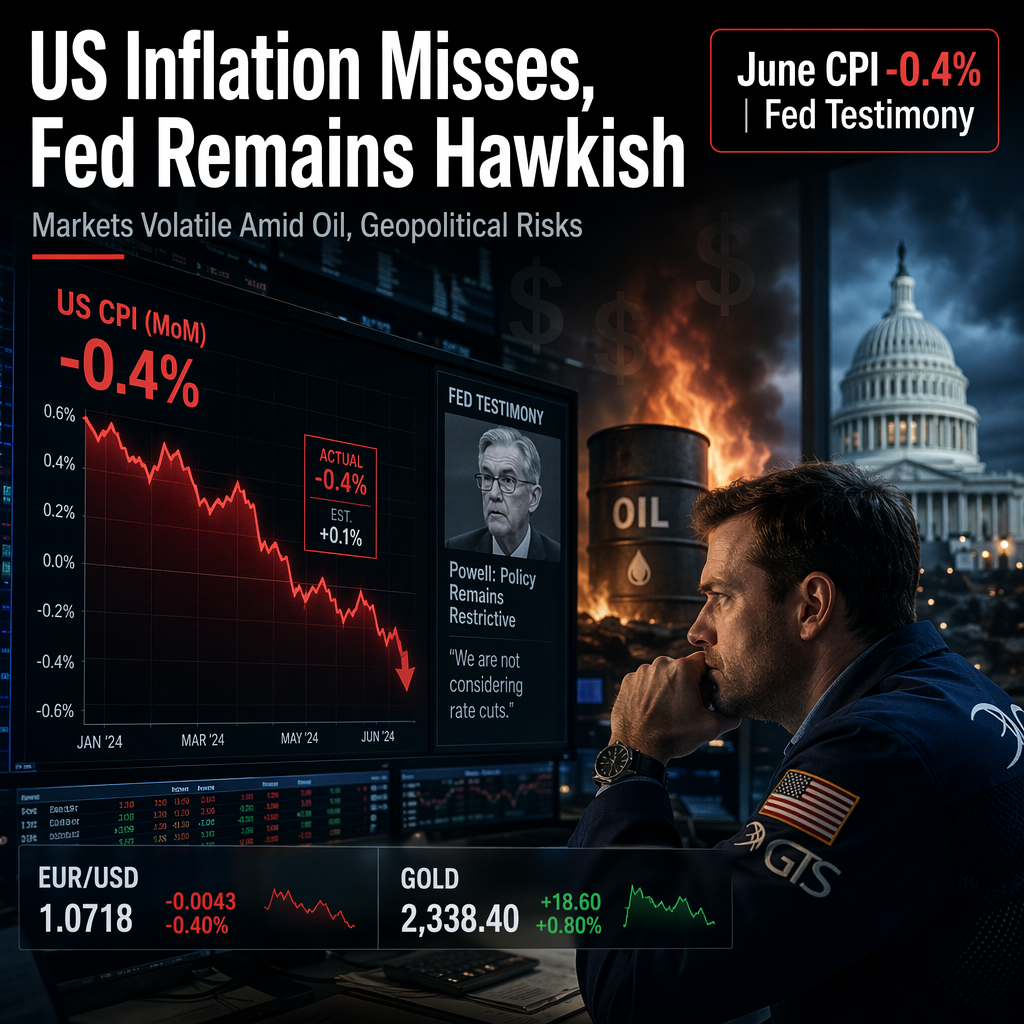
US consumer inflation data released on Tuesday showed a significant decline, with the headline Consumer Price Index (CPI) dropping 0.4% in June, marking the largest one-month decrease since April 2020 and missing expectations of a 0.1% fall. The core CPI was flat in June, compared to a consensus estimate of 0.3%. On a yearly basis, headline and core CPI decelerated to 3.5% and 2.6%, respectively, also missing forecasts [3]. This softer-than-expected inflation prompted traders to scale back their expectations of Federal Reserve (Fed) rate hikes, resulting in modest US Dollar (USD) weakness and pushing the USD to a nearly four-week low [1][3].
Despite the initial market reaction, Fed Chair Kevin Warsh reiterated the central bank's commitment to price stability in his first congressional testimony, leaving the door open for at least one rate hike by year's end [3]. Elevated crude oil prices, driven by escalating US-Iran tensions and the closure of the Strait of Hormuz, continue to pose inflation risks and support the case for further tightening by the Fed [1][3]. According to the CME Group's FedWatch Tool, traders are pricing in the possibility that the US central bank will raise borrowing costs, either in September or December [3].
The EUR/USD pair attracted dip-buyers following the previous day's pullback from the 1.1460-1.1470 resistance, trading around 1.1435-1.1440 during the Asian session on Wednesday. The pair remains confined within a multi-week-old range, with momentum indicators such as MACD turning positive and RSI at 56 suggesting moderate bullish momentum. However, the pair struggles to build strength beyond the 23.6% Fibonacci retracement level, with resistance at 1.1490 (200-period SMA), 1.1523 (38.2% retracement), and 1.1585 (50.0% retracement). Structural support is at 1.1323, and a break below this would reinforce a bearish outlook [1].
Gold (XAU/USD) edged lower after failing to hold above the $4,100 mark, trading above $4,000 during the Asian session. The combination of soft CPI data and persistent inflation risks from elevated oil prices, along with Fed Chair Warsh's hawkish remarks, exerted pressure on gold prices. Geopolitical risks, including US-Iran tensions and recent military actions, continue to influence market volatility and support the USD [3]. Traders are now awaiting the US Producer Price Index (PPI) and further congressional testimony from Fed Chair Warsh, as well as developments in the Middle East, for additional market direction [3].
CONCLUSION
US inflation data missed expectations, initially weakening the USD and supporting EUR/USD and gold prices. However, persistent inflation risks from elevated oil prices and Fed Chair Warsh's hawkish stance have offset these gains, keeping markets cautious. Ongoing geopolitical tensions and upcoming economic releases are expected to drive further volatility and influence market sentiment.