
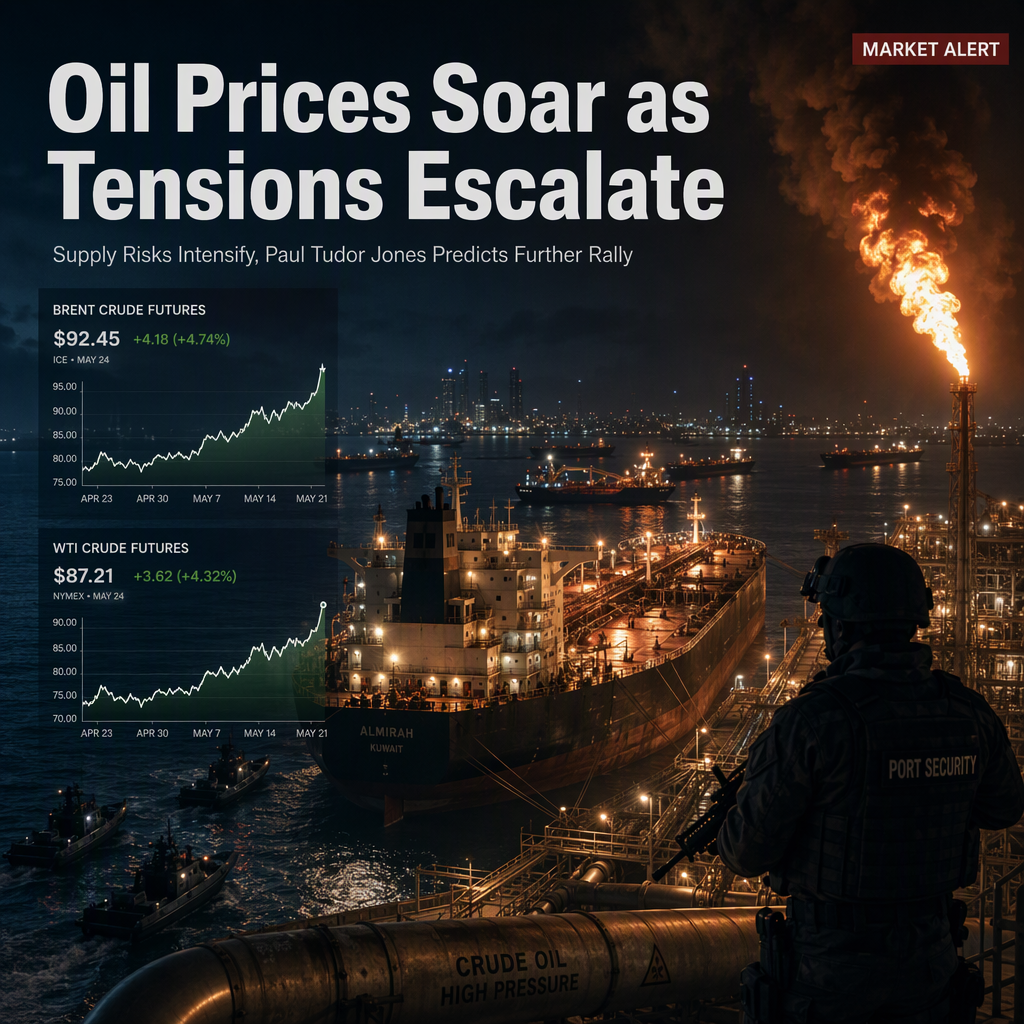
West Texas Intermediate (WTI) oil prices have extended their rally for a fifth consecutive day, trading around $94.30 per barrel during Asian hours on Wednesday, as escalating hostilities between Saudi Arabia and Iran-backed Houthi rebels have intensified fears of supply disruptions in the Middle East [1]. International benchmark Brent crude for December delivery also rose, gaining 1.24% to $107.02 a barrel, while U.S. WTI futures for November advanced 1.18% to $95.25 per barrel [2]. The surge in crude prices follows a series of attacks, including a missile strike by Yemen’s Houthi militants on Saudi Aramco’s headquarters in Dhahran, which caused a fire, and a deadly attack on Riyadh's main airport [1][2]. In response, a Saudi-led coalition struck Houthi energy terminals and fuel reserves in Yemen, with officials claiming precautions were taken to avoid civilian casualties [2].
Regional tensions have also escalated around critical shipping lanes, particularly the Strait of Hormuz, as Tehran intensified attacks on tankers. Despite these threats, the United States reported facilitating the safe passage of over 19 million barrels of crude through the waterway [1]. U.S. Central Command publicly rejected Iranian claims of control over the Strait, asserting that "American forces and regional partners clearly control the Strait of Hormuz" [2].
Amid these geopolitical risks, OPEC+ reported a sharp gain in oil production for September, pumping an average of 39.07 million barrels per day (bpd), an increase of roughly 900,000 bpd from August. Saudi Arabia, the top producer, reported pumping 8.372 million bpd in September, a jump of more than 2 million bpd compared to the previous month [1]. Markets are also monitoring the potential impact of a US-Russia diesel agreement, though the Kremlin denied any direct link between diesel exports and Ukraine peace talks [1].
Market sentiment remains bullish, with TD Securities noting that "strength across the energy market is hard to shake as tanker attacks escalate," highlighting the resilience of the oil complex despite mounting risks [1]. Hedge fund manager Paul Tudor Jones expressed a particularly bullish outlook, stating, "I am long oil... bullish oil... I think it can rally another $20 or $25 bucks," citing the Iran conflict as a key driver [2][3]. He noted that such a rally would push U.S. oil prices above their previous 2026 high of just under $113 per barrel, with WTI crude futures trading at around $92.50 on Tuesday morning [3]. Tudor Jones also warned that a further surge in oil prices would be strongly negative for equities, saying the equity market would "absolutely totally hate it," though he acknowledged that stocks managed a 7% decline at their trough in late March after the start of the U.S.-Iran war on February 28 [3].
Looking ahead, Tudor Jones suggested that a resolution to the conflict is unlikely before the U.S. midterm elections, but he expects President Donald Trump to pursue peace efforts post-election, stating, "I assume the president has a plan post-election... what's going on is untenable. It's not sustainable, I don't think, in the long-run" [3].
CONCLUSION
Oil prices have surged on escalating Middle East tensions and supply risks, with both WTI and Brent crude posting significant gains. Market sentiment is strongly bullish, as highlighted by Paul Tudor Jones' prediction of a further $20-$25 rally in oil prices, though such a move could negatively impact equities. The situation remains highly volatile, with geopolitical developments and potential post-election policy shifts likely to drive future market direction.