
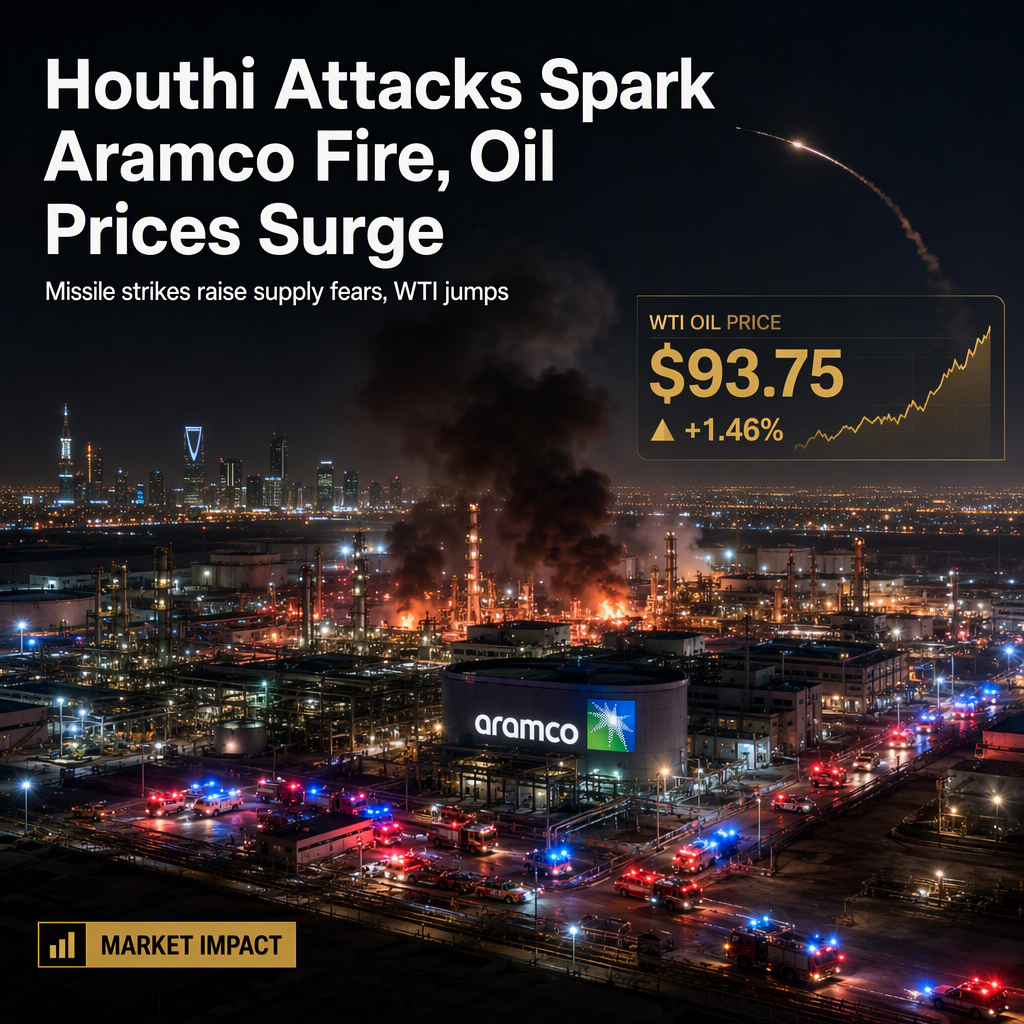
Yemen's Houthi rebels launched a series of missile attacks targeting multiple cities across Saudi Arabia, resulting in falling shrapnel in Dhahran and Riyadh that injured at least four people in the Saudi capital, according to the Saudi military. The Saudi Ministry of Energy confirmed that an attack on the Saudi Aramco facility in Dhahran caused a small fire, though no casualties were reported from this incident [1].
These latest attacks followed several days of strikes on Riyadh’s main airport, which reportedly killed at least 18 people and injured more than 300, marking the deadliest incidents in Saudi Arabia since the Iran war began in late February [1]. The escalation in violence has heightened concerns over the security of critical energy infrastructure in the region.
In response to the news, the market reacted sharply, with West Texas Intermediate (WTI) crude oil prices rising 1.46% on the day to $93.75 at the time of reporting [1]. The increase in oil prices reflects market fears of potential supply disruptions stemming from the attacks on Saudi oil facilities, a key factor influencing global oil benchmarks like WTI [1].
No forward-looking statements or analyst opinions were provided in the source article.
CONCLUSION
The Houthi missile attacks on Saudi Arabia, particularly the fire at the Aramco facility, have triggered a notable rise in WTI oil prices due to concerns over supply disruptions. The market's immediate reaction underscores the sensitivity of oil prices to geopolitical risks affecting major energy producers.