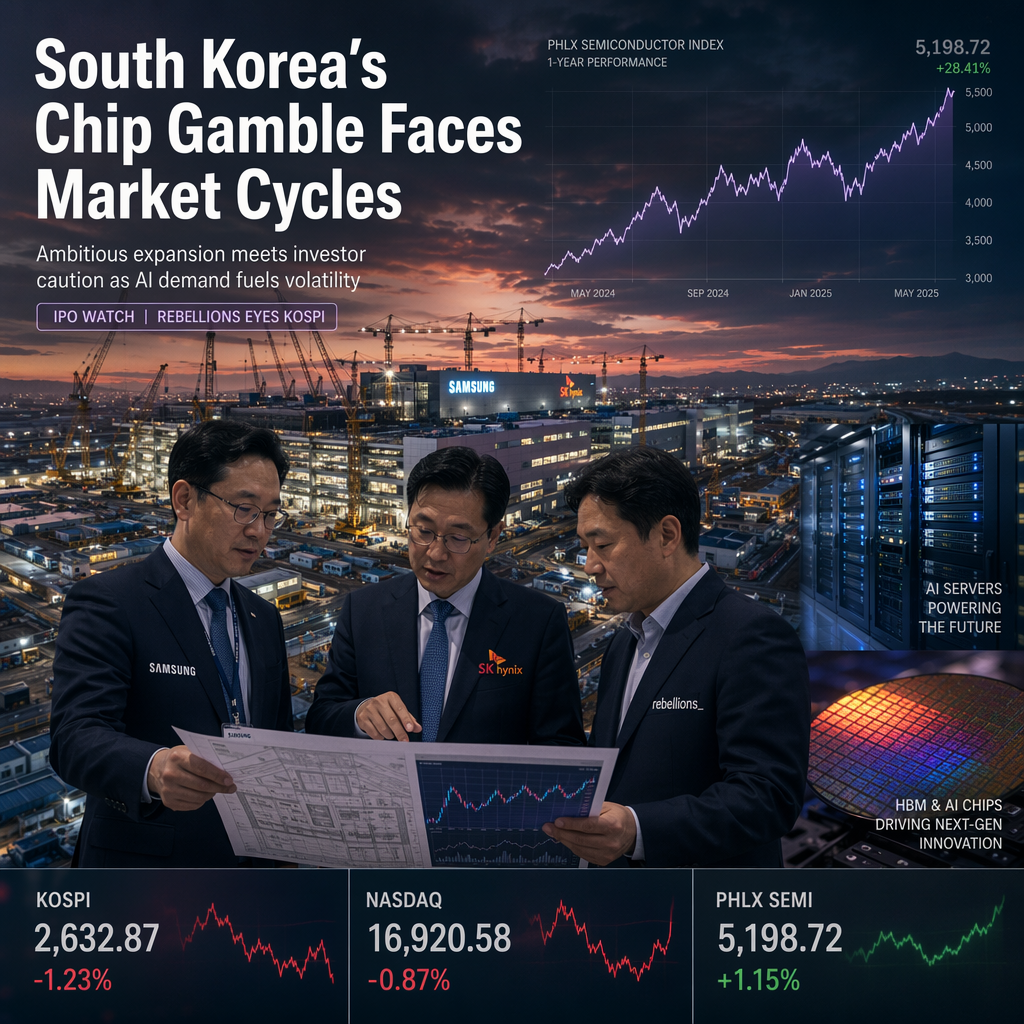
South Korea is advancing an ambitious plan to establish a new chip production hub in the country's southwest, involving major players Samsung Electronics and SK Hynix, in response to surging demand for memory chips fueled by artificial intelligence applications [1]. However, industry analysts and market watchers are raising concerns about the timing and sustainability of this expansion, citing the cyclical nature of the memory chip market and the risk of future oversupply [1]. Despite Samsung's profits soaring 19 times recently, its shares fell 6.9% due to investor worries about potential oversupply, highlighting the volatility in the sector [1].
The South Korean government has emphasized the strategic importance of the chip industry, noting that exports in June surpassed $100 billion for the first time, largely driven by chip demand [1]. Policymakers hope the new hub will reinforce South Korea's global leadership in semiconductors, but they must balance expansion with market volatility risks [1].
In parallel, Rebellions, a South Korean AI chip startup backed by Samsung, SK Hynix, and a key government fund, is targeting an initial public offering (IPO) in South Korea in the first or second quarter of next year, with a preference for listing on the KOSPI [2]. CEO Sunghyun Park stated that the company is generating real revenue and is preparing the IPO with J.P. Morgan and Samsung Securities as underwriters [2]. Rebellions is also considering U.S. listing options and is in talks with both the New York Stock Exchange and Nasdaq [2].
Rebellions aims to compete in the AI inference semiconductor market, selling server systems powered by its Rebel100 NPU chips and positioning itself as a rival to companies like Nvidia [2]. The company is aligned with a major Korean government megaproject focused on AI infrastructure, described as one of the largest commitments in the world [2]. The broader market remains bullish on semiconductor companies, with the PHLX Semiconductor index up around 80% this year [2]. Meanwhile, SK Hynix is set to list shares on the Nasdaq in the U.S. this week to capitalize on investor appetite for memory chips, despite already being listed in South Korea [2].
Market participants are closely monitoring technical indicators and price movements to assess the sustainability of the current AI-driven chip boom, as both established giants and startups seek to capture growth in the evolving semiconductor landscape [1][2].
CONCLUSION
South Korea's semiconductor sector is experiencing robust growth driven by AI demand, but faces questions about long-term sustainability due to market cycles and potential oversupply. Major players like Samsung, SK Hynix, and Rebellions are making significant moves, including new investments and IPO plans, to capitalize on current market momentum. Investors remain optimistic but cautious, closely watching for signs of sustained demand and strategic adjustments.