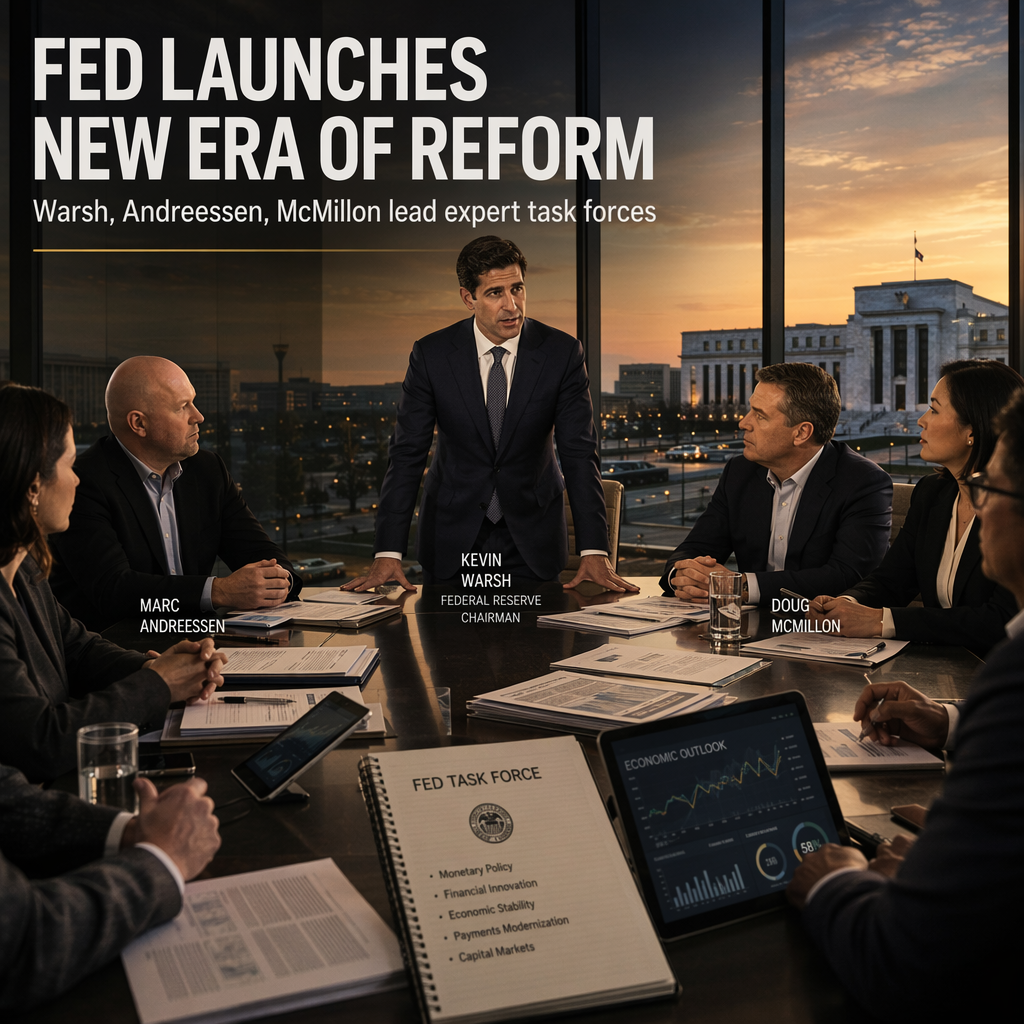
Federal Reserve Chairman Kevin Warsh announced on Thursday the members of five newly established task forces aimed at examining the central bank's operations, with a focus on communications, the Fed's balance sheet, data, productivity and jobs, and the framework for policymakers' view on inflation [1]. The task forces include high-profile figures such as venture capitalist Marc Andreessen, former Bank of England Governor Mervin King, and Greg Mankiw, former chairman of the White House's Council of Economic Advisers [1]. Doug McMillon, the former CEO of Walmart, is leading the group of business executives involved in the initiative [1].
Warsh emphasized the diversity and expertise of the panel members, stating, "I am honored that the best minds from a range of disciplines have agreed to work with us to sharpen our performance as an institution. The goal is straightforward: to ensure the Fed is best positioned to achieve our objectives in this consequential time" [1]. Other notable experts named include Raghuram Rajan, former governor of the Reserve Bank of India; former Fed Governor Jeremy Stein; and William White, a Canadian economist recognized for his warnings about central bank easy money prior to the 2008 global financial crisis [1].
According to the Federal Reserve's news release, the panels will operate independently, with a mandate to follow the evidence, provide candid feedback, and produce rigorous findings to be reported back to the Federal Open Market Committee [1]. While no specific timeline was provided for the completion of the task forces' work, Warsh indicated that he expects changes to be implemented within the year [1].
The announcement signals a proactive approach by the Federal Reserve to address key operational and policy challenges, drawing on a broad spectrum of expertise. However, the lack of a detailed timeline leaves some uncertainty regarding the pace and scope of potential reforms [1].
CONCLUSION
The Federal Reserve's formation of expert task forces under Chairman Kevin Warsh marks a significant step toward institutional review and potential reform. With prominent figures from finance, academia, and business, the initiative is expected to yield recommendations this year, though the exact timing and impact remain to be seen.