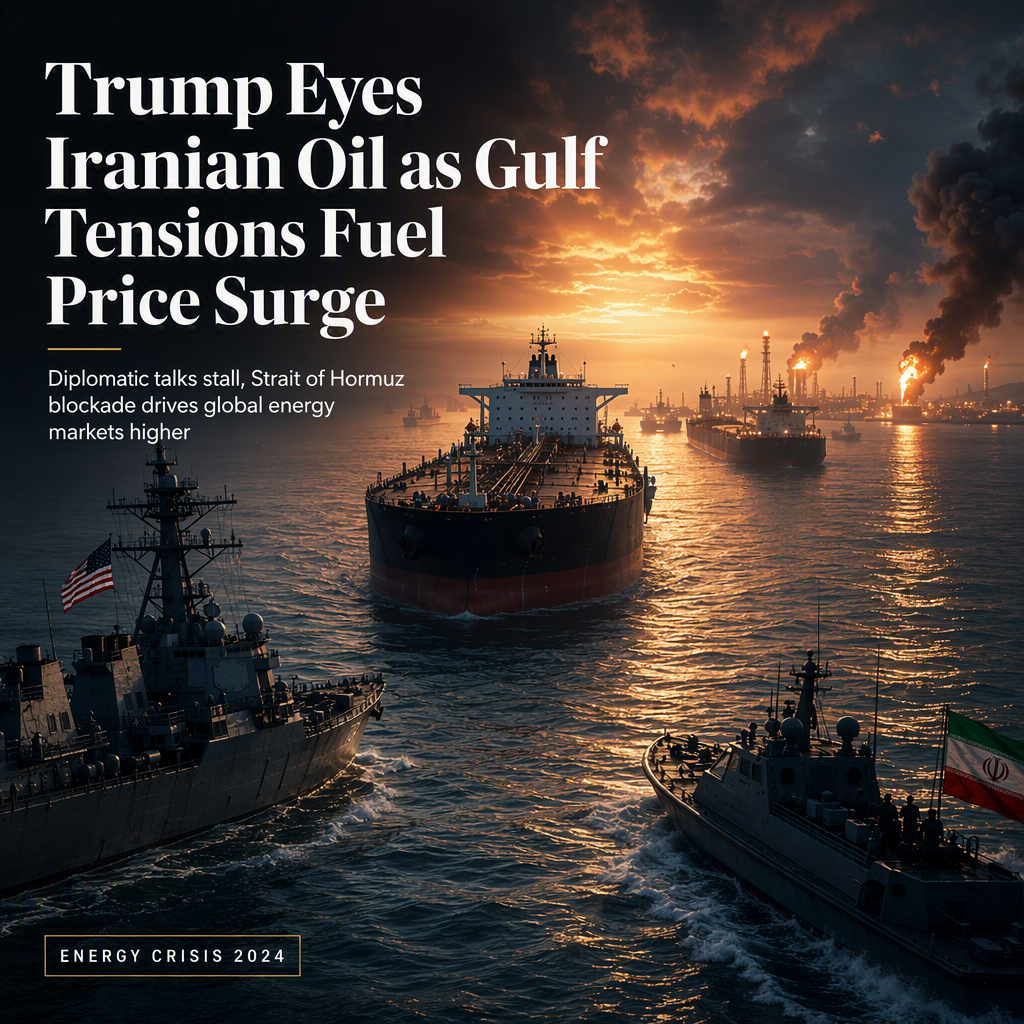
President Donald Trump stated that the United States could potentially take control of Iran's oil resources, drawing a parallel to the recent deal with Venezuela, where the U.S. secured access to over 65 billion barrels of Venezuelan oil reserves in exchange for $209 billion to Venezuela's state treasury and an expected $100 billion in private investment for the Venezuelan economy [1]. Trump made these remarks at the Irish Open golf championship, emphasizing that the revenue from the Venezuela arrangement has 'paid for the war many times' [1].
Regarding the ongoing Iran conflict, Trump expressed his expectation that the seven-month war would end within the year, possibly after the November midterm elections, and predicted that gasoline prices would 'drop like a rock' once the conflict concludes. He also claimed that Tehran has been 'calling constantly' for peace talks, though Iran has previously denied this assertion [1].
Diplomatic efforts to resolve tensions in the Strait of Hormuz have stalled, as a planned meeting in Oman between Gulf countries and Iran was postponed due to a lack of consensus, according to Omani foreign minister Badr Albusaidi. The meeting was intended to establish an Iran-Oman shipping route through the critical waterway, but no direct U.S.-Iran talks were scheduled [1].
The Strait of Hormuz remains under blockade by both Iranian and U.S. naval forces since the war began in February, contributing to elevated global energy prices. A previous June accord between Washington and Tehran collapsed over disagreements regarding the strait, and recent attacks by Yemen's Houthi rebels have further destabilized the region by threatening the Bab el-Mandeb waterway [1]. Ships not complying with regulations have been targeted by Iranian strikes, while the U.S. has conducted periodic bombings of the Iranian coastline to challenge Tehran's control [1].
Oil markets reacted sharply to these developments. Oil prices surged past $100 a barrel for the first time since May, with U.S. West Texas Intermediate futures rising 2.3% to $102.39 per barrel and Brent crude climbing 2.4% to $107.11 a barrel. The price spike was exacerbated by Saudi Arabia's closure of a key East-West energy pipeline following damage from Iraqi drones [1].
CONCLUSION
President Trump's comments on potentially seizing Iranian oil and the ongoing instability in the Strait of Hormuz have contributed to a significant surge in global oil prices. With diplomatic efforts stalled and regional tensions escalating, the market remains highly sensitive to further developments in the Gulf.