
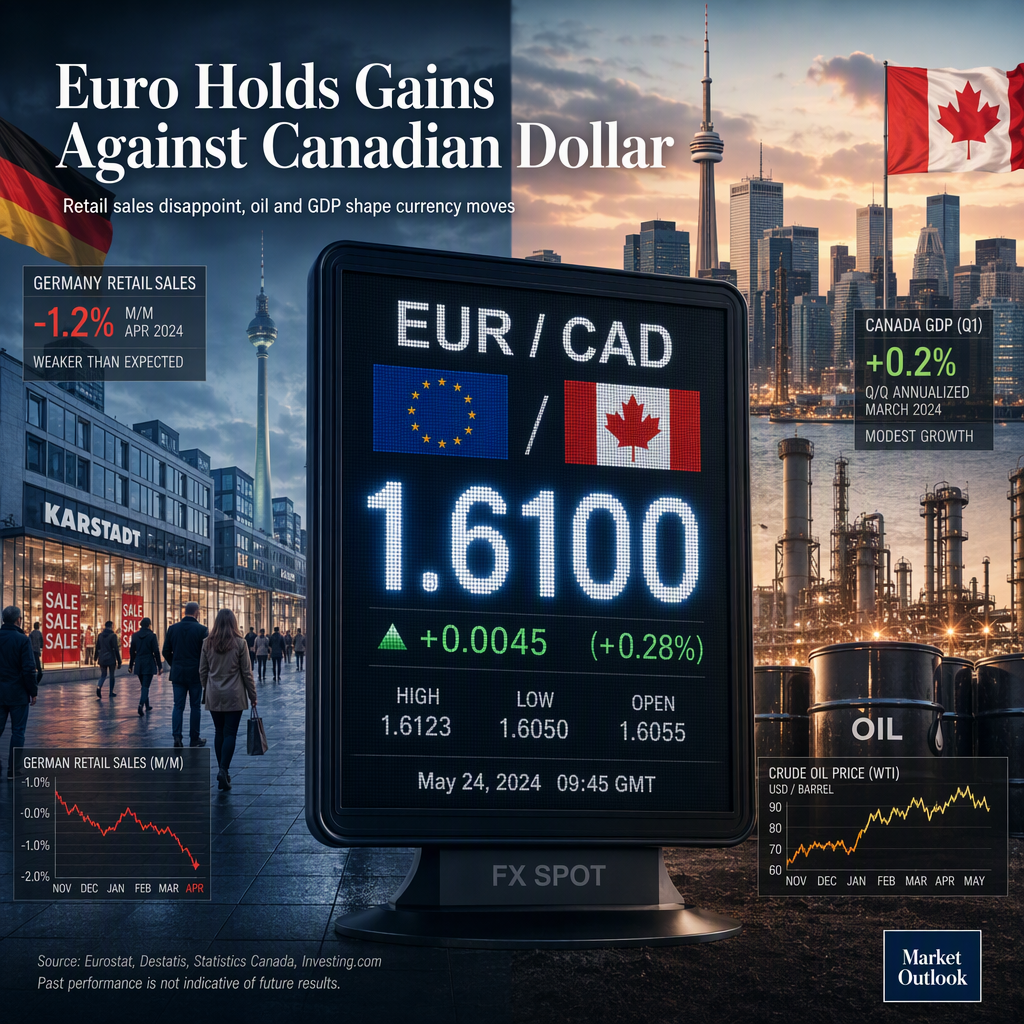
The Euro (EUR) maintained its gains against the Canadian Dollar (CAD), with the EUR/CAD currency pair trading around 1.6100 during European hours on Wednesday, despite the release of weaker-than-expected German retail sales data for August [1]. German Retail Sales increased by 1.3% month-on-month, missing the forecasted 2.0% rise, although July's contraction was revised to -3.2% from -3.4%. On an annual basis, retail sales contracted by 0.4% in August, following a 2.5% decline in July [1].
Market participants are now turning their attention to upcoming German economic indicators, including the German Unemployment Change for August and the preliminary Harmonized Index of Consumer Prices (HICP) for September. The HICP is projected to accelerate to 3.1% year-on-year from 2.9% in August, which could influence future Euro movements [1].
The Canadian Dollar's strength, supported by a recovery in oil prices, has the potential to cap further upside in the EUR/CAD pair. Oil prices initially gained after US President Donald Trump denied easing sanctions on Iran, but gains moderated as Middle Eastern supply flows improved. Regional exports recovered to 17.5 million barrels per day, 98% of pre-war levels, aided by Saudi Arabia resuming exports through its East-West pipeline and ongoing shipments through the Strait of Hormuz. Additional downward pressure on oil prices came from the US government's plan to release up to 40 million barrels from the Strategic Petroleum Reserve and a reported 1-million-barrel increase in US crude inventories last week [1].
On the Canadian economic front, the GDP rebound appears to be losing momentum in the third quarter. Economists at NBC noted that the latest GDP report confirms a slowdown, with Statistics Canada's preliminary estimate indicating a 0.2% increase in GDP for August. This suggests continued, but more subdued, economic expansion compared to previous months [1].
CONCLUSION
Despite weaker German retail sales, the Euro has held its ground against the Canadian Dollar, supported by upcoming inflation data and tempered by oil market dynamics. The Canadian economy shows signs of slower growth, while oil price fluctuations and supply developments continue to influence the CAD. Market participants remain focused on forthcoming economic indicators from both regions for further direction.