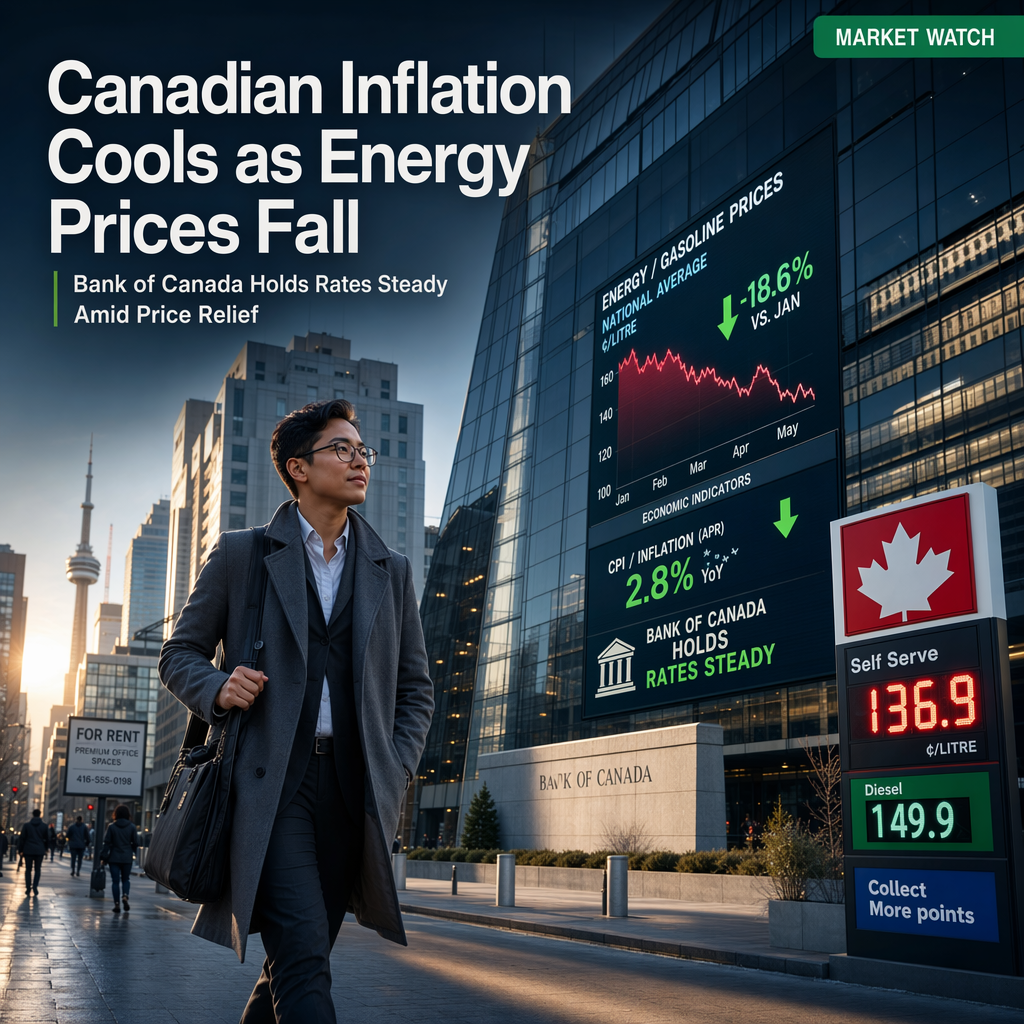
Canada's June Consumer Price Index (CPI) is expected to show headline inflation easing, primarily due to sharply lower energy prices. RBC economists Nathan Janzen and Abbey Xu forecast headline inflation at 2.8% year-over-year, down from 3.2% in May, with core inflation excluding food and energy holding near 1.6% [1]. TD Securities’ Robert Both projects headline CPI to ease to 2.9% year-on-year in June, with a 0.2% monthly decline driven by a significant drop in gasoline and other energy products. Gasoline and energy are expected to shave approximately 0.4 percentage points from the monthly headline print and contribute about 1.0 percentage point to annual inflation, compared to 1.5 percentage points in May [3]. Both RBC and TD Securities note that core inflation measures, such as CPI-trim and CPI-median, are forecast to remain steady, with TD Securities expecting these measures to hold at 2.0% and 2.1% respectively for a third consecutive month [1][3]. Shelter prices are cited as a source of disinflation, offsetting stronger food and travel services, while the food component is expected to strengthen due to higher producer prices and a weaker Canadian dollar [3]. The headline CPI is tracking in line with Bank of Canada projections, which estimate 3.0% for Q2 [3]. Wells Fargo Economics highlights that the Bank of Canada is likely to hold rates steady as it assesses whether commodity-driven price increases feed into underlying inflation, contrasting with expected final hikes from other major central banks such as the ECB, RBA, and BoJ [2]. RBC economists anticipate the Bank of Canada will remain on hold through 2026, as inflation gradually returns toward its 2% target [1]. TD Securities suggests that the recent pullback in oil prices gives the Bank of Canada more scope to look through any upside surprises in core measures or increases in inflation breadth, but notes that further deceleration in core inflation could raise questions about the BoC's policy stance if GDP growth does not strengthen in 2026 [3]. One wildcard mentioned by TD Securities is the impact of the FIFA World Cup on travel-related components, with industry sources reporting higher average daily rates on game days, though previous large-scale events have shown mixed effects on traveler accommodation costs [3].
CONCLUSION
Canadian headline inflation is easing, mainly due to lower energy prices, while core inflation remains stable. The Bank of Canada is expected to hold rates steady, with inflation tracking in line with its projections and analysts forecasting a gradual return toward the 2% target. Market sentiment is cautiously positive, with the energy price decline providing the central bank flexibility, though future policy may depend on core inflation trends and GDP growth.