
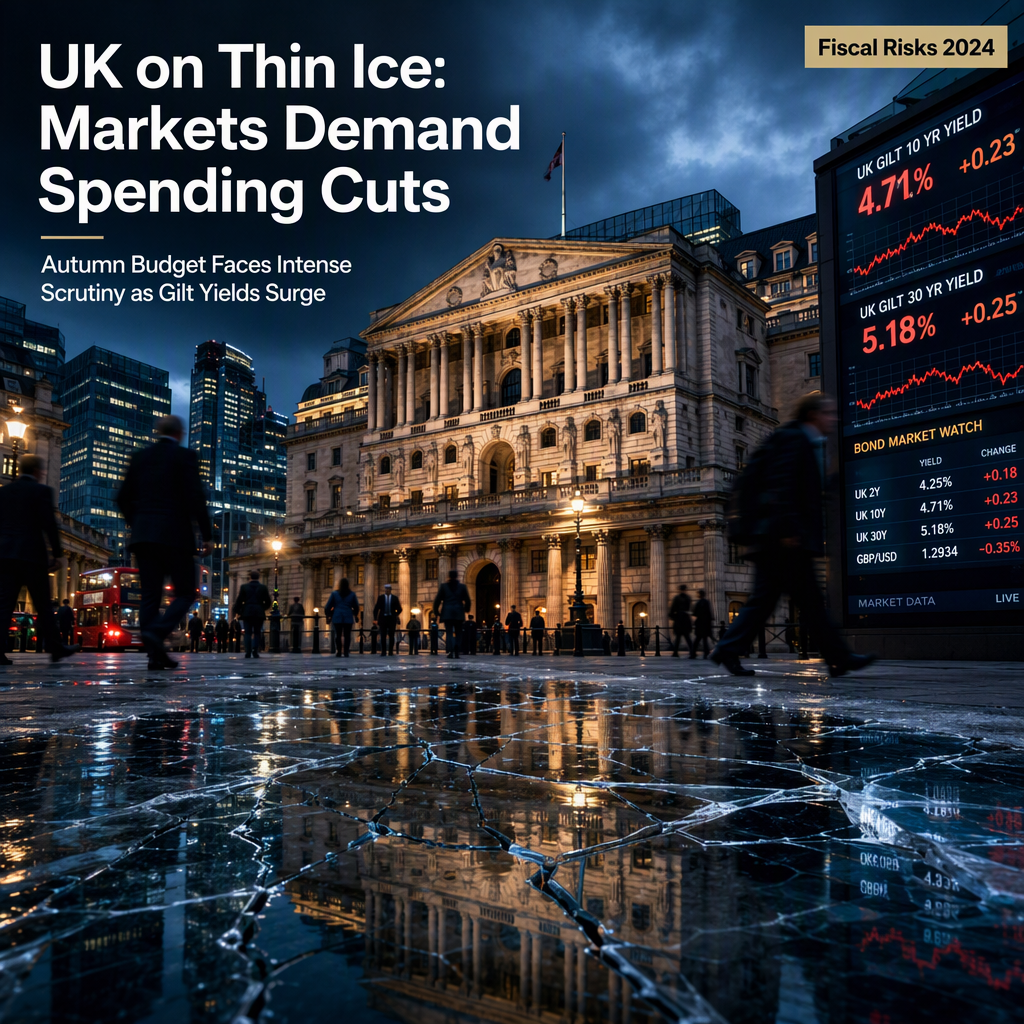
The United Kingdom faces a precarious fiscal situation ahead of its Autumn Budget, with former Bank of England chief economist Andy Haldane warning that the country is 'on thin ice' and must act decisively to reassure financial markets [1]. Haldane, speaking at the How Britain Can Win conference, emphasized the risks associated with the upcoming budget update, scheduled for October 28, and stated that the government needs to curb public spending rather than resort to painful tax hikes [1].
Haldane described the current fiscal environment as perilous, noting that 'nothing would be worse both economically and politically than if the ice were to crack beneath our feet.' He identified the 'single most effective way' to prevent a market crisis as demonstrating the government's willingness to reduce public spending, which he called the 'Achilles' heel' of Prime Minister Andy Burnham's administration [1]. Unless action is taken, Haldane warned, Burnham will remain 'in hock to the bond market' [1].
Prime Minister Andy Burnham, who succeeded Keir Starmer over the summer, has previously criticized the UK's fiscal dependence on bond traders. Burnham's rise to leadership earlier in the year unsettled bond markets, as investors viewed him as more left-leaning than his predecessor [1]. The UK currently has the highest government borrowing costs in the G7, with gilt yields surging amid both domestic and global instability [1].
Haldane also highlighted that the UK's inflation remains 'higher and stickier,' and growth is 'lower and stickier' compared to peers, with the country yet to balance its books this century. He described the international bond market environment as 'hostile' for all government borrowers, but particularly so for the UK, which he called 'a leveraged bet on the world economy' [1]. Haldane acknowledged Burnham's proposal to end the triple lock on state pensions as a 'good first instalment,' but stressed that welfare spending remains a contentious issue for both the Labour party and the bond market [1].
Recent history has shown market sensitivity to UK fiscal policy, as gilt markets came under pressure last year when then-finance minister Rachel Reeves softened plans to cut welfare spending after internal party opposition [1].
CONCLUSION
The UK's fiscal position is under intense scrutiny from both markets and policymakers, with high borrowing costs and persistent inflation compounding the risks. Market participants are likely to watch the Autumn Budget closely for concrete measures on spending cuts, as failure to act could further unsettle gilt markets and increase borrowing costs.