
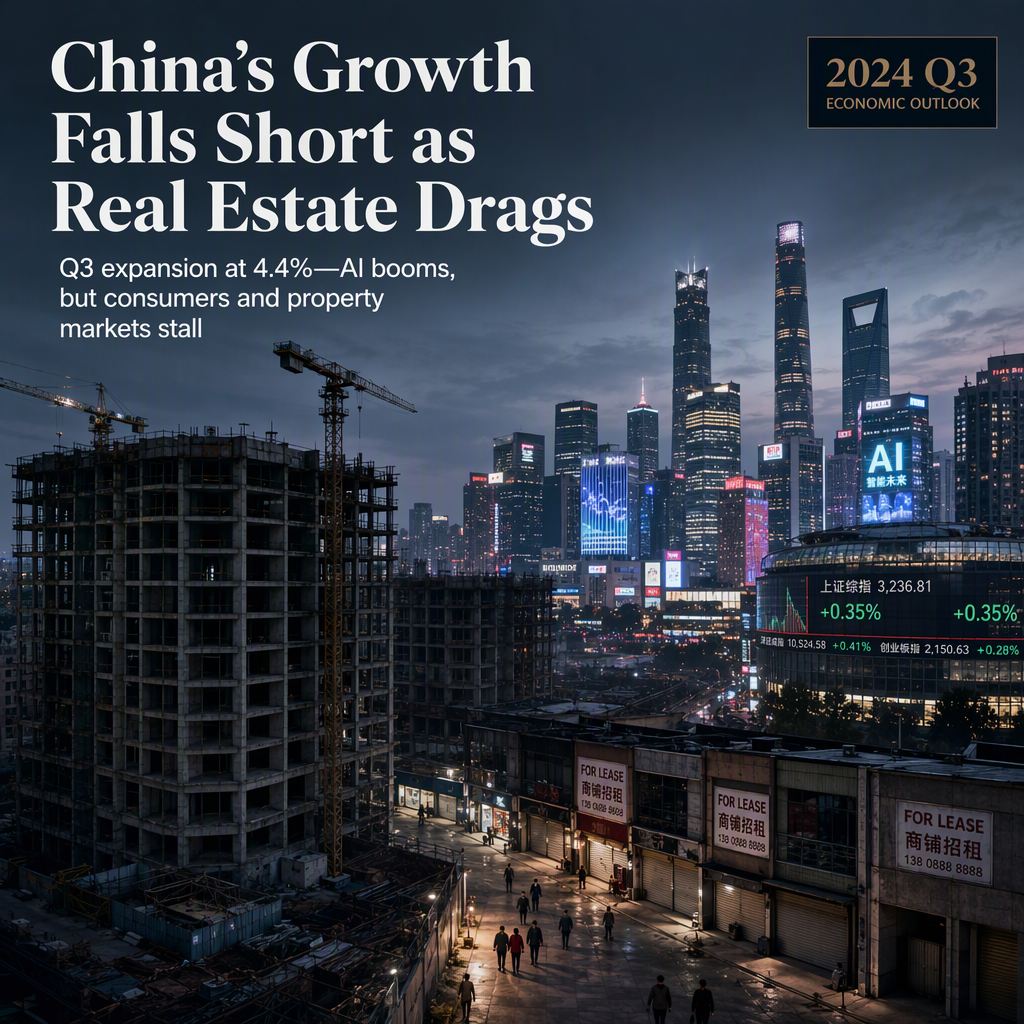
China's economy grew by an estimated 4.4% year-on-year in the July-September quarter, according to economists cited in the report. This figure is only marginally higher than the previous term and falls short of the official government target, underscoring persistent challenges in the country's economic recovery [1]. Despite robust performance in exports and artificial intelligence-related sectors, these gains were insufficient to counterbalance ongoing weakness in the real estate market and subdued consumer spending [1].
The real estate sector continues to act as a significant drag on overall growth, with both property investment and sales remaining sluggish throughout the quarter [1]. Consumer spending also showed little sign of significant recovery, further dampening hopes for a stronger economic rebound [1]. While the AI boom has contributed positively to industrial output and exports, analysts warn that technology-driven growth alone cannot fully offset structural issues in other key sectors [1].
Market watchers are closely monitoring for additional policy measures, but expectations for broad-based stimulus remain muted. Policymakers are reportedly focused on targeted interventions rather than sweeping economic support [1]. The slight uptick in growth reflects a mixed economic outlook, with ongoing concerns about the sustainability of the recovery and the effectiveness of recent policy responses [1].
CONCLUSION
China's estimated Q3 growth of 4.4% highlights ongoing economic challenges, particularly in the real estate and consumer sectors. While AI and exports provided some support, they were not enough to meet the government's growth target. The outlook remains cautious as markets await further policy direction.