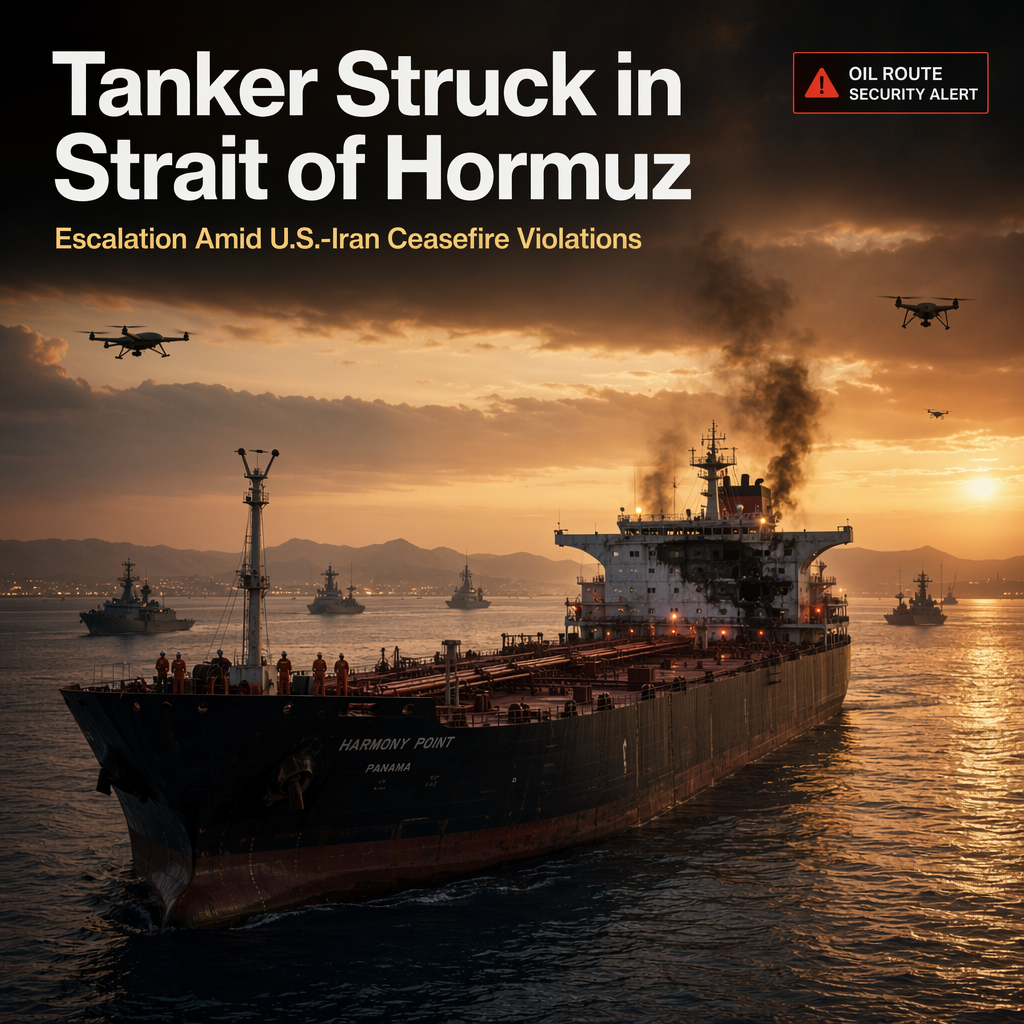
On June 27, 2026, a tanker transiting the Strait of Hormuz was struck by an unidentified projectile, escalating tensions between the United States and Iran during a period when both nations were supposed to be observing a 60-day ceasefire and negotiating a permanent peace deal [1]. The U.K. Maritime Trade Operations Centre confirmed that the vessel sustained damage to its bridge, but the crew remained unharmed [1]. Bahrain condemned an Iranian drone strike as a 'blatant violation' of its sovereignty on the same day [1].
The incident follows a series of attacks in the region, including a drone strike by Iran on June 26 targeting the Singapore-flagged cargo ship Ever Lovely in the strait off Oman. Despite the attack, the vessel continued its journey through the Strait of Hormuz, a critical route for global oil shipments [1]. In response, the U.S. military launched airstrikes on Iranian missile and drone storage locations and coastal radar sites, with President Donald Trump labeling Iran's actions as a 'foolish violation' of the ceasefire agreement [1].
Iran has not directly commented on the attacks on ships, but state media reported that the Islamic Revolutionary Guard Corps fired 'warning shots' at unspecified vessels not approved by Iran attempting to pass through the strait [1]. The renewed hostilities come shortly after Trump and Iranian President Masoud Pezeshkian signed a memorandum of understanding to pursue a permanent peace deal [1]. Vice President JD Vance recently traveled to Switzerland for talks with Iranian officials, emphasizing that the U.S. has honored the ceasefire and warning that 'violence will be met with violence' [1].
Following the U.S. retaliatory strikes, Iran's Revolutionary Guard accused the U.S. of violating the ceasefire and responded by targeting U.S. positions in the region, referencing clause 5 of the Islamabad Memorandum [1]. President Trump, when asked about potential consequences for Iran, stated, 'You'll find out,' indicating further possible escalation [1].
CONCLUSION
The escalation in the Strait of Hormuz, including attacks on commercial vessels and reciprocal military strikes, has heightened tensions between the U.S. and Iran despite ongoing ceasefire negotiations. The incidents pose significant risks to global oil shipping routes and suggest continued volatility in the region. Market participants should remain alert to further developments, as both sides have signaled readiness for additional retaliatory actions.