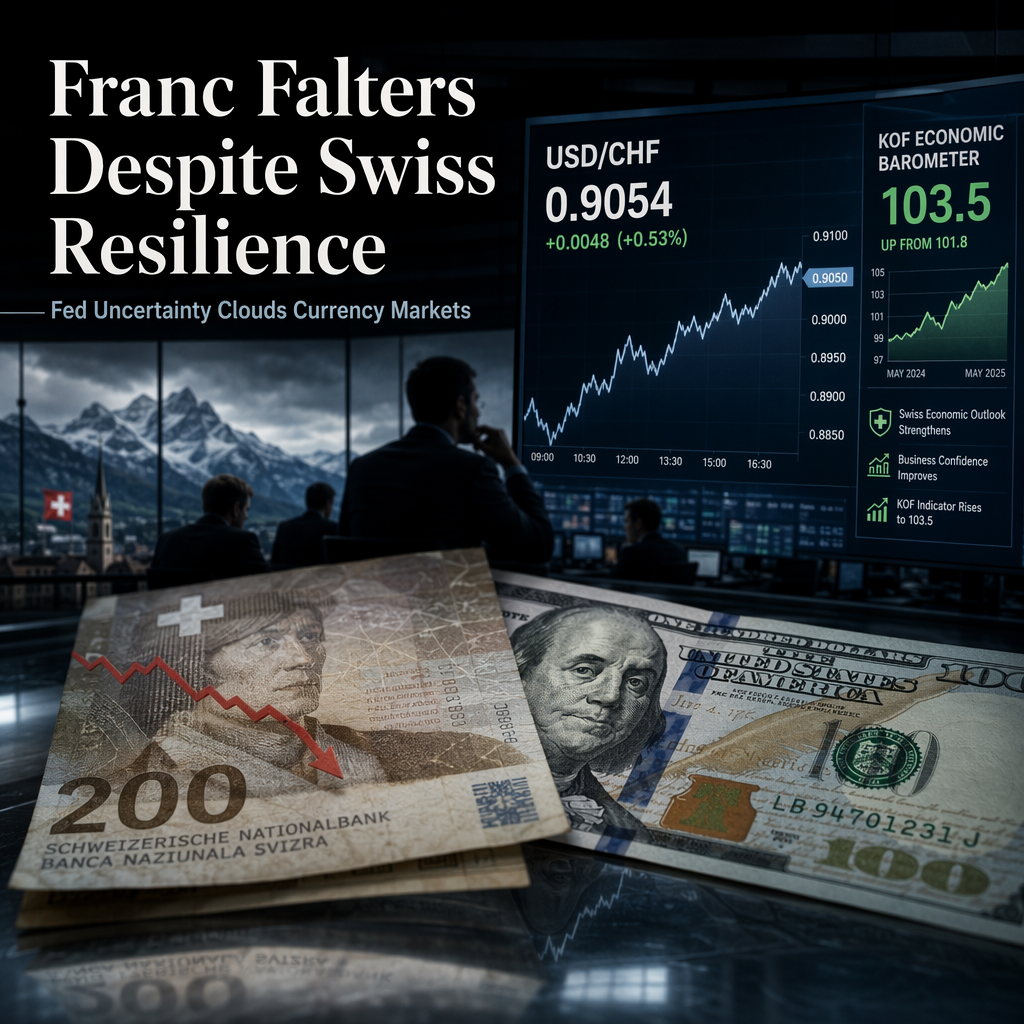
The Swiss Franc (CHF) continued to lose ground against the US Dollar (USD) on Thursday, even as Switzerland's KOF Leading Indicators showed an unexpected improvement. The KOF Economic Barometer rose for the second consecutive month in July, reaching 103.5, up from a revised 102.1 in June and surpassing market expectations of a decline to 101.0. The KOF Institute attributed this positive result to improvements in production indicators across all economic sectors, while foreign demand and private consumption remained largely unchanged [1].
Despite this upbeat Swiss data, the USD/CHF pair reversed some of Wednesday's losses. The market's risk-off sentiment, driven by escalating tensions in the Middle East, outweighed the positive Swiss economic news. Additionally, the US Federal Reserve's decision to leave interest rates unchanged, with three committee members voting for a quarter-point hike, and Chairman Kevin Warsh's refusal to provide forward guidance, disappointed investors and contributed to volatility [1].
Analysts at MUFG highlighted that the long end of the US Treasury bond market sold off following the FOMC meeting, which dragged the Dollar lower. They noted that Fed credibility is being questioned, especially after a significant jump in inflation expectations, and warned that the US dollar outlook has worsened. Futures markets reflected this uncertainty, with the probability of the Fed leaving rates unchanged in September rising to 34%, up from 24% before the meeting and 17% a week earlier [1].
Overall, while the Swiss economy showed signs of resilience, global risk sentiment and US monetary policy uncertainty played a larger role in currency movements, keeping the Swiss Franc on the defensive against the Dollar [1].
CONCLUSION
Despite stronger-than-expected Swiss economic data, the Swiss Franc weakened as global risk aversion and uncertainty over US Federal Reserve policy dominated market sentiment. The lack of Fed guidance and rising inflation expectations have clouded the outlook for the US Dollar, leading to increased volatility in currency markets.