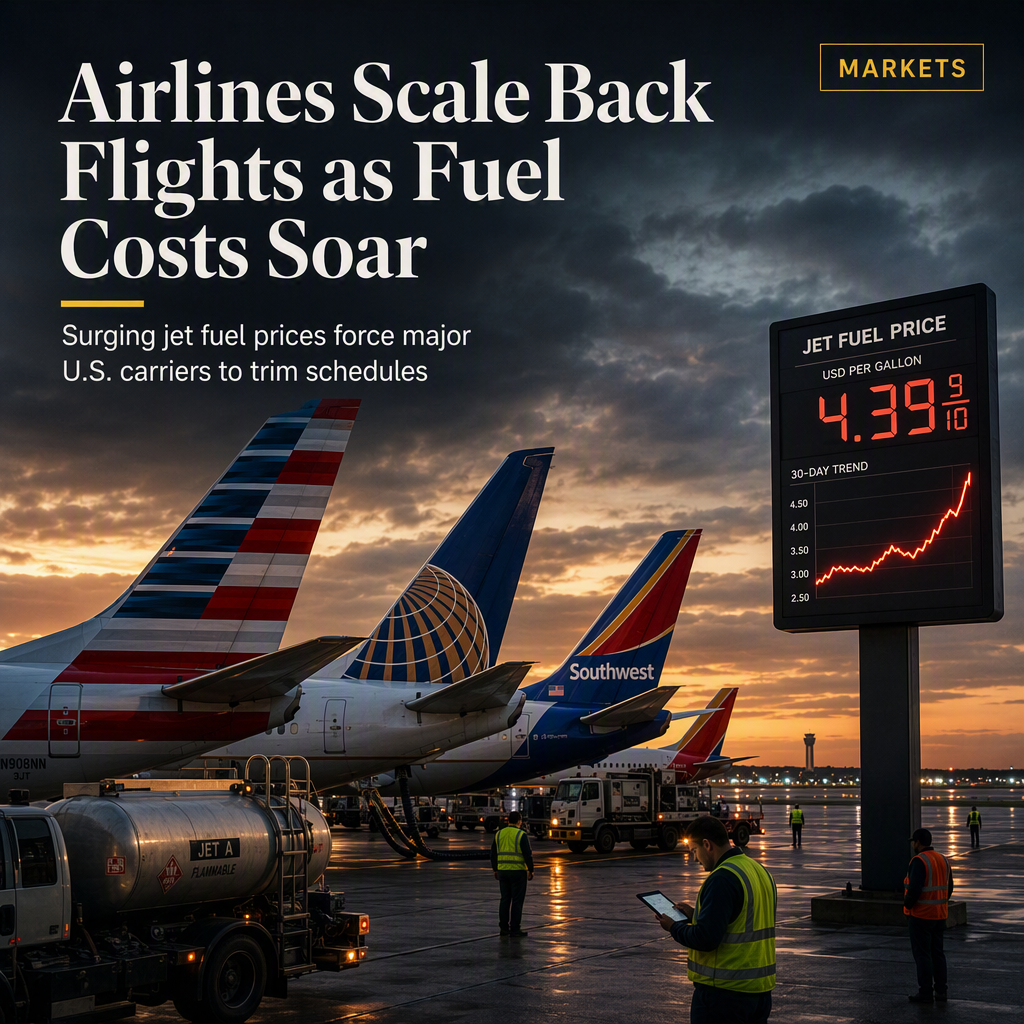
Major U.S. airlines, including American Airlines, United Airlines, and Southwest Airlines, are reducing flight schedules in response to a significant rise in jet fuel prices. The global average jet fuel price increased by 6.1% week over week to $181.46 per barrel last week, according to the International Air Transport Association (IATA) [1]. American Airlines Chief Financial Officer Devon May stated that fourth-quarter jet fuel prices are running about $1 per gallon above the airline's July projections, which is expected to add roughly $1 billion to its fuel bill [1]. May emphasized that while the third quarter performance remains strong, the recent surge in fuel prices has prompted the airline to adjust capacity for the fourth quarter [1].
American Airlines CEO Robert Isom noted that the airline still anticipates third-quarter revenue to rise 16% to 19% year-over-year, driven by robust demand across both domestic and international markets, as well as in premium and economy cabins. Isom also highlighted the airline's success in recapturing much of the increased fuel expense [1]. United Airlines CFO Michael Leskinen announced that some flights planned for December will be canceled due to higher fuel prices, and further adjustments may be made into the first quarter and beyond into 2027 if fuel prices remain elevated. Leskinen described United's fourth-quarter bookings as "tremendously strong," with resilient demand across premium, corporate, and economy segments, and reported "very little evidence of demand destruction" [1].
Southwest Airlines CFO Tom Doxey revealed that the carrier has already reduced about half of its planned year-over-year capacity growth for early 2026, stating that trimming capacity would be the "natural response" if fuel prices stay high. However, a Southwest spokesperson clarified that the schedule adjustments so far have been minimal and that Doxey's comments were illustrative rather than indicative of concrete actions taken [1]. Doxey also mentioned that stronger-than-expected fall bookings have helped offset higher fuel costs, enabling Southwest to maintain its third-quarter earnings guidance [1].
Spokespersons for both American Airlines and United Airlines indicated that they had no further comments on the matter [1].
CONCLUSION
Major U.S. airlines are responding to a sharp rise in jet fuel prices by adjusting flight schedules and capacity plans. Despite the increased costs, strong bookings and resilient demand have allowed carriers to maintain positive revenue and earnings outlooks for the near term. The situation remains dynamic, with further capacity adjustments possible if fuel prices remain elevated.