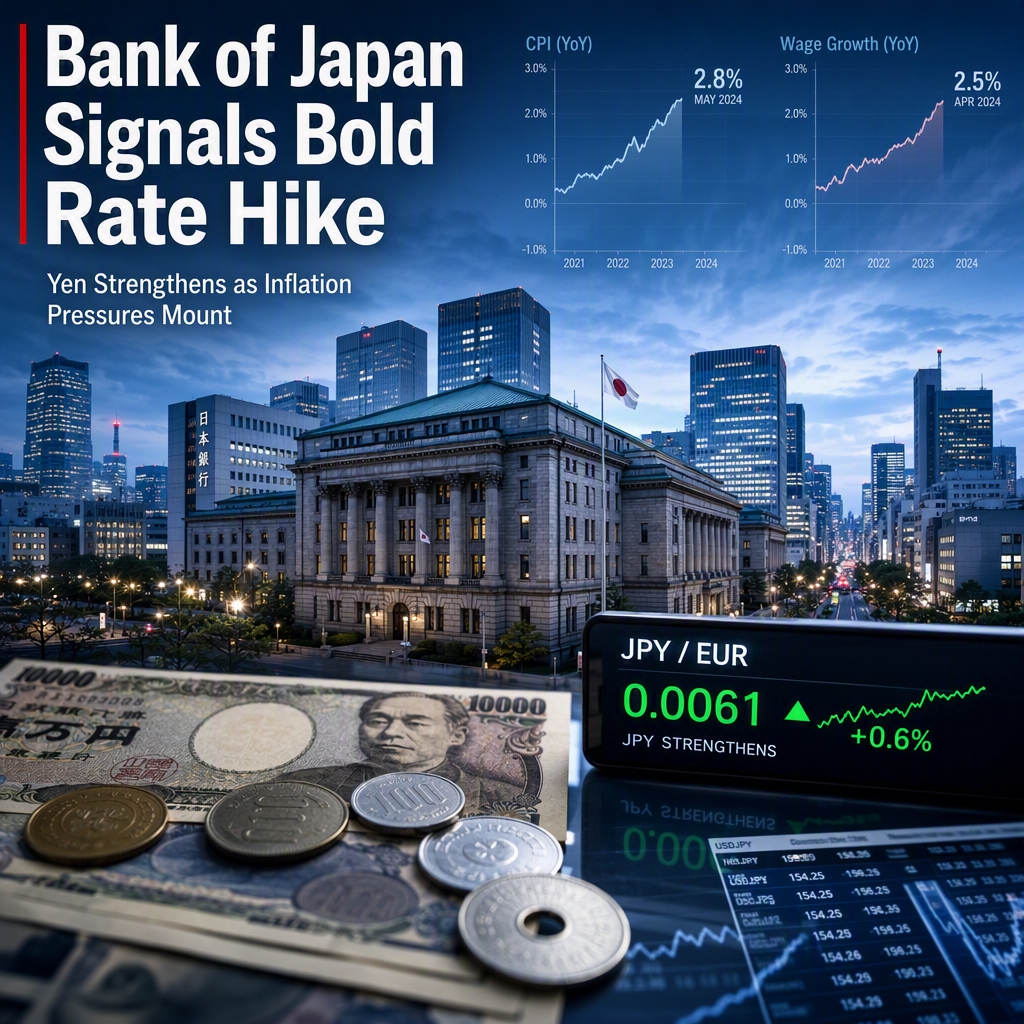
The Bank of Japan (BoJ) is expected to deliver a hawkish quarter-point rate hike at its upcoming monetary policy meeting, pressured by rising inflation and wage growth, which would push its benchmark interest rate to the highest level in approximately 31 years [1]. Futures markets are nearly fully pricing in this move, reflecting strong expectations for a shift toward tighter monetary policy. The anticipated rate increase from 1% to 1.25% would bring policy closer to neutral for the Japanese economy, with broad support expected from the Policy Board, though committee member Toichiro Asada may dissent as he did in June [1].
Japan's Consumer Price Index (CPI) data from July showed prices rising at their fastest pace in seven months, reaching 1.9%, just below the BoJ's 2% target [1]. Additionally, wages have continued to climb, suggesting further inflationary pressures. Japan's GDP also exceeded expectations in Q2, with 1.4% annualized growth, providing a favorable backdrop for monetary tightening [1]. The BoJ's decision follows similar moves by the Federal Reserve and European Central Bank, as global inflation is exacerbated by geopolitical tensions and oil supply disruptions, with Brent Oil prices rising above $100 [1].
Market reactions have been notable, with the Japanese Yen (JPY) showing strength this week, particularly against the New Zealand Dollar [2]. The EUR/JPY currency pair dropped by about 0.08% on Thursday, trading at 179.02, below its opening price, and forming back-to-back spinning tops near the 180.00 level, indicating buyer exhaustion and potential for bearish momentum [2]. The Relative Strength Index (RSI) signals that sellers are stepping in, with the index set to turn oversold for the third time in September [2]. Key support levels for EUR/JPY include 178.71 and 177.85, while resistance is at 180.00 and the 50-day Simple Moving Average at 183.58 [2].
Investors are awaiting a clear message from the BoJ regarding its monetary policy normalization cycle, especially after recent coordinated interventions in the Forex market by the US and Japan to halt the Yen's decline [1]. Analysts at ING are cited, but their specific opinions are not available in the provided sources [1].
CONCLUSION
The Bank of Japan's expected hawkish rate hike, driven by rising inflation and wage growth, has strengthened the Japanese Yen and heightened market anticipation for further monetary tightening. Currency markets are reacting with increased volatility, particularly in EUR/JPY, as traders position for potential shifts in policy. The BoJ's actions are likely to have significant implications for global markets, given the current inflationary environment and geopolitical risks.