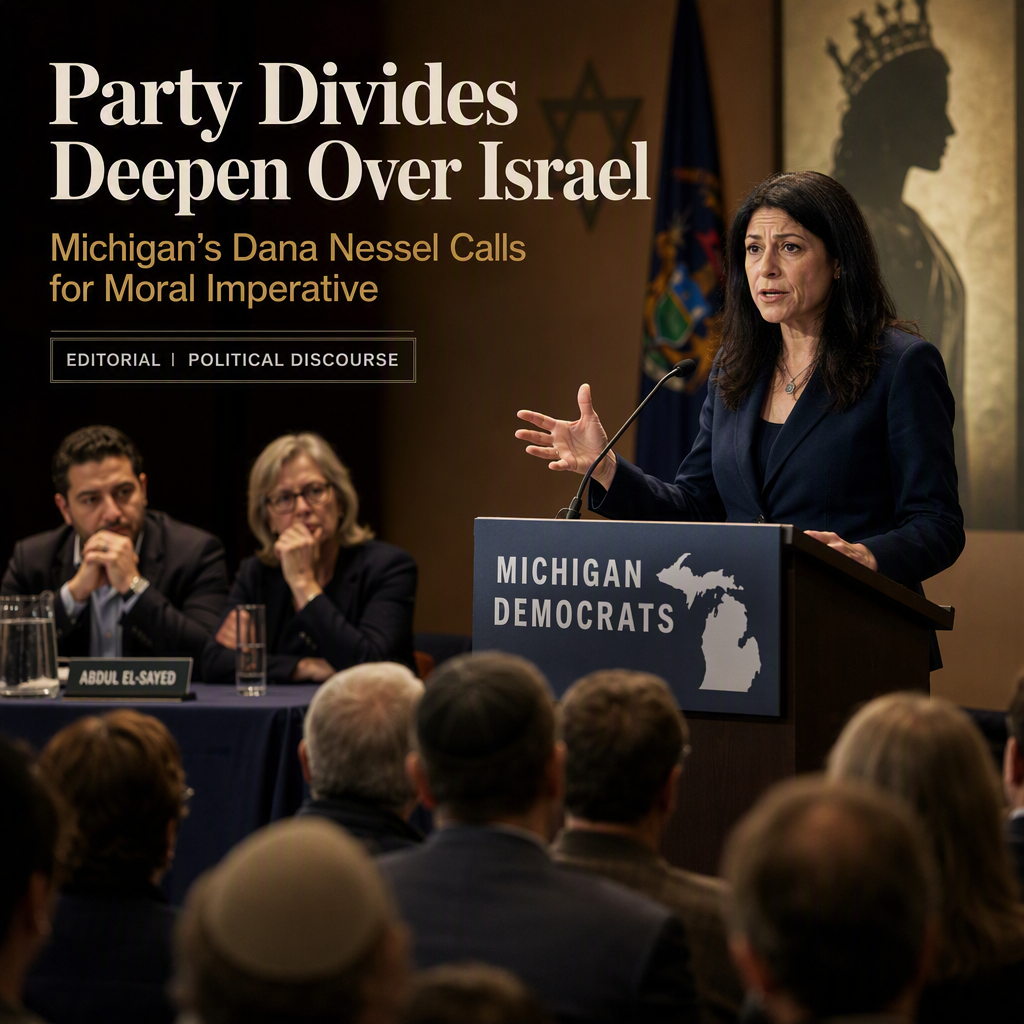
Michigan's Democratic Attorney General Dana Nessel, who is Jewish, addressed a private gathering of Jewish Democrats on August 30 in Birmingham, urging attendees to place the needs of 'the rest of humanity' above their own 'safety and security' [1]. Nessel invoked the story of Queen Esther to argue for a 'moral imperative' to prioritize global concerns over self-interest, stating that Jewish Democrats should be willing to 'sacrifice the comfort, safety and security and even the very future of our own people in exchange for the opportunity to save the rest of humanity' [1].
The event, hosted by the Michigan Democratic Party's Jewish Caucus and closed to the press, highlighted deep intra-party divides over Israel, particularly as Jewish voters in Michigan face rising anti-Israel rhetoric from progressive candidates [1]. Democratic U.S. Senate candidate Abdul El-Sayed, known for his criticism of Israel and U.S. military aid to the country, attended the gathering and apologized to the Jewish Caucus for past controversial remarks [1]. Nessel has publicly stated she will not vote for Republican Mike Rogers in the Senate race but has withheld endorsement from El-Sayed due to concerns about his stance on Israel [1].
Nessel questioned the value of defending Israel if global crises like climate change remain unaddressed, asking, 'What good is defending the historic homeland of our ancestors and demanding that candidates acknowledge its right to exist if the planet upon which it rests is no longer inhabitable?' [1]. She also criticized Republican focus on cultural issues and characterized support for former President Donald Trump as an 'abdication of our responsibilities as Jews,' emphasizing that Jewish tradition demands 'compassionate action toward others' [1].
The remarks underscore the tension within Michigan's Democratic base, especially among Jewish voters who feel torn between their faith and party loyalty amid contentious debates over Israel and broader humanitarian issues [1].
CONCLUSION
Dana Nessel's comments reflect growing divisions within Michigan's Democratic Party over Israel and global humanitarian priorities. The event signals potential challenges for party unity and voter alignment ahead of the general election, with implications for the Senate race and broader political discourse.