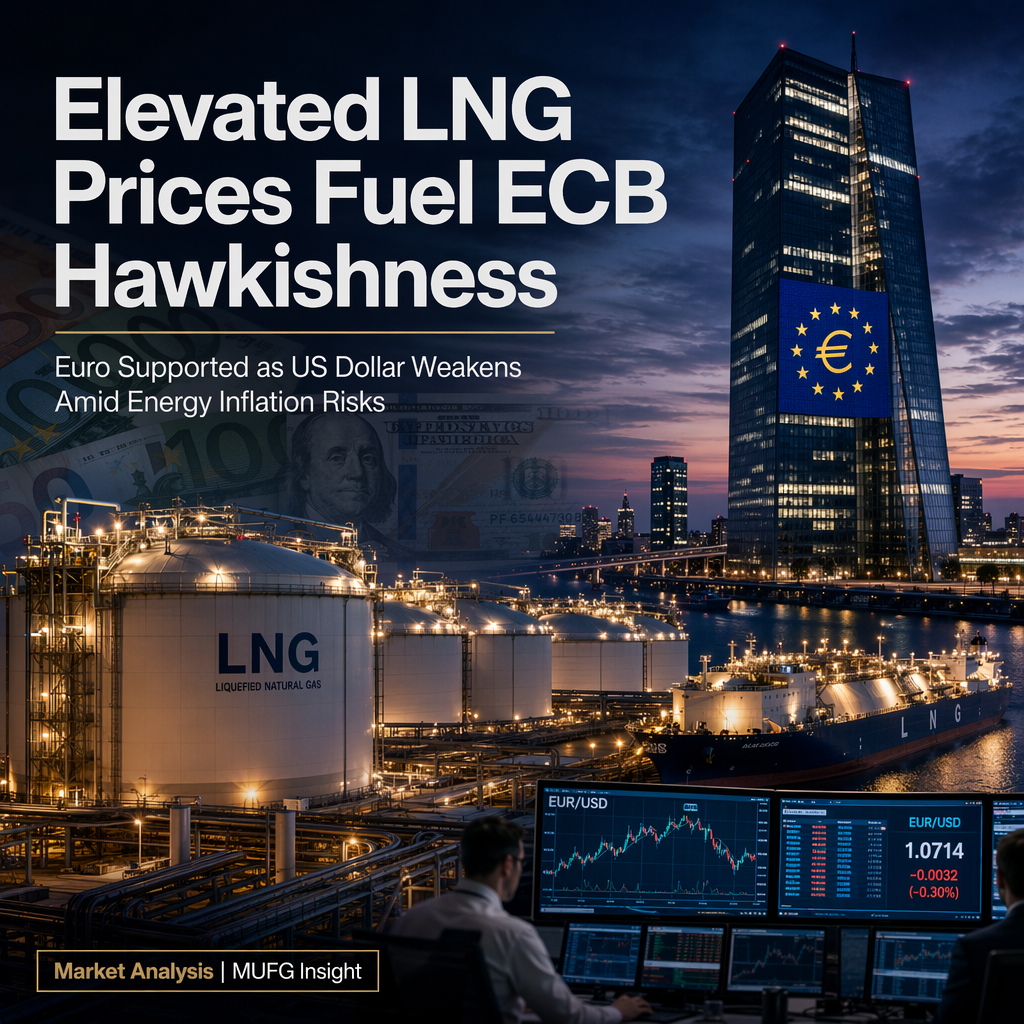
MUFG’s Derek Halpenny observes that the EUR/USD currency pair could benefit from a weakening US Dollar and a persistently hawkish stance from the European Central Bank (ECB) [1]. Halpenny notes that LNG prices remain elevated, currently 40% above pre-conflict levels, which continues to pose inflation risks for the Eurozone [1]. Although Brent crude oil has reversed its post-conflict surge, the retracement in LNG prices since the ceasefire extension and the reopening of the Strait of Hormuz has not been sufficient to eliminate energy-related inflation risks [1].
Halpenny states, 'Inflation risks may have subsided in Europe, but the level of risk remains higher than before the conflict,' emphasizing that the ECB is likely to remain vigilant and biased toward further rate hikes as it monitors energy price developments [1]. The rates curve is maintaining pricing for another ECB hike, especially as US yields fall back on easing Federal Reserve rate hike expectations, which could further support the Euro [1].
The market implication is that the Euro may be supported by both the prospect of additional ECB rate hikes and a weaker US Dollar, driven by shifting expectations around US monetary policy [1]. MUFG suggests that the ECB's bias toward hiking rates again is underpinned by ongoing energy price concerns, particularly the elevated LNG prices [1].
CONCLUSION
MUFG highlights that elevated LNG prices are keeping Eurozone inflation risks higher, supporting the ECB's hawkish bias and potential for further rate hikes. The Euro could benefit from both US Dollar weakness and sustained rate hike expectations. Market participants should monitor energy price developments and ECB policy signals for future direction.