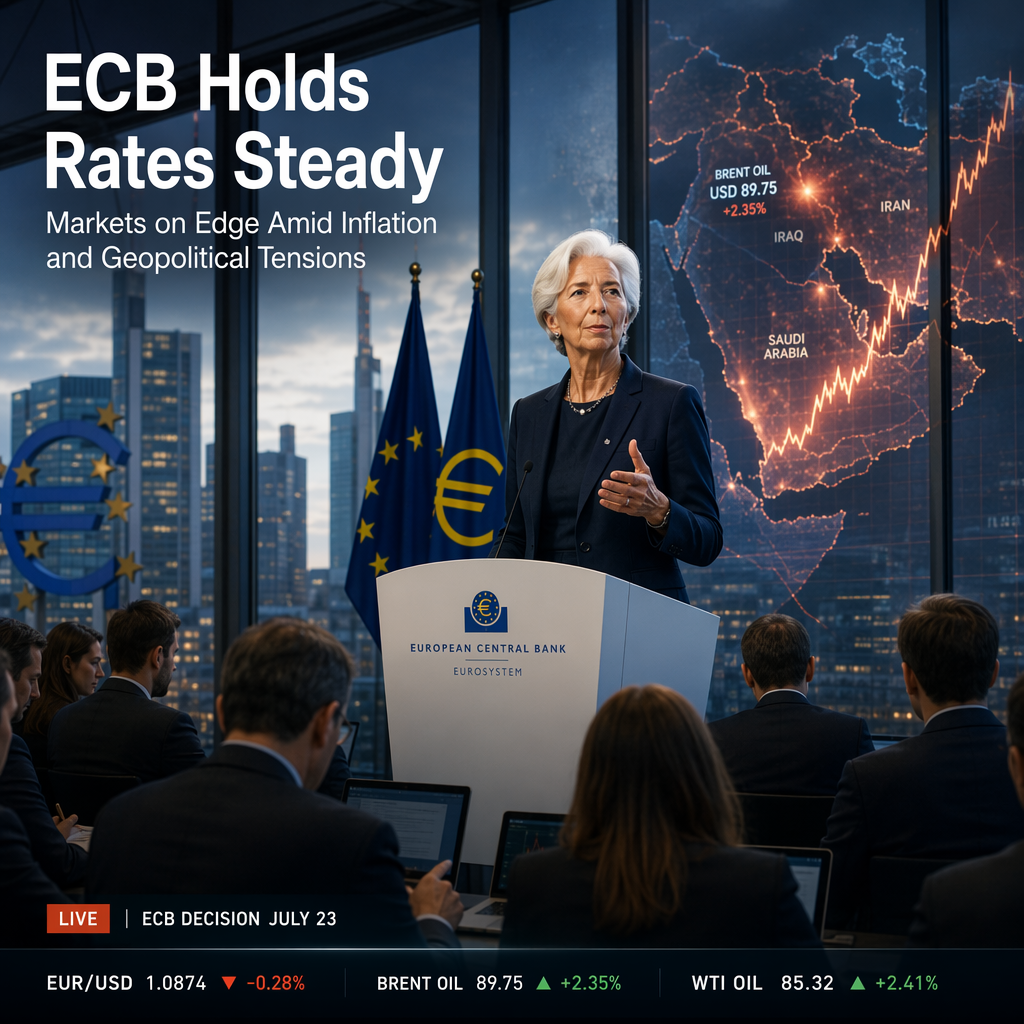
On Thursday, July 23, the European Central Bank (ECB) is expected to announce its decision to hold interest rates steady, with the main refinancing operations rate at 2.4% and the deposit facility rate at 2.25% [2][4]. This decision comes as inflation in the Eurozone has cooled more than anticipated, with the core Harmonised Index of Consumer Prices (HICP) rising by only 0.2% month-on-month in June, down from 0.3% previously [2]. However, inflation expectations remain above the ECB's 2% target through 2027, and natural gas and refined fuel prices are still elevated [2]. The ECB's policy announcement will not be accompanied by updated economic projections, but President Christine Lagarde will hold a press conference at 12:45 GMT [2][4].
The Euro has shown resilience ahead of the ECB meeting, holding near 1.1400 against the US Dollar after correcting from a monthly high of 1.1482 on July 15 [2]. Against the British Pound, the Euro has rallied for six consecutive days, testing highs at the 0.8645 area and posting a nearly 0.9% gain over the past few days, marking its strongest weekly performance since May [4]. This strength is attributed more to Pound weakness, following soft UK inflation data and concerns about fiscal stability under Prime Minister Andrew Burnham's new cabinet [4].
Analysts at ING and Commerzbank expect the ECB to maintain a hawkish hold, keeping the door open for a potential rate hike in September, especially as Middle East tensions and rising European gas prices sustain inflation risks [3][4]. ING's Francesco Pesole notes that policymakers aim to preserve market pricing of around 45 basis points of tightening by year-end, possibly through post-meeting media leaks rather than direct statements [3]. Commerzbank analysts believe it is too early for a hike now but anticipate a move to 2.50% in September if new forecasts justify it [4]. Both warn that the Euro may not benefit significantly from the ECB meeting unless President Lagarde delivers a hawkish surprise [3][4].
The broader market context is marked by risk aversion, as crude oil prices surge amid escalating tensions in the Middle East. Brent crude jumped 3.36% to $94.07 per barrel by Wednesday's close and rose a further 1.96% to $95.94 per barrel Thursday morning, with the 6-month Brent future hitting a one-month high of $81.74 per barrel [1]. Deutsche Bank analysts highlight that investors are pricing in a longer period of high oil prices, reflecting expectations of sustained supply tightness [1]. The US Dollar has strengthened against most major currencies this week, notably against the Swiss Franc [1].
The Eurozone economy is losing momentum, with growth slowing and business activity remaining weak amid worsening labor market conditions. The economy contracted by 0.2% in the first quarter of 2026, compared to an expected 0.1% growth [2]. These factors place the ECB in a dilemma between supporting growth and containing elevated inflation, reinforcing the likelihood of a cautious, data-dependent approach [2][3][4].
CONCLUSION
The ECB is poised to hold rates steady, balancing cooling inflation and weaker growth against persistent inflation risks from elevated energy prices and renewed Middle East tensions. Analysts expect a hawkish tone, keeping the possibility of a September rate hike alive, but caution that the Euro may not see significant gains unless Lagarde surprises markets. The event is driving high market impact, with risk aversion and surging oil prices shaping broader financial sentiment.