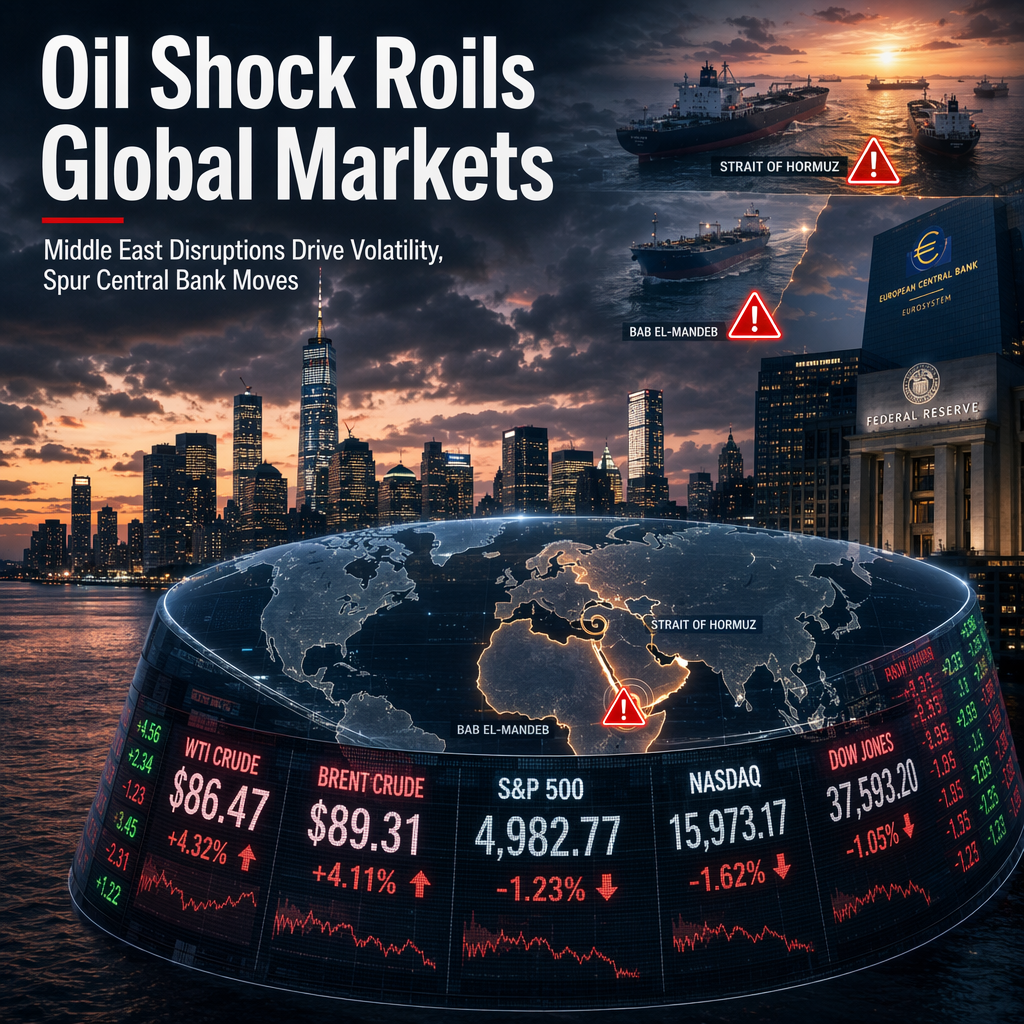
A sharp escalation in Middle East tensions, including the closure of the Strait of Hormuz by Iran and the Bab el-Mandeb Strait by Yemen's Houthis, has disrupted nearly 27% of global energy supply, driving oil prices sharply higher [6]. West Texas Intermediate (WTI) futures extended their rally for a fifth consecutive day, rising over 3% to around $88.60, while Brent crude futures surged 3.9% to $97.76 per barrel, their highest since June 3 [6][8]. The oil price spike follows threats of further military escalation between the U.S. and Iran, with both sides issuing warnings of decisive retaliation [6][8].
The surge in energy prices has had significant ripple effects across global financial markets. U.S. Treasury yields climbed, with the 10-year note rising to 4.675% and the 2-year note to 4.317%, as investors anticipated higher inflation and tighter monetary policy [8]. European and Asian government bond yields also moved higher, with the U.K. 10-year yield rising 4 basis points above 5% [8]. Analysts at MUFG and ING note that the energy shock is fueling expectations for more hawkish central bank actions, particularly from the European Central Bank (ECB) and the Federal Reserve [2][3].
The ECB is widely expected to keep its deposit rate steady at 2.25% at its upcoming meeting, following a 25 basis point hike in June [1][2][6]. However, markets are now pricing in two to three additional ECB hikes over the next year, with ING and MUFG analysts highlighting that rising oil prices and well-anchored long-term inflation expectations are driving this hawkish outlook [1][2]. ING's Michiel Tukker suggests a September hike is likely, while also noting that the upside risk to rates is limited unless oil volatility persists [1]. Societe Generale analysts caution that while hawkish ECB expectations are supporting the euro, the negative impact of higher energy prices on European growth could cap further gains [2].
The currency markets have responded to these developments, with the euro remaining resilient above 1.1400 against the U.S. dollar, supported by expectations of ECB tightening [2]. In contrast, the Japanese yen and Swiss franc have weakened, as rising global yields and energy prices create a challenging environment for low-yielding currencies [3]. MUFG reports that the Bank of Japan may consider a rate hike as soon as September, but doubts that a single move would reverse yen weakness unless global financial conditions deteriorate further [3].
Other asset classes are also feeling the impact. Gold prices rebounded to around $4,150/oz on dip buying and short covering, but TD Securities warns that rising oil prices and higher Fed hike probabilities should cap further upside, with resistance seen at $4,200/oz [4]. Meanwhile, the Australian dollar found support from a strong labor market report, prompting markets to raise the probability of a Reserve Bank of Australia (RBA) hike to 30%, though Commerzbank expects the RBA to remain on hold in August but possibly adopt a more hawkish tone [5].
In the U.K., the British pound's recent strength is attributed to positioning and carry trades rather than fundamentals, with ING analysts expecting sterling to weaken as fiscal risks resurface and short-dated rates drift lower [7]. The new prime minister's 20% cut in business rates for hospitality venues, costing about £100 million, has added to investor unease and contributed to higher gilt yields [8].
CONCLUSION
The surge in oil prices driven by Middle East supply disruptions is fueling expectations for tighter monetary policy across major central banks, resulting in higher global bond yields and increased market volatility. While the euro is supported by hawkish ECB expectations, other currencies like the yen and sterling face headwinds from rising yields and fiscal concerns. The market remains highly sensitive to further developments in energy markets and central bank policy signals.