
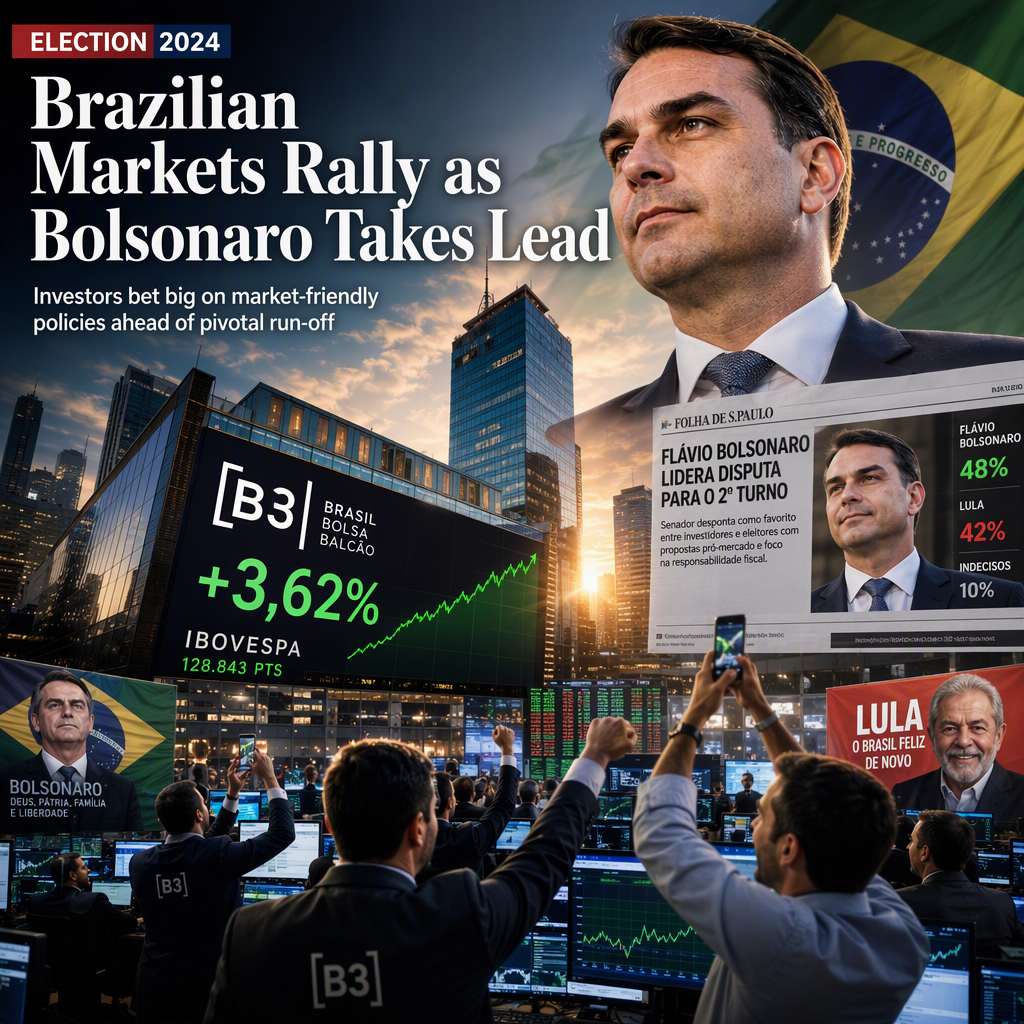
On October 5, Brazilian stocks experienced a significant rally after Flávio Bolsonaro, son of former president Jair Bolsonaro, outperformed expectations in the first round of Brazil's presidential election, positioning himself as the heavy favorite to win the presidency in the upcoming run-off against incumbent Luiz Inácio Lula da Silva on October 25 [1]. Bolsonaro secured more than 47% of the votes, surpassing Lula by nearly 2 percentage points, despite pre-election polls predicting he would trail in the initial tally [1]. The run-off was triggered as neither candidate achieved a majority in the first round [1].
Investor sentiment shifted markedly following the results, with prediction markets reflecting increased confidence in Bolsonaro's victory. On Kalshi, his odds of winning jumped from about 60% before the first round to over 80%, while Polymarket saw his odds rise from 63% to 85% [1]. This recalibration in expectations led to a surge in Brazilian assets: the iShares MSCI Brazil ETF (EWZ) climbed more than 12% on Monday, U.S.-listed shares of Itau Unibanco (ITUB) gained 15%, and Banco Bradesco (BBD) soared 19%. Brazil's local Bovespa index also rose by 8% [1].
Investors broadly view Bolsonaro as more favorable to markets, citing his promises of greater fiscal discipline. Brazil's deficit-to-GDP ratio was nearly 10% as of June, underscoring the importance of fiscal policy in the election's outcome [1]. Meanwhile, Lula, who reclaimed the presidency in 2022 after a 12-year hiatus, is seeking a fourth term. His campaign has attempted to link Flávio Bolsonaro to his father's contested 2022 loss and allegations of corruption [1].
The decisive run-off between Flávio Bolsonaro and Lula is scheduled for October 25, with market participants closely watching for further developments that could impact Brazilian assets [1].
CONCLUSION
Brazilian markets responded strongly to Flávio Bolsonaro's unexpectedly strong first-round performance, with major indices and financial stocks posting double-digit gains. Investors are optimistic about Bolsonaro's market-friendly policies and fiscal discipline, while prediction markets now overwhelmingly favor his victory in the upcoming run-off. The outcome of the October 25 election will be pivotal for Brazil's economic outlook and investor confidence.