
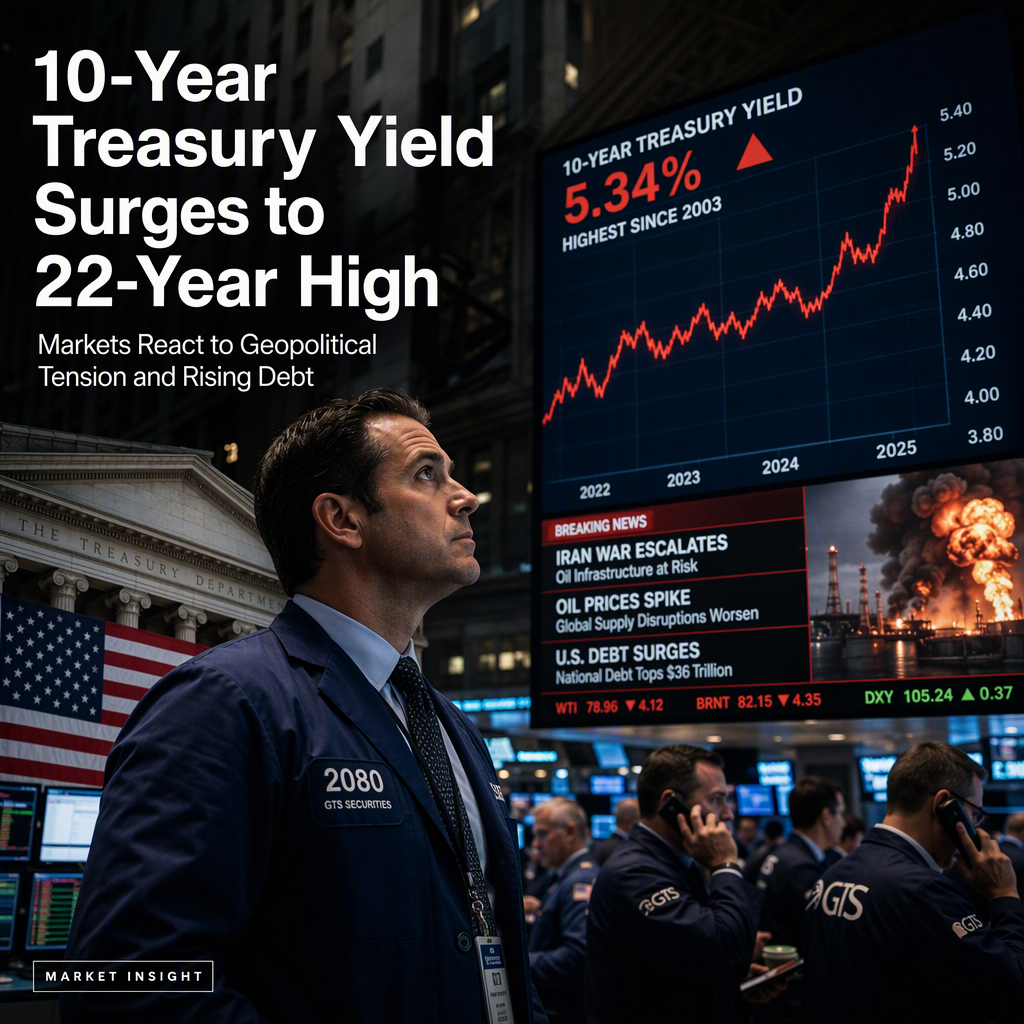
The yield on the 10-year Treasury note surged to 5.34% during Thursday's trading session, marking its highest level since 2002 before declining later in the day and into Friday [1]. This spike in yields has been driven by several factors, including geopolitical uncertainty stemming from the Iran war, which has disrupted oil flows from the Strait of Hormuz, as well as growing federal budget deficits, tighter monetary policy, and increased competition in the bond market due to a surge in corporate debt issuance related to the AI buildout [1].
Brian Therien, senior analyst at Edward Jones, noted that higher Treasury yields "may be a headwind by increasing borrowing costs for households and business," potentially slowing interest rate-sensitive sectors such as housing and auto sales, despite a solid labor market and resilient consumer spending [1]. The 10-year Treasury note serves as a key benchmark for the U.S. economy, influencing rates on 30-year fixed mortgages, auto loans, and fixed-rate student loans. Mortgage rates have trended higher in tandem with longer-term Treasury yields, and Therien advised that consumers considering new loans should be prepared for higher rates and payments [1].
While higher yields can negatively impact borrowers, there are also benefits for savers and investors. Therien explained that savers and fixed-income investors now earn more income, with high-yield savings accounts, money market funds, CDs, and bonds offering more attractive yields than earlier in the year. For long-term investors, higher starting yields can improve the return potential of bonds, with a greater share of expected returns coming from interest income rather than price appreciation [1].
Peter C. Earle, senior director of research at the American Institute for Economic Research (AIER), highlighted that higher long-term yields raise financing costs for businesses and put pressure on stock and existing bond prices, also affecting retirement portfolios. However, those buying Treasurys or reinvesting maturing holdings can now secure higher yields [1].
CONCLUSION
The surge in the 10-year Treasury yield to its highest level since 2002 signals increased borrowing costs for consumers and businesses, potentially slowing sectors like housing and autos. However, the higher yields also present opportunities for savers and fixed-income investors. The market impact is significant, with both risks and benefits depending on one's financial position.