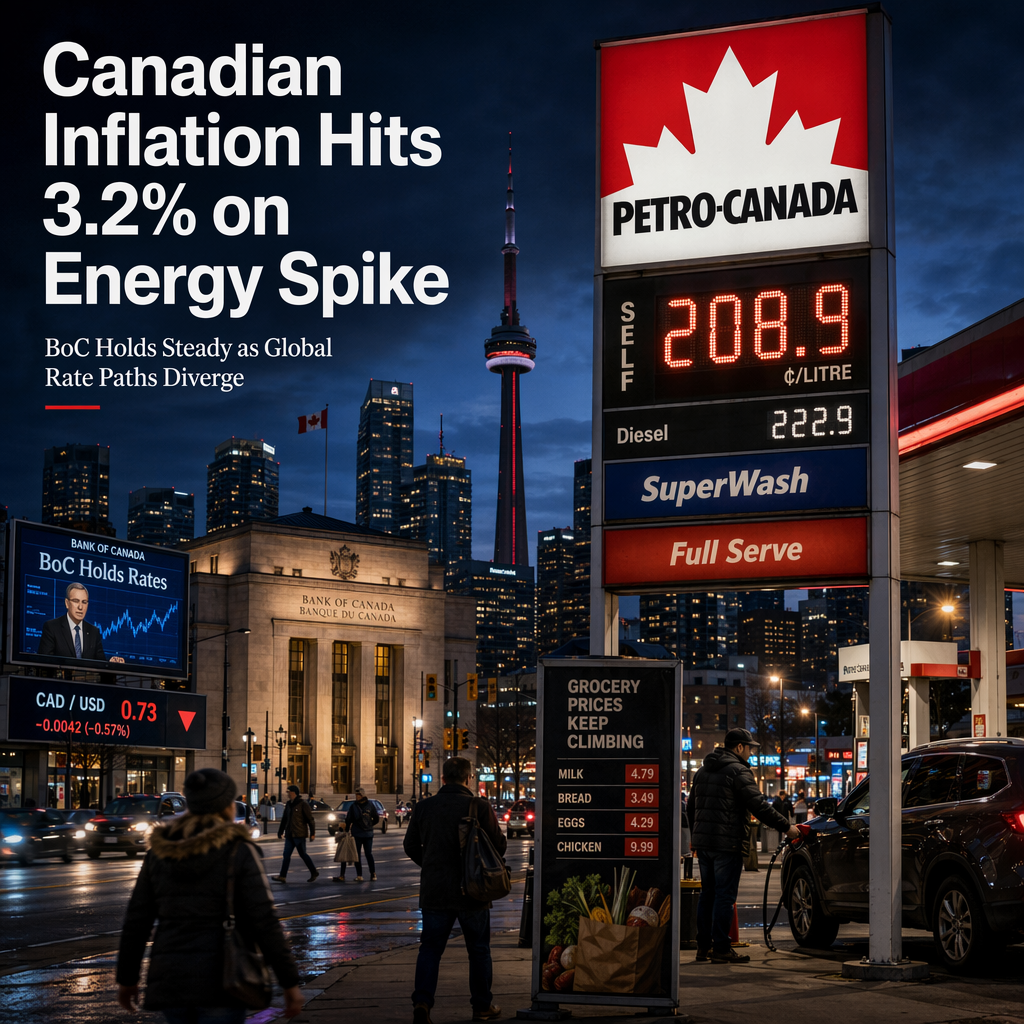
Canadian headline inflation accelerated to 3.2% year-over-year in May, up from 2.8% in April, primarily driven by higher gasoline and food prices, according to both National Bank of Canada (NBC) and Royal Bank of Canada (RBC) economists [1][3][4]. Core inflation measures, however, remained subdued and close to the Bank of Canada’s (BoC) 2% target, with the core Consumer Price Index (CPI) rising to 2.2% year-over-year and CPI excluding food and energy at 1.6% [3][4]. Wage growth has softened, and underlying price pressures outside volatile categories remain contained, leading analysts to argue that the BoC should maintain a patient stance and keep interest rates unchanged, viewing the energy-driven inflation as temporary [1][3][4].
Despite the stronger-than-expected headline inflation, the Canadian Dollar (CAD) struggled to gain traction, with USD/CAD trading around 1.4165, near its highest level since April 2025 [4]. Markets focused on stable core inflation rather than the headline print, and the BoC is widely expected to keep policy settings unchanged. This contrasts with the Federal Reserve (Fed), which has adopted a hawkish stance, with TD Securities reporting that the Fed is expected to keep rates on hold through 2026 and 2027, and nine FOMC participants penciling in hikes for 2026 [2][4]. The Fed's focus on elevated inflation risks and labor market stabilization has raised the bar for rate cuts, making a hike more likely than a cut if any move occurs this year [2][4].
The divergence in monetary policy between the BoC and Fed is contributing to CAD weakness, especially as the US Dollar remains supported by the Fed's hawkish outlook and risk sentiment improves amid progress in US-Iran negotiations [4]. The US Dollar Index (DXY) is trading around 101, near a thirteen-month high [4]. Additionally, a decline in oil prices due to US-Iran optimism is adding further pressure on the commodity-linked Loonie [4]. However, TD Securities analysts expect oil market tightness to persist through the summer, supporting higher oil prices despite recent rebounds in Middle East energy flows, which are seen as temporary [5].
Looking ahead, the Canadian economic calendar is light, with BoC Governor Tiff Macklem scheduled to speak, while US markets await the Personal Consumption Expenditures (PCE) Price Index for further clues on the Fed's policy path [4]. Broader global context shows the European Central Bank (ECB) maintaining a cautious stance, with President Christine Lagarde stating there is "no evidence yet of de-anchoring or second-round effects" that would warrant stronger action, and the ECB confident that inflation will return to target with appropriate policy [6]. Meanwhile, policy divergence between the Fed and ECB is seen as a key driver for EUR/USD, with the ECB recently raising rates by 25 basis points and revising inflation projections upward, though weaker Eurozone growth and energy vulnerability offset this support for the Euro [8].
Analyst opinions from NBC and RBC emphasize that the risk of second-round inflation effects in Canada remains limited, especially with expectations of relief in energy prices as geopolitical tensions ease [1][3]. The BoC is expected to remain patient, while the Fed's hawkish shift and the ECB's cautious approach highlight diverging global monetary policy paths [1][2][3][4][6][8].
CONCLUSION
Canadian inflation rose to 3.2% in May, mainly due to energy prices, but subdued core inflation and softening wage growth support expectations that the BoC will keep rates on hold. The Canadian Dollar remains under pressure amid a strong US Dollar, diverging policy outlooks, and softer oil prices. Analysts see limited risk of persistent inflation in Canada, with global monetary policy divergence shaping currency and commodity markets.