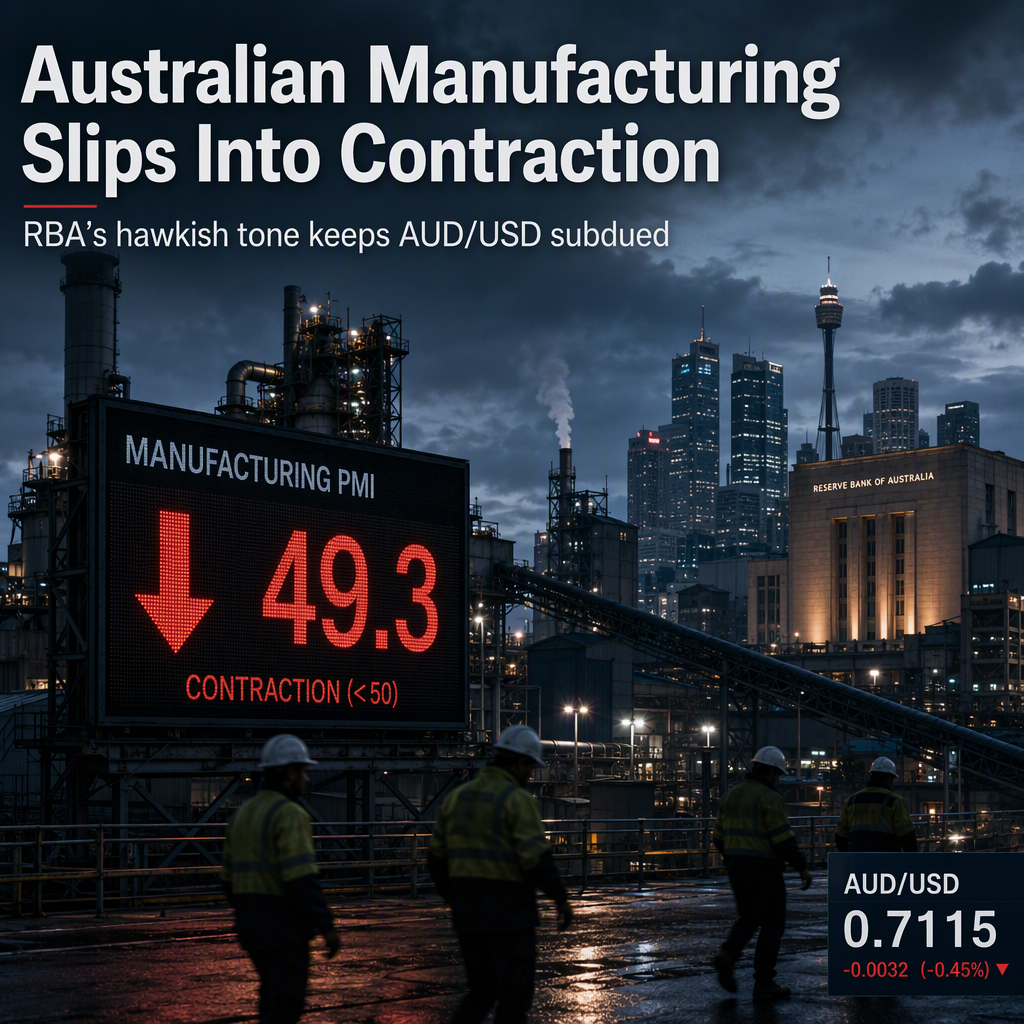
Australia's S&P Global Manufacturing Purchasing Managers Index (PMI) fell to 49.3 in September, down from 52.0 in the previous month, according to preliminary data released by S&P Global on Wednesday [1]. The Services PMI also eased to 51.4 from 53.2, while the Composite PMI declined to 50.8 from 52.7 [1]. Despite these weaker PMI readings, the Australian Dollar (AUD) showed little reaction, with the AUD/USD pair trading near 0.7115 and holding negative ground [1].
On the policy front, officials from the Reserve Bank of Australia (RBA) maintained a hawkish tone. RBA Governor Bullock highlighted upside risks to inflation due to high energy prices and clarified that she is not signaling the path of interest rates ahead of the board meeting on September 29 [2]. RBA Assistant Governor Sarah Hunter also indicated that rates may need to rise again if inflation becomes entrenched [2].
Meanwhile, external factors such as hawkish comments from US Federal Reserve officials and easing geopolitical tensions in the Middle East contributed to a subdued session for the AUD/USD, which ended Tuesday unchanged at 0.7114 [2]. The US ADP Employment Change 4-week average rose to 20K from 16.75K, reinforcing the strength of the US labor market [2].
Technical analysis shows AUD/USD trading at 0.7115, with a mildly bullish near-term bias as the spot rate remains above the triple simple moving average at 0.7091. The Relative Strength Index (14) is at 46, indicating neutral momentum [2]. Immediate support is at 0.7115, with further support at 0.7091, 0.7035, and 0.6905. Resistance levels are noted at 0.7198 and higher at 0.7381, 0.8700, and 0.9545 [2].
Looking ahead, the Australian economic docket will feature the S&P Global Flash PMIs for September in its preliminary reading [2].
CONCLUSION
Australia's manufacturing sector showed signs of contraction in September, but the Australian Dollar remained largely unaffected as hawkish signals from both the RBA and the US Federal Reserve offset the impact of weaker PMI data. Market participants are likely to watch upcoming economic releases and central bank commentary for further direction.