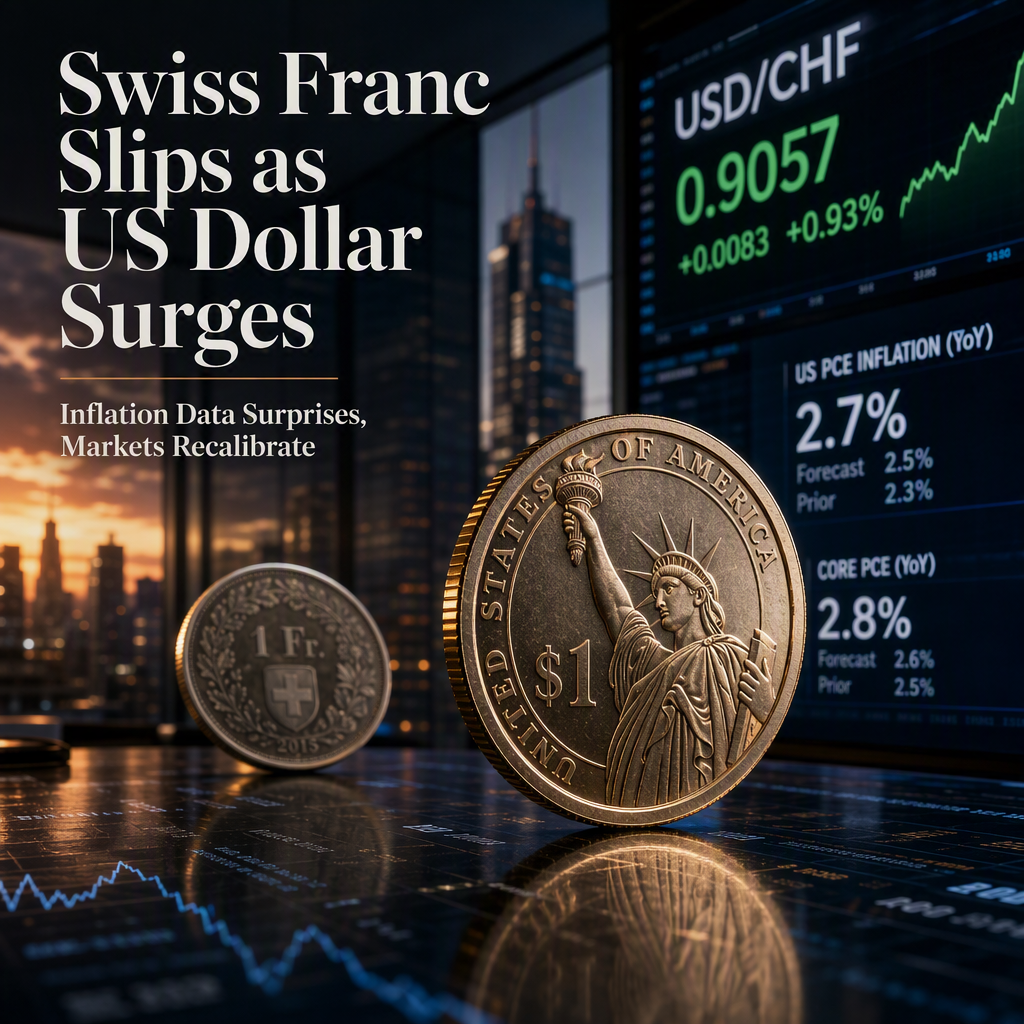
The Swiss Franc (CHF) depreciated against the US Dollar (USD) on Wednesday, following the release of US inflation data that surpassed market expectations. At the time of writing, USD/CHF traded around 0.8052, marking a 0.47% increase for the day [1]. The headline Personal Consumption Expenditures (PCE) Price Index rose by 0.2% month-on-month in July, outpacing the 0.1% forecast and reversing June’s 0.1% decline. On an annual basis, headline inflation remained at 3.7%, above the anticipated 3.6% [1].
The core PCE Price Index, which is the Federal Reserve’s preferred measure of underlying inflation, increased by 0.2% month-on-month, matching expectations but accelerating from June’s 0.1% rise. Annual core inflation held steady at 3.3%, consistent with forecasts [1]. Despite these figures reinforcing expectations that the Federal Reserve will keep interest rates unchanged at its upcoming meeting, inflation remains well above the central bank’s 2% target, leaving open the possibility of a future rate hike [1].
The US Dollar Index (DXY), which tracks the Greenback against a basket of six major currencies, traded around 99.16, up nearly 0.25% on the day. The Dollar had faced selling pressure last week after the US Treasury unexpectedly increased buybacks of longer-dated government securities, raising concerns about rising debt and fiscal credibility [1].
Geopolitical tensions in the Middle East, particularly unresolved transit agreements between Iran and Oman regarding the Strait of Hormuz, continue to keep oil prices elevated and cloud the inflation outlook. US President Donald Trump stated there is no timetable to resume peace talks with Iran, emphasizing that both economic pressure and military action are effective [1].
On the Swiss side, the ZEW Survey Expectations Index improved to 12.1 in August from 10.0 previously. However, Switzerland’s subdued inflation backdrop supports expectations that the Swiss National Bank (SNB) will maintain its policy rate at 0% throughout the year, limiting support for the Swiss Franc [1].
CONCLUSION
Stronger-than-expected US inflation data has boosted the US Dollar and weakened the Swiss Franc, with market participants anticipating steady Fed rates but acknowledging the possibility of future hikes. Geopolitical uncertainties and Switzerland’s low inflation environment suggest limited upside for the Swiss Franc in the near term.