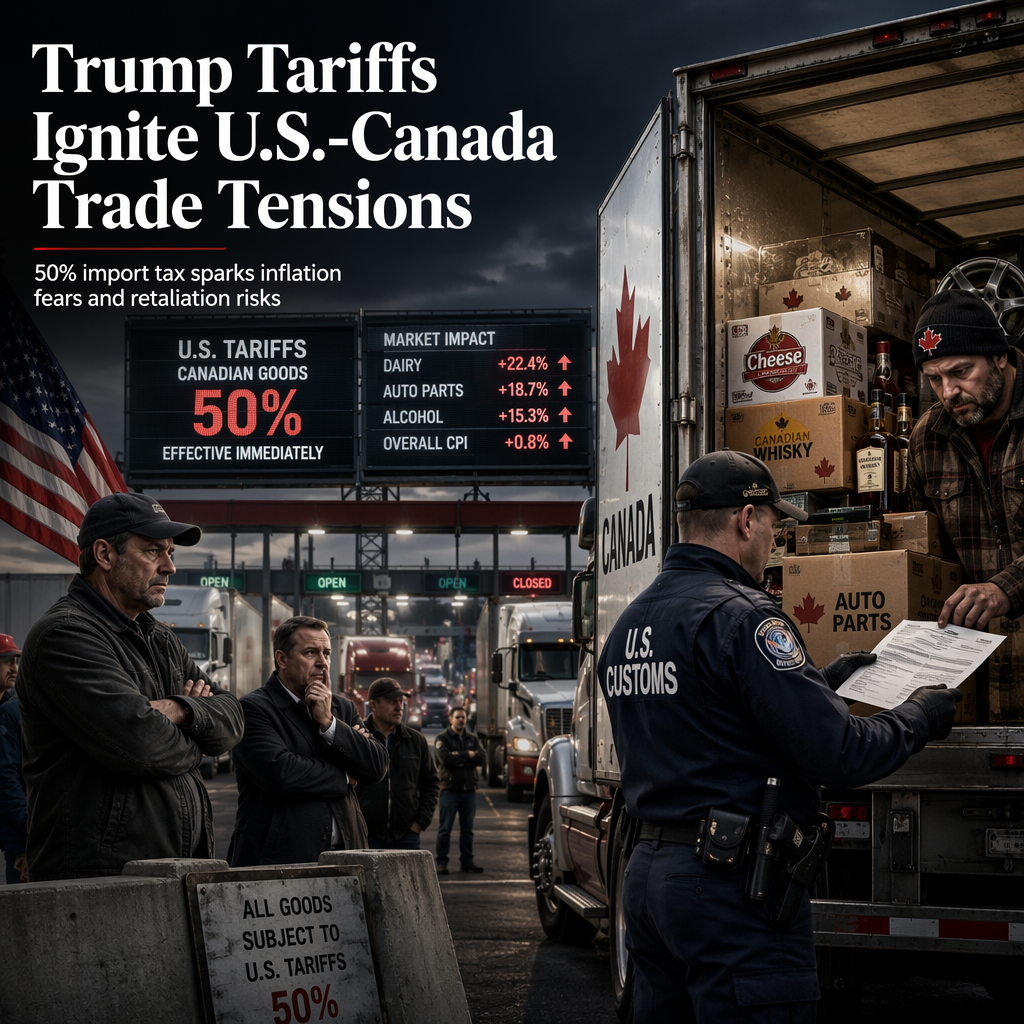
President Donald Trump has announced the imposition of 50% tariffs on most Canadian goods, excluding energy products, potash, fish, and critical minerals, in a move that marks a significant escalation in trade tensions between the United States and Canada [1]. The tariffs target key sectors such as dairy, alcohol, and automobiles, including goods that were previously protected under the U.S.-Mexico-Canada agreement [1]. Trump justified the tariffs by accusing Canada of discriminating against American autos, alcohol, and cheese, referencing retaliatory actions taken after his previous tariff measures last year [1].
Analysts warn that the 50% import tax could substantially increase consumer prices in the U.S., particularly for automobiles and food products, with market participants expecting the move to stoke inflationary pressures and potentially dampen consumer sentiment and spending [1]. Financial experts highlight that the exclusion of certain commodities like energy and critical minerals indicates a strategic focus on industries where the U.S. aims to bolster domestic production or safeguard supply chains [1]. However, the tariffs are expected to disrupt cross-border trade flows and impact businesses on both sides of the border [1].
John Simmons, chief economist at NorthBridge Financial, described the measure as a 'dramatic escalation in trade tensions,' cautioning that while the intent is to protect American industries, there is a significant risk of Canadian retaliation, possibly targeting U.S. agricultural exports or other sectors [1]. Technical analysts are closely monitoring the effects on related equities, particularly Canadian auto manufacturers, as the market digests the implications of the new tariffs [1].
The announcement comes amid heightened geopolitical tensions, with the U.S. also engaged in military conflict with Iran, further contributing to an atmosphere of uncertainty and potential volatility in both political and economic spheres [1].
CONCLUSION
Trump's decision to impose sweeping 50% tariffs on Canadian goods is expected to raise consumer prices and heighten inflationary pressures in the U.S., while risking retaliatory measures from Canada. The move marks a sharp escalation in trade tensions and introduces significant uncertainty for cross-border businesses and markets.