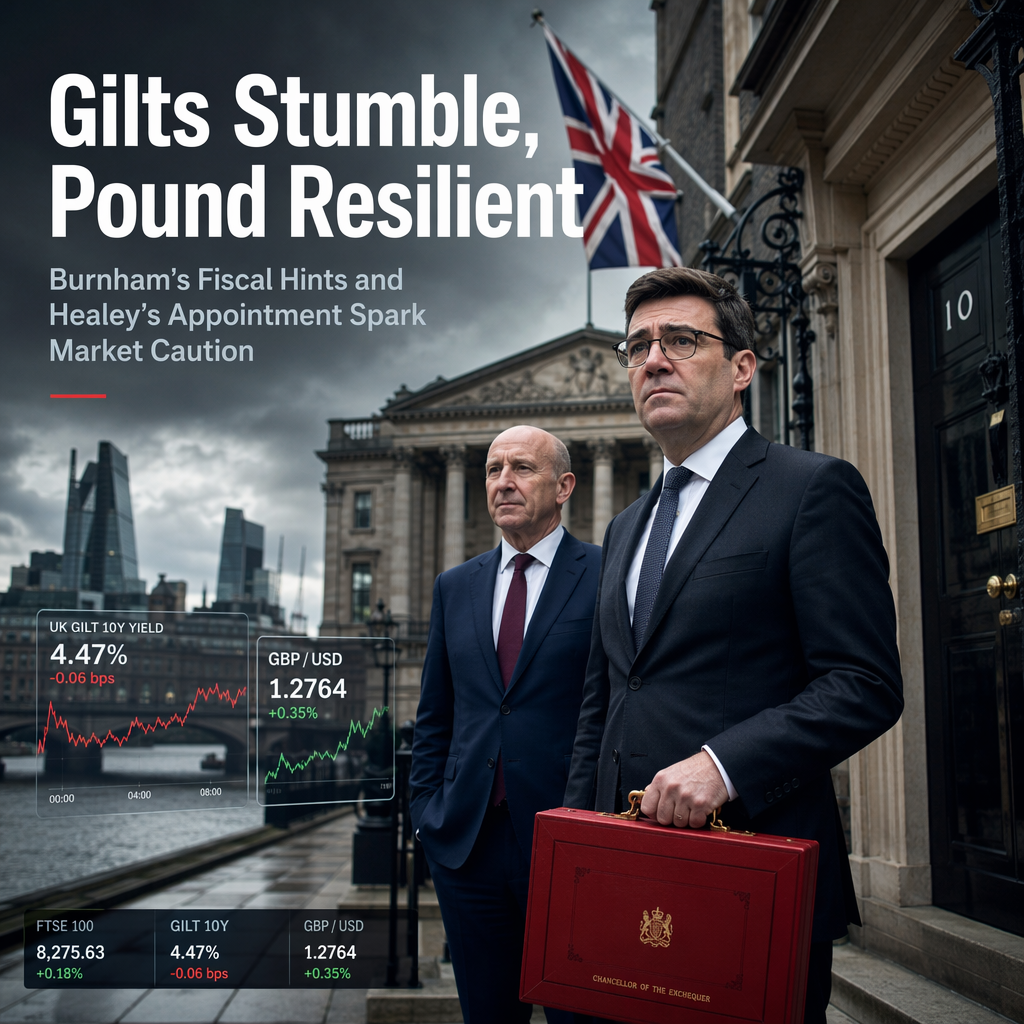
UK Prime Minister Andy Burnham's first day in office led to notable market movements, particularly in the bond and currency markets. According to ING’s Francesco Pesole, 10-year UK gilts significantly underperformed compared to other European bonds after Burnham indicated he would use flexibility within the fiscal rules. This announcement triggered a negative, though limited, reaction in sterling, with the pound initially showing little response but later recovering, supported by stronger jobs market data [1].
The surprise post-market appointment of John Healey as Chancellor of the Exchequer drew market attention, but sterling's muted reaction suggests that Healey is not perceived as a major departure from the previously expected frontrunner, Shabana Mahmood. Analysts believe that Burnham is likely to take a leading role in economic policymaking, preferring a loyal appointee over someone with more independent policy views, such as Ed Miliband [1].
Despite the pound's recent outperformance, analysts at ING see vulnerabilities for GBP. They argue that EUR/GBP remains undervalued based on short-term valuation metrics, and the absence of a political or fiscal risk premium, combined with what they view as overly aggressive market pricing for Bank of England tightening, presents upside risks for the EUR/GBP pair [1].
Market participants are closely watching for stabilization in the bond market, which is seen as necessary for the pound to regain its strong momentum. The overall sentiment remains cautious, with analysts highlighting potential risks for sterling going forward [1].
CONCLUSION
The appointment of John Healey as Chancellor and Prime Minister Burnham's signal of fiscal flexibility have introduced some turbulence in UK gilts and limited downside in sterling. While the pound has shown resilience, analysts remain cautious, citing vulnerabilities and potential upside risks for EUR/GBP. Market stabilization, particularly in bonds, is seen as key for the pound's future performance.