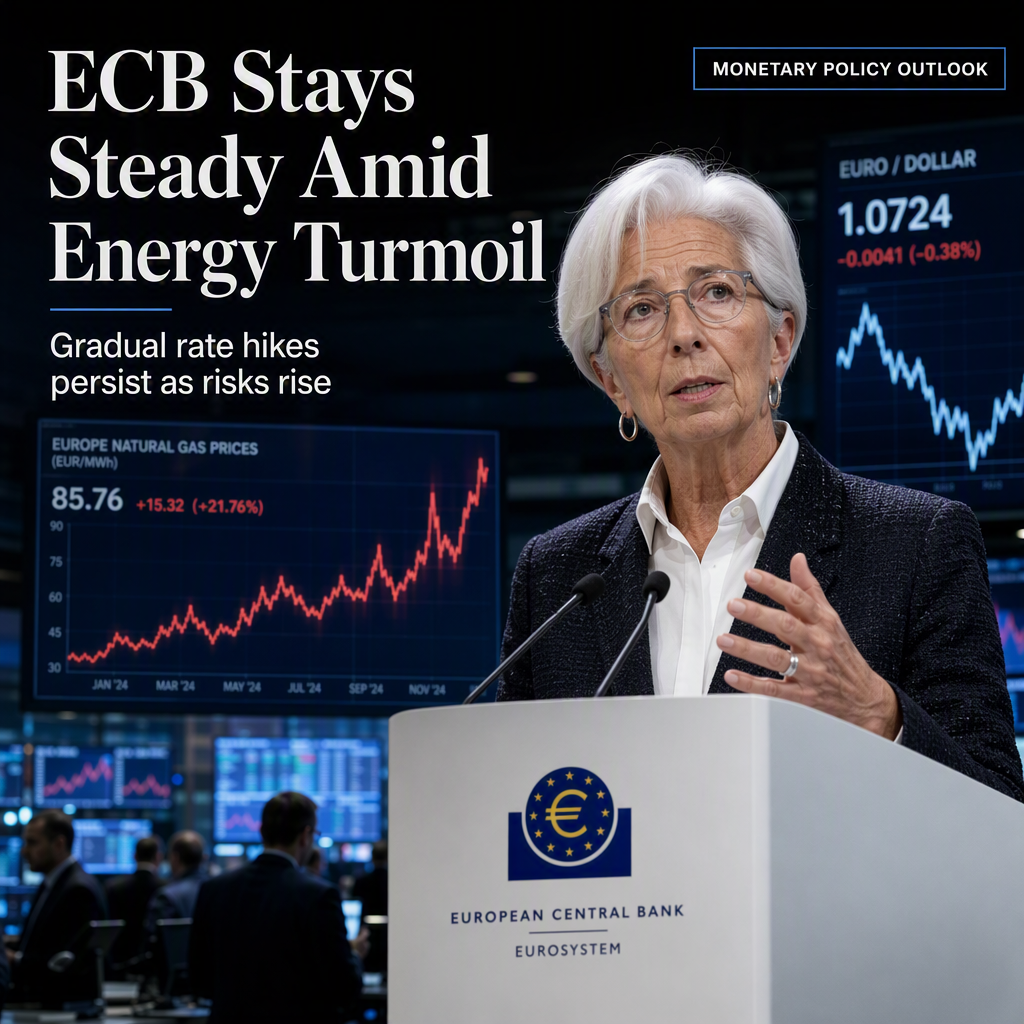
The European Central Bank (ECB) is expected to continue its gradual approach to monetary tightening, with Nordea forecasting two additional 25 basis point rate hikes, one in December and another in March 2027, despite more aggressive market pricing in recent weeks [1][2]. This outlook is influenced by rapidly climbing energy prices and heightened uncertainty stemming from ongoing Middle East tensions, which have contributed to increased rate expectations in financial markets [1][2]. Nordea notes that while risks have tilted towards potentially faster hikes, the ECB's communication remains consistent with a quarterly pace, and there is no indication of urgency for a more aggressive tightening cycle [1].
On the Euro side, the currency has come under pressure, heading for a weekly loss against the US Dollar as the Federal Reserve's hawkish outlook and recent rate hike have kept the Greenback supported [2]. The EUR/USD traded around 1.1462, near levels last seen in late July, as a rebound in oil prices and US Treasury yields added further pressure [2]. ECB President Christine Lagarde stated that growth is 'a bit more promising than we thought' and emphasized that policymakers are 'not seeing second-round effects yet.' She highlighted energy as a significant variable and reiterated that rate decisions will be made 'meeting by meeting' [2].
Market participants are closely watching both the ECB and the Fed, with the latter having delivered its first rate hike since 2023, raising the federal funds rate by 25 basis points to the 3.75%-4.00% range [2]. The US Dollar Index (DXY) climbed above 100.50, its highest in seven weeks, reflecting continued demand for the Greenback amid expectations of further tightening [2]. According to the CME FedWatch Tool, traders see around a 55% probability of another 25-basis-point Fed rate hike in October [2].
Analysts at Nordea reiterate that while financial market pricing for ECB hikes has increased rapidly, their baseline remains two more 25bp hikes, with the possibility of faster action if energy prices continue to rise or geopolitical risks escalate [1][2]. However, the ECB's current stance does not suggest an imminent acceleration in the pace of rate increases [1].
CONCLUSION
The ECB is maintaining a gradual, quarterly rate hike trajectory despite mounting market expectations for faster tightening due to rising energy prices and geopolitical uncertainties. While risks have shifted towards potentially quicker action, the central bank's communication and recent data support a steady approach. The Euro remains under pressure against the US Dollar, reflecting divergent monetary policy outlooks between the ECB and the Fed.