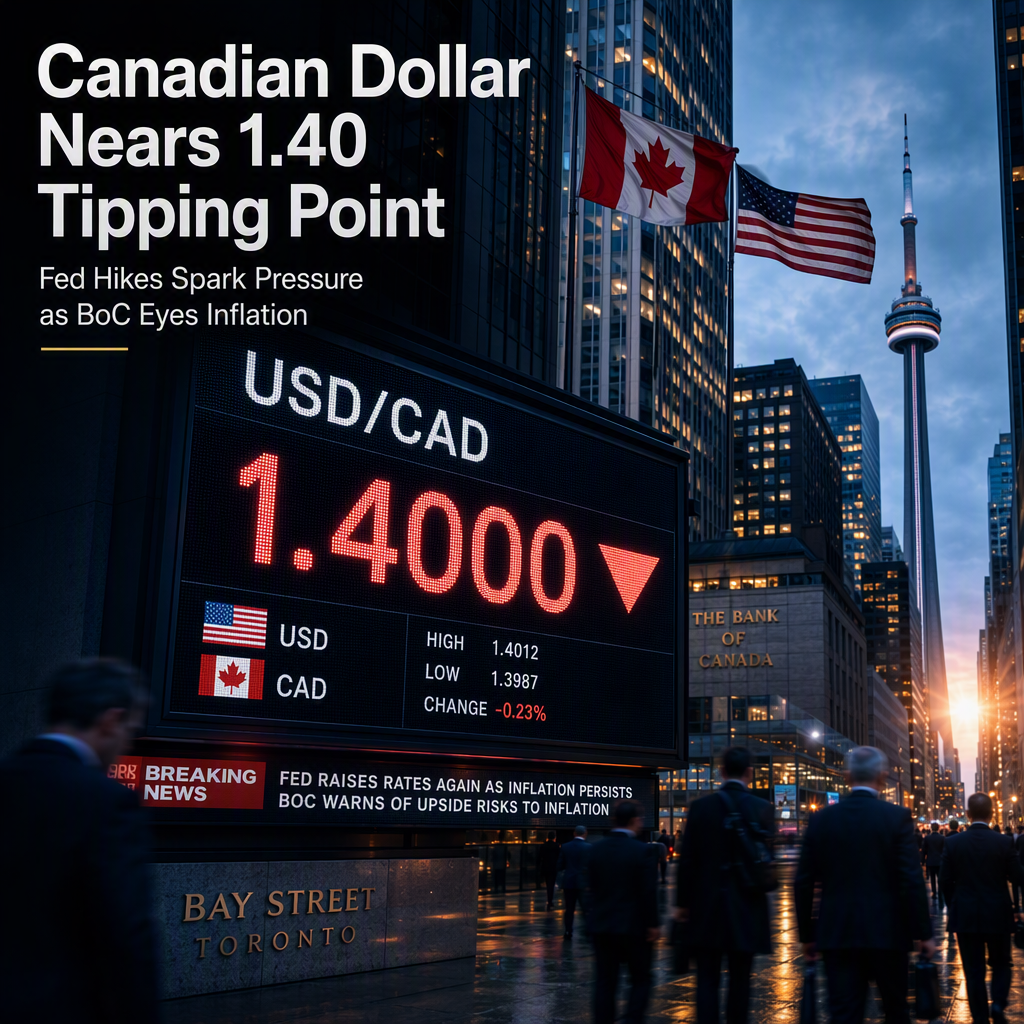
The Canadian Dollar (CAD) traded near the 1.40 level against the US Dollar (USD) on Friday, with USD/CAD edging higher by 0.10% to around 1.4000 [1][2]. This movement was primarily driven by a firm US Dollar, supported by the Federal Reserve's (Fed) recent decision to raise its benchmark interest rate by 25 basis points to a range of 3.75%-4%, marking its first rate hike since 2023 [1][3]. Sixteen of the 18 Fed officials anticipate at least one more rate hike this year, and investors now see a 55% chance of another 25 basis point increase at the Fed's October meeting, according to the CME FedWatch tool [1]. The US Dollar Index (DXY) traded above 100.50, its highest in seven weeks, while the US 10-year Treasury yield rebounded to around 4.98%, close to its 2007 peak [1].
On the Canadian side, the CAD's losses were described as 'minor' and attributed more to the bullish USD undertone and wider US–Canada front-end spreads than to CAD-specific factors [1][2]. Crude oil prices, while rebounding to $97.30 after an intraday low of $94.63, provided some support to the CAD, but were not enough to offset the drag from interest rate differentials [1][2]. Scotiabank strategists noted that the spot rate remains somewhat overvalued relative to their fair value estimate of 1.3910, and that a weaker CAD is 'unhelpful for the BoC as it considers building inflation risks' [1][2].
Looking ahead, Bank of Canada (BoC) Governor Tiff Macklem is scheduled to speak on Monday in Halifax, with markets watching for any reiteration of concerns about intensifying upside risks to inflation [1][2][3]. RBC's Nathan Janzen highlighted that the BoC is focused on the inflation passthrough from higher energy prices, with meeting minutes clarifying that policymakers are more concerned about the impact on general inflation than on oil prices themselves [3]. While RBC's base case is for gradual rate hikes starting in early 2027, risks are shifting toward earlier tightening, especially after the Fed's recent move [3].
Technical analysis from Scotiabank indicates that the USD is pressuring the 50% retracement resistance at 1.3990, and a sustained push through 1.40 could lead to further gains toward 1.4050/1.4125, with support now at 1.3940/50 [2]. Broader risk appetite was described as 'a little soft,' with European stocks lower and US equity futures slightly positive [1][2].
CONCLUSION
The Canadian Dollar remains under pressure near the 1.40 level against the US Dollar, driven by Fed rate hikes, strong US yields, and wider US–Canada spreads. Market participants are closely watching upcoming remarks from BoC Governor Macklem for signals on inflation and potential policy tightening. The outlook for the CAD will depend on evolving central bank guidance and global risk sentiment.