
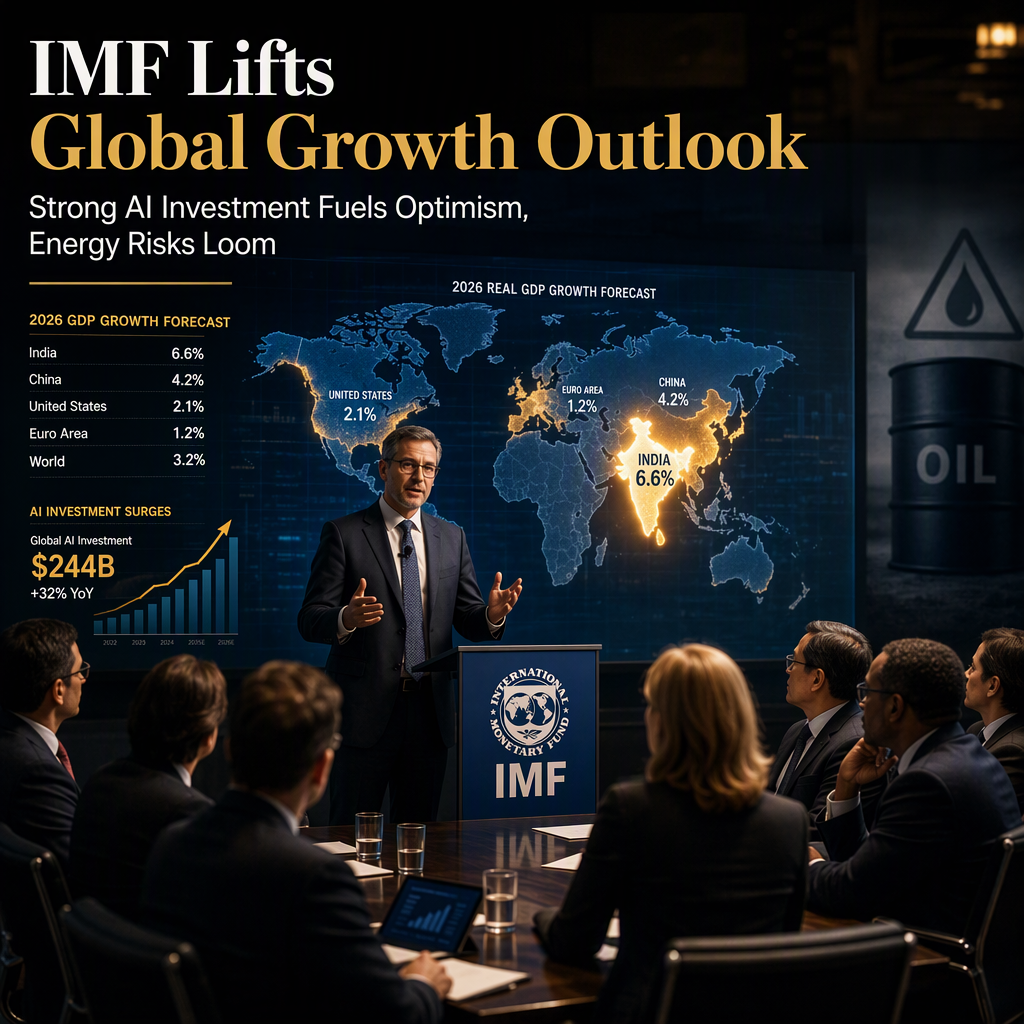
The International Monetary Fund (IMF) has updated its global economic outlook, raising its 2026 real GDP growth forecast to 3.1% from the previous estimate of 3.0% in July. This revision is attributed to robust investment in artificial intelligence, which is helping to offset the negative impact of the ongoing energy shock stemming from the Middle East war [1]. The IMF's forecast for global growth in 2027 remains unchanged at 3.4%, while the 2025 projection stands at 3.5% [1].
Key country-specific forecasts include the United States, with 2026 growth expected at 2.3%, unchanged from July and 2025, and a slight increase to 2.3% in 2027 compared to 2.2% previously [1]. China's growth is forecast at 4.5% for 2026 and 4.0% for 2027, both down by 0.1 percentage point from July estimates [1]. The Euro area is projected to grow by 1.1% in 2026, up from 0.9% in July, reflecting resilience in Germany, Italy, and Spain [1]. India stands out with a forecasted growth rate of 7.0% for both 2026 and 2027, significantly higher than July's projections of 6.4% and 6.7%, respectively, due to strong domestic demand [1].
The IMF notes a concentration of global growth, with 32 countries now accounting for 95% of global expansion, down from about 54 countries in the April forecast [1]. Inflation is expected to rise to 4.7% globally in 2026 before easing to 4.1% in 2027, matching the 2025 level [1]. Oil prices are projected to average $96 per barrel in 2026 and $87 in 2027, higher than July's forecasts of $89 and $78, respectively [1].
The IMF's baseline assumes the reopening of the Strait of Hormuz in March 2027 and a return to pre-war conditions by October 2027 [1]. However, in a scenario where the Middle East conflict worsens and oil prices reach $130 per barrel through Q1 2027, global growth could be reduced by 0.2 percentage point in 2026 and 0.5 percentage point in 2027 [1]. Additionally, if AI investment unwinds and asset prices fall sharply, global GDP output could decline by 1.1% by 2028 [1].
CONCLUSION
The IMF's revised forecasts highlight optimism driven by AI investment and resilient demand in key economies, particularly India. However, elevated oil prices and geopolitical risks pose significant threats to global growth and inflation. Markets may react cautiously, balancing positive growth signals against persistent energy and geopolitical uncertainties.