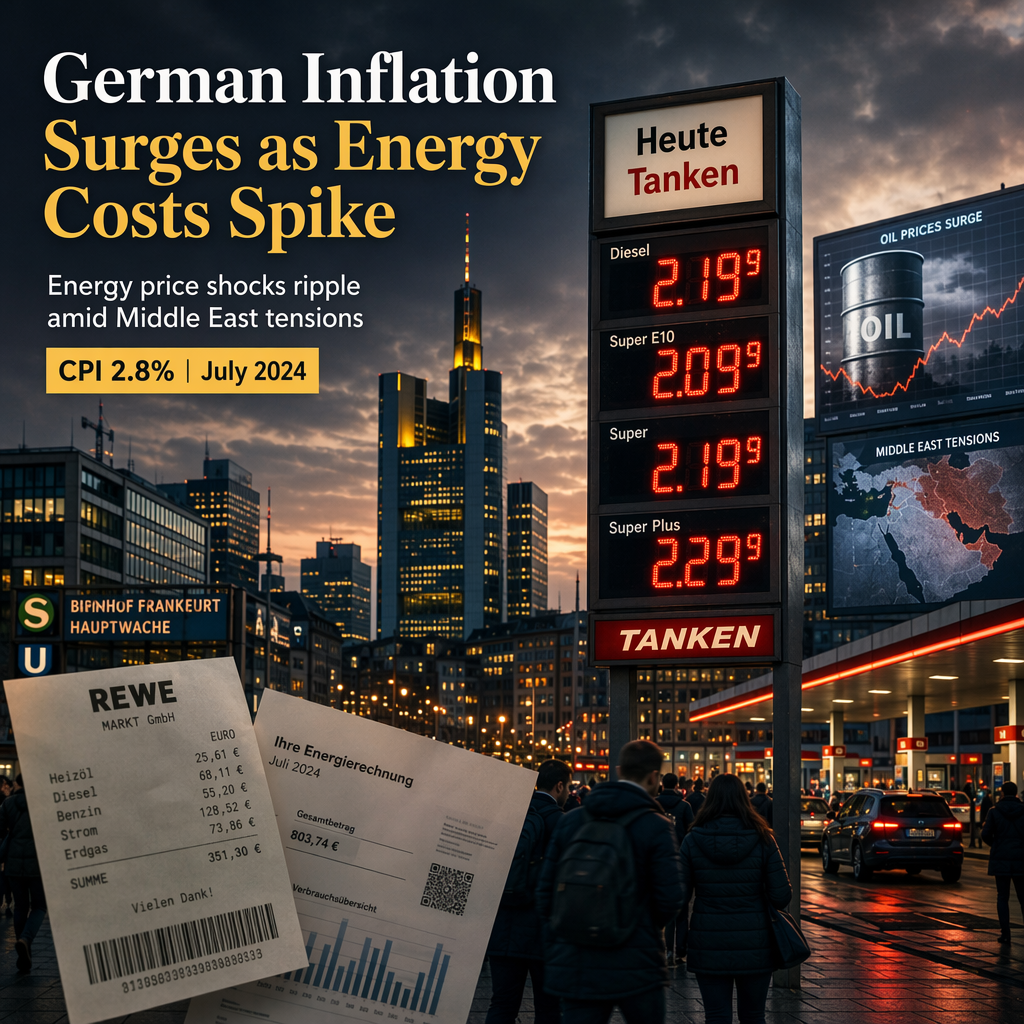
Germany's national Consumer Price Index (CPI) increased from 2.3% in June to 2.8% in July, primarily due to a sharp rise in energy prices. This uptick was attributed to ongoing conflict in the Persian Gulf and the expiration of fuel tax rebates, according to Commerzbank’s Dr. Ralph Solveen [1]. In contrast, core inflation—which excludes energy and food—eased slightly, dropping from 2.5% to 2.4% [1].
Within the core inflation components, service price inflation slowed to just under 3% in July, while inflation for goods (excluding energy and food) remained steady at 1.6% [1]. The report highlights that the short-term trajectory of German inflation is closely tied to developments in the Middle East, with ongoing volatility in oil prices expected to drive further fluctuations in household energy costs [1].
Commerzbank anticipates that if hostilities in the region subside, energy prices—and consequently the overall inflation rate—could fall back toward 2%. However, the core inflation rate is expected to decline only gradually, as companies may continue to pass higher energy costs onto consumers, despite slower growth in labor costs tempering service price increases [1].
CONCLUSION
Germany's inflation rate has rebounded due to energy price shocks linked to Middle East tensions, while core inflation shows only modest easing. The outlook for inflation remains uncertain and highly sensitive to geopolitical developments, with a potential for moderation if energy prices stabilize.