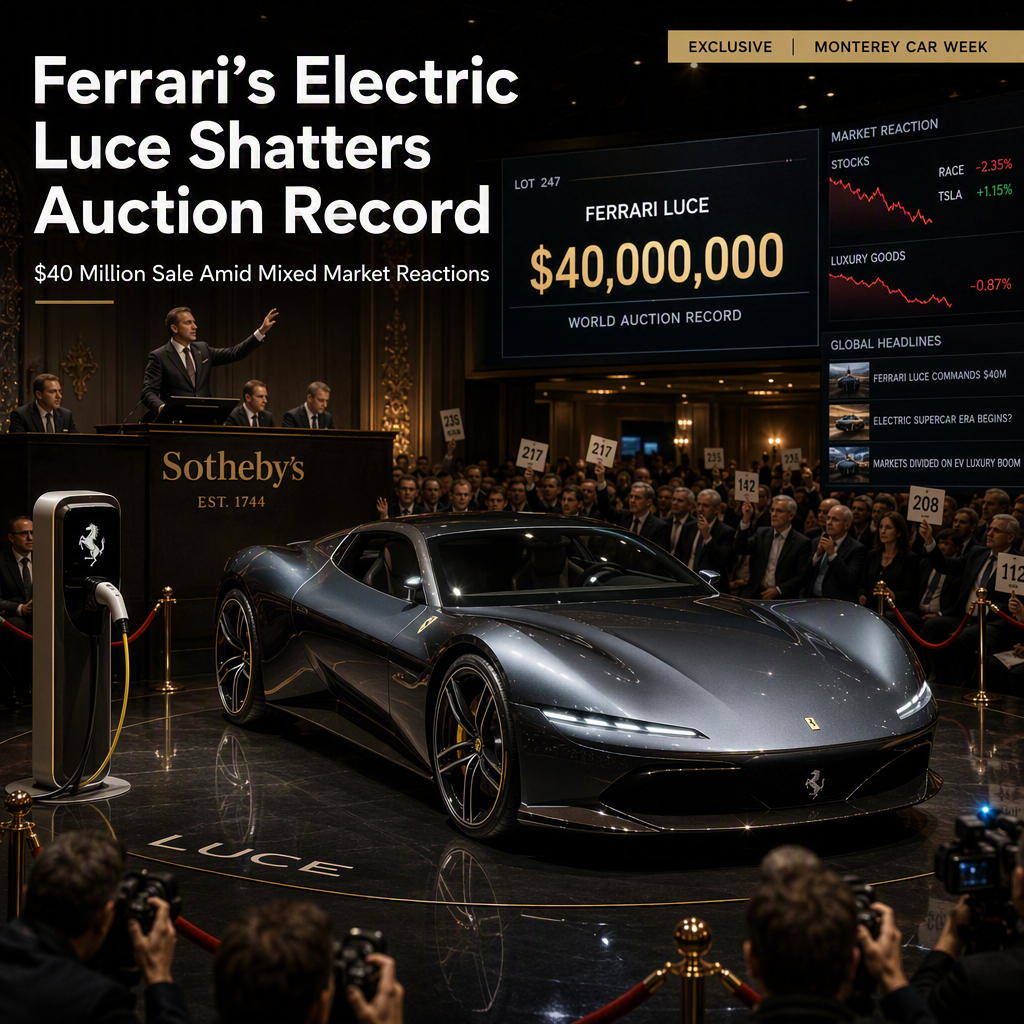
Ferrari's first fully electric vehicle, the bespoke Luce, sold for $40 million at a Sotheby's charity auction during Monterey Car Week in California, setting a new record for a new car sold at auction [1]. The auction featured the first production chassis of the Luce program, with a unique semi-gloss finish and other custom parts, and was described as an 'unrepeatable opportunity' [1]. The winning buyer was not named, and all proceeds will be donated to Ferrari's foundation for educational programs [1]. The Luce was unveiled nearly three months prior to the auction, with a retail price of 550,000 euros (approximately $640,000) [1]. This launch marked a significant shift for Ferrari, diverging from its traditional aesthetic, especially as competitors like Porsche and Lamborghini have scaled back their EV plans due to weak demand [1].
The unveiling of the Luce triggered a negative market reaction, with analysts attributing this to widespread 'design hate' and the phenomenon of 'travel and arrive,' where Ferrari's stock had already risen substantially ahead of the launch [1]. Despite this, Ferrari CEO Benedetto Vigna emphasized the company's commitment to respecting customer preferences and expressed confidence that both existing and new clientele would be interested in the fully electric model [1].
Ferrari's financial performance remains strong, as the company raised its full-year guidance last month, citing unexpectedly robust demand for personalized vehicles and beating Wall Street's second-quarter expectations [1]. Milan-listed shares of Ferrari have increased by nearly 12% year-to-date [1].
CONCLUSION
Ferrari's record-setting $40 million auction for its first electric car, Luce, highlights both the brand's enduring appeal and the polarizing reception of its EV strategy. While the market reacted negatively to the design and launch, Ferrari's financial outlook remains positive, supported by strong demand for personalization and rising share prices. The event underscores Ferrari's ability to attract high-value buyers and adapt to evolving automotive trends.