
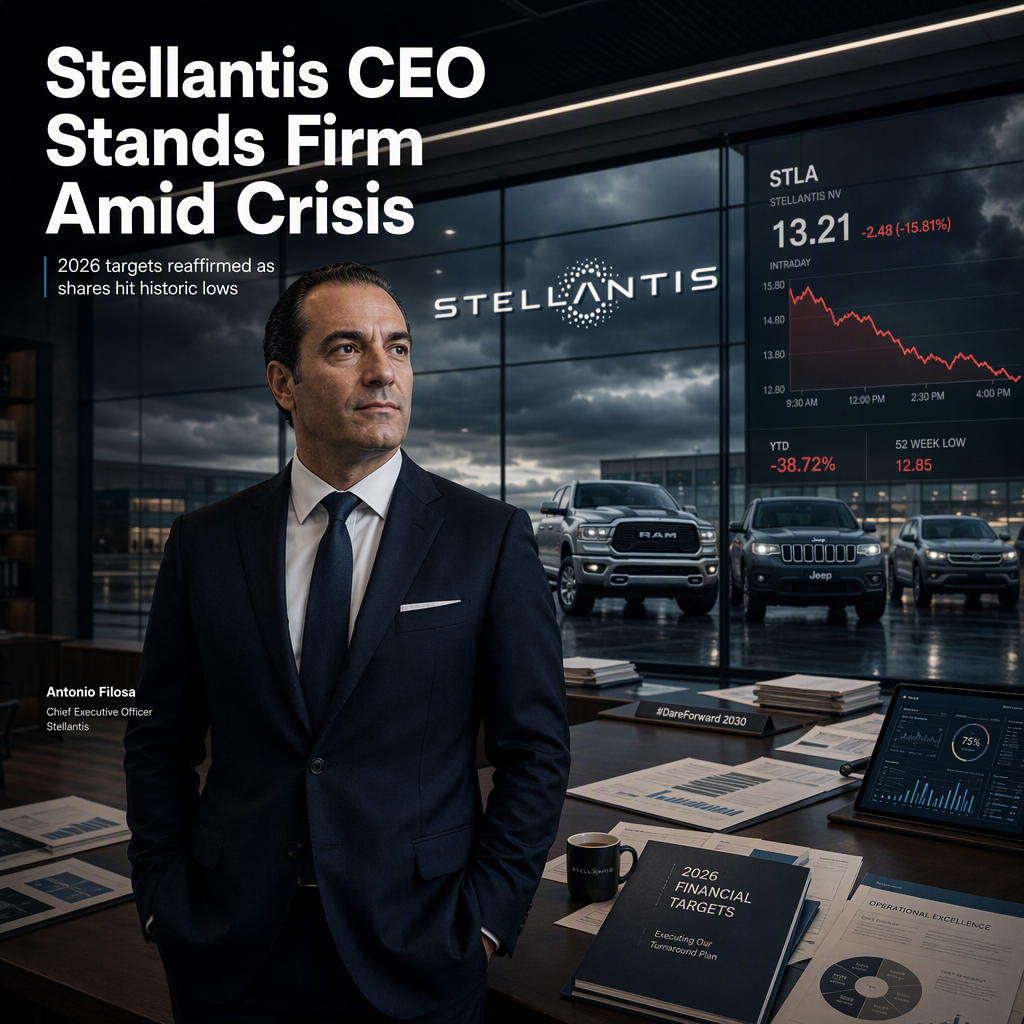
Stellantis CEO Antonio Filosa has reconfirmed the automaker's 2026 guidance and long-term cash flow targets, even as the company's U.S. shares reached an all-time low. Filosa stated, "We are completely committed and we are convinced that we will do that," referring to Stellantis' forecast for a mid-single-digit percentage increase in net revenue and a low-single-digit adjusted operating margin for this year [1]. The CEO also reiterated the company's aim to be cash flow positive by next year and to generate more than 3 billion euros ($3.4 billion) of free cash flow in 2028 [1].
On Tuesday, Stellantis' stock closed at $4.43 per share, marking a 4.1% decline during the trading session and contributing to a nearly 60% loss year-to-date. This performance puts the stock on track for its worst annual result since the company's formation through the merger of Fiat Chrysler and PSA Groupe in January 2021 [1]. The company is currently executing a $70 billion turnaround plan in response to margin dilution and prolonged sales declines, particularly in North America and the U.S. [1].
Filosa's strategy centers on strengthening regional brands such as Ram and Jeep in the U.S., while maintaining the company's portfolio of 14 automotive brands. The turnaround plan emphasizes sharper management of the brand portfolio, new investments, enhanced partnerships, optimized manufacturing, excellence in execution, and empowering regional teams [1].
RBC Capital Markets analyst Tom Narayan noted in an investor report that, despite management's public commitment to keeping the company together, a break-up remains a plausible longer-term scenario for Stellantis [1]. The company's goal is to achieve positive free cash flow by 2027, following a free cash flow loss of 4.5 billion euros last year [1]. Filosa, who became CEO in June 2025, emphasized a customer-focused approach, stating, "The mantra of the reset is around freedom of choice. It's around listening more to the customer" [1].
CONCLUSION
Stellantis is reaffirming its financial targets and turnaround strategy despite significant share price declines and ongoing challenges in key markets. The company's leadership remains committed to its multi-year plan, though analysts suggest structural changes could be considered in the future. Market sentiment remains negative as the stock continues to underperform.