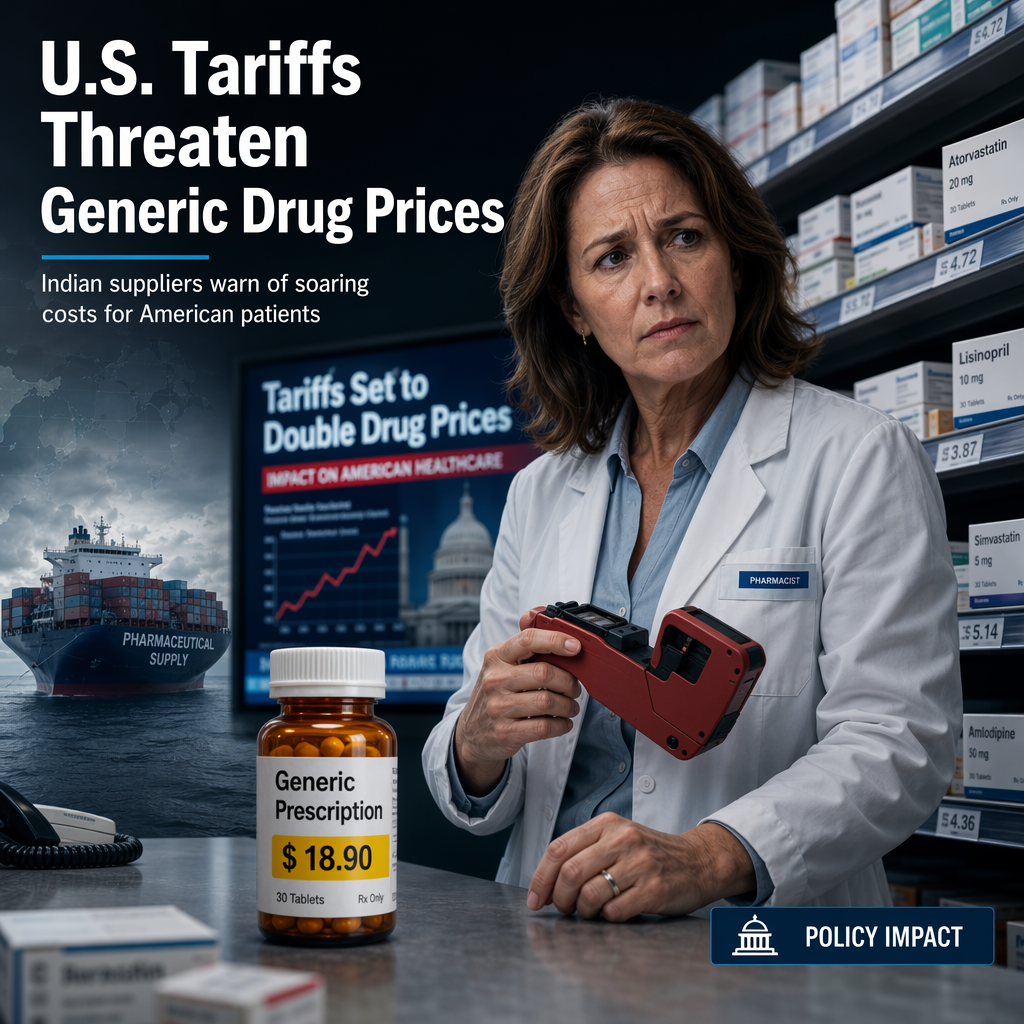
U.S. President Donald Trump has announced that generic drugs imported into the United States will face zero tariffs for two years starting August 1, after which a 100% levy will take effect in August 2028 and rise to 200% a year later [1]. This policy aims to encourage the onshoring of the generic medicine industry to the U.S., where generics account for more than 90% of prescriptions [1]. However, Erez Israeli, CEO of Indian pharmaceutical company Dr. Reddy's Laboratories, warned that these tariffs will result in higher prices for U.S. patients, as the generic drug industry operates on thin margins and cannot absorb such high tariffs [1].
Indian companies currently supply nearly half of the generic drugs to the U.S., according to the Indian Pharmaceutical Alliance [1]. Industry representatives, including Namit Joshi, chair of the Pharmaceuticals Export Promotion Council of India, echoed concerns that tariffs of 100% to 200% are not absorbable by generic drug companies [1]. Israeli further explained that moving manufacturing operations to the U.S. is not feasible for these low-margin products due to higher production costs, and that the process could take four to seven years, much longer than the two-year tariff-free window provided [1].
Dr. Reddy's CEO also noted that the company's generic drug sales to the U.S. have declined from 50% of total sales a few years ago to 27% currently, and are expected to fall below 25% this year as other business segments grow faster [1]. Both Israeli and a report from global brokerage Nomura stated that Indian companies are unlikely to relocate generic manufacturing to the U.S. due to low economic viability [1].
The consensus among industry leaders and analysts is that the tariffs will not achieve the intended goal of onshoring production but will instead lead to increased costs for U.S. consumers [1].
CONCLUSION
The proposed U.S. tariffs on imported generic drugs are expected to significantly raise prices for American patients, as Indian manufacturers—who supply nearly half of the market—cannot absorb the increased costs. Industry leaders and analysts agree that relocating production to the U.S. is economically unfeasible, suggesting the policy may not achieve its intended effect.