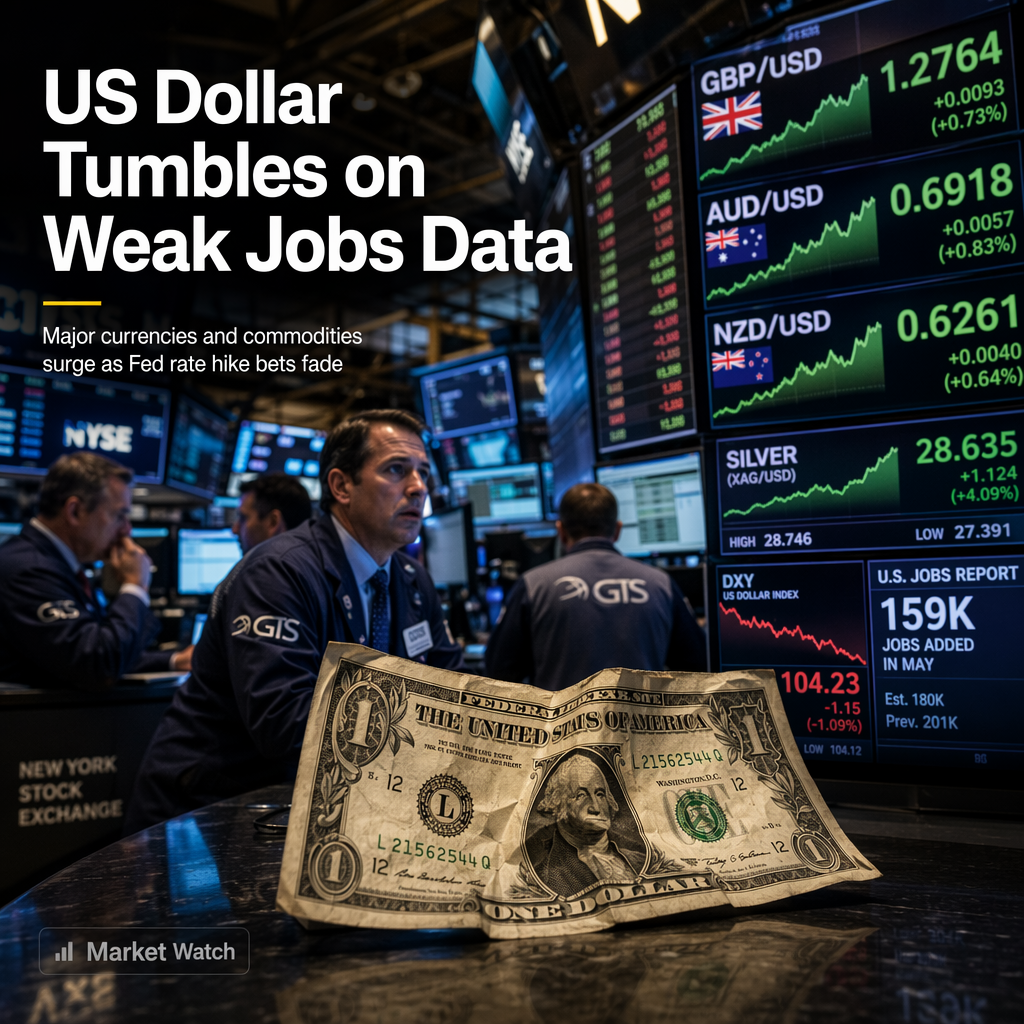
A significantly weaker-than-expected US Nonfarm Payrolls (NFP) report for June triggered a broad sell-off in the US Dollar, fueling gains in major currencies and commodities on Thursday. The US economy added only 57,000 jobs in June, well below consensus estimates of 110,000, with May's figure revised down to 129,000 from 172,000 and April's to 148,000 from 179,000, resulting in a combined downward revision of 74,000 jobs [1][2][3][4]. Despite the disappointing headline, the US Unemployment Rate unexpectedly fell to 4.2% from 4.3%, though this was attributed to a drop in labor force participation to 61.5%, the lowest since March 2021 [1][2][3]. Average Hourly Earnings rose 0.3% month-on-month in June to $37.64, with annual wage growth at 3.5%, in line with expectations [1][2].
The weak jobs data led investors to scale back expectations for further Federal Reserve (Fed) tightening. According to the CME FedWatch Tool, the probability of a Fed rate hike at the September meeting fell to 51% from 63% prior to the data release [4]. Money markets now price in just 23 basis points of additional tightening by year-end [3]. US Treasury yields declined, with the 10-year note yield at 4.461%, down 2 basis points, and the US Dollar Index (DXY) dropped to around 100.74–100.75, its lowest in two weeks [1][3][4].
Currency markets responded sharply. The Australian Dollar (AUD/USD) climbed near 0.6930, supported by the weaker US Dollar, though capped by soft Australian trade data [1]. The New Zealand Dollar (NZD/USD) rose 0.59% to around 0.5705, making it the strongest major currency against the US Dollar on the day [2]. The British Pound (GBP/USD) rallied to 1.3359, its highest in ten days, as the weak payrolls data reduced Fed hike bets and lower oil prices further supported the Pound [3].
Commodities also benefited, with Silver (XAG/USD) surging nearly 3.5% to $61.15, reaching the top of its weekly range as the US Dollar weakened [4]. However, analysts noted that the Fed's hawkish stance may persist due to inflation remaining above target, potentially limiting further upside for silver and other assets [4].
On the technical front, AUD/USD and GBP/USD showed constructive but capped momentum, while XAG/USD retained a bearish near-term bias below key moving averages despite the day's rally [1][3][4].
Forward-looking commentary from San Francisco Fed's Mary Daly indicated that while policy is 'slightly restrictive,' the Fed remains vigilant on inflation, suggesting that further tightening is not off the table [3].
CONCLUSION
The weaker-than-expected US jobs report prompted a sharp decline in the US Dollar and Treasury yields, boosting major currencies and commodities. While markets have scaled back expectations for further Fed rate hikes, persistent inflation means the central bank could still tighten policy later this year. Investors remain cautious, balancing softer labor data against ongoing inflation risks.