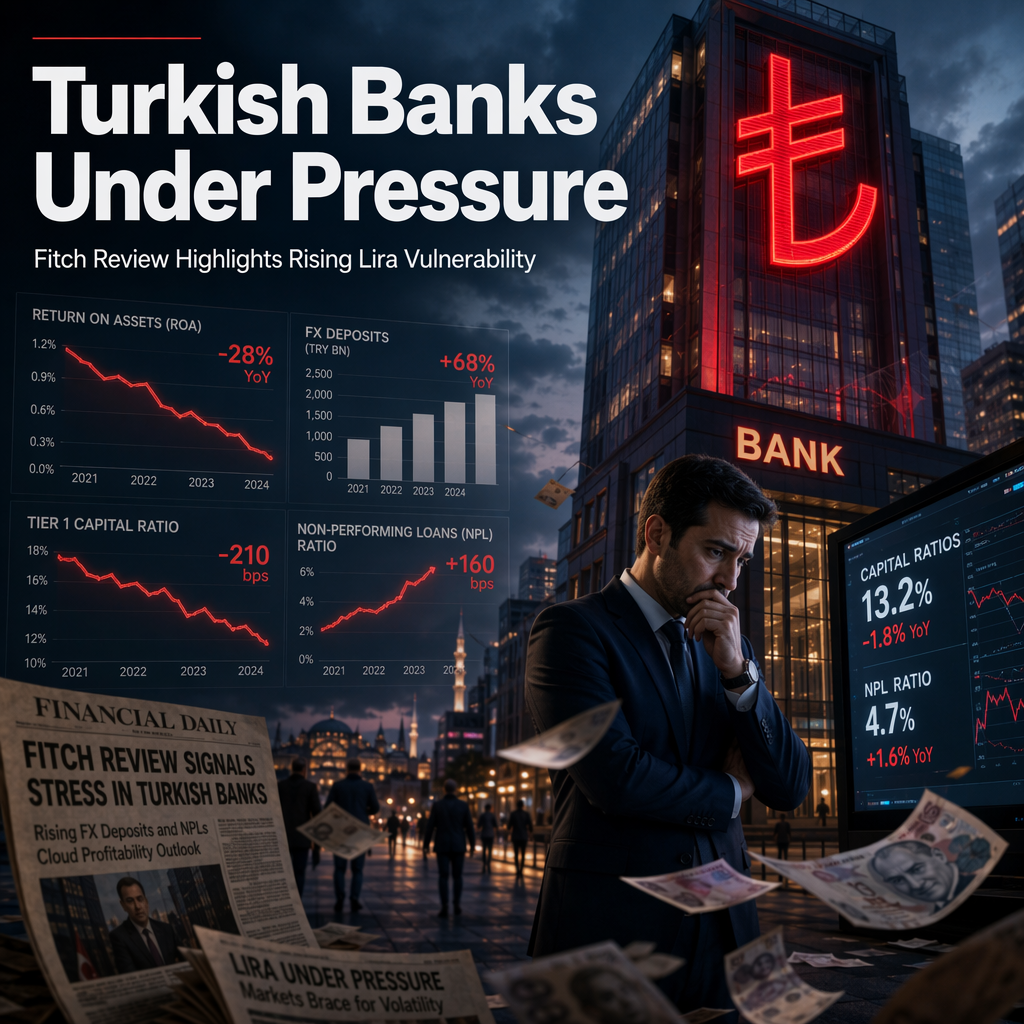
Commerzbank analyst Tatha Ghose has highlighted Fitch's latest review of Turkish banks as a negative signal for the Turkish Lira, citing several deteriorating financial indicators and increased vulnerability for the currency [1]. According to Fitch, Turkish bank profitability weakened in Q1, largely due to the removal of regulatory waivers on FX risk-weighted assets. This regulatory change led to a decline in capital ratios, with the equity Tier 1 ratio dropping to 11.5% from 14.1% [1]. Operating profits remained under pressure due to lower securities yields, squeezed lending margins following Q4 2025 rate cuts, and persistently high trading losses and operating costs [1].
The non-performing loan (NPL) ratio increased to 3.3% at the end of Q1 from 3.1% at the end of Q4 2025, signaling rising credit risk within the banking sector [1]. Fitch expects the challenging conditions to persist, with higher lira interest rates and inflationary pressures—exacerbated by the Iran conflict—likely to further squeeze net interest margins in Q2 through increased funding costs [1].
Another concerning development is the renewed growth in FX deposits, which rose to 38.1% of total deposits from 35.2%. This shift indicates how quickly depositor confidence can change in response to deteriorating external conditions, further increasing financial stress and exchange-rate risk for the Turkish Lira [1].
Overall, the combination of weakened profitability, rising NPLs, and increased FX deposits underscores heightened vulnerability for the Turkish Lira, with Fitch warning that financial stress and inflationary pressures are likely to persist in the near term [1].
CONCLUSION
Fitch's review signals mounting stress in Turkish banks, with key metrics such as capital ratios and NPLs worsening and FX deposits rising. These developments are expected to keep the Turkish Lira under pressure, as financial and inflationary risks remain elevated. Market participants should remain cautious given the ongoing challenges highlighted by Fitch.