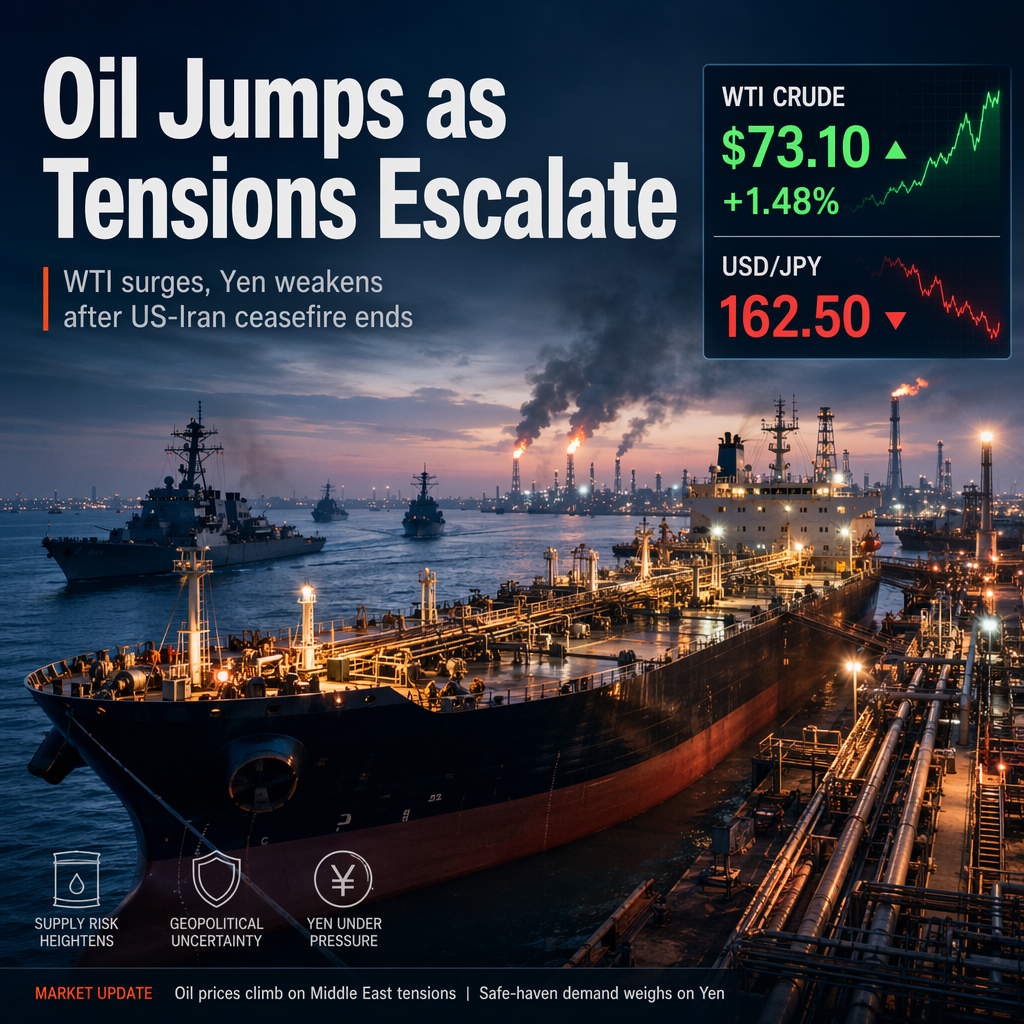
West Texas Intermediate (WTI) Oil prices advanced to around $73.10 on Wednesday, rising 1.48% on the day, as investors responded to renewed geopolitical risks in the Middle East following a breakdown in US-Iran relations [1]. US President Donald Trump, speaking at the NATO summit, confirmed that the memorandum of understanding with Iran aimed at ending the conflict is now over and stated he no longer wants to negotiate with Iran after recent attacks on commercial vessels in the Strait of Hormuz [1][2]. The US Central Command (CENTCOM) confirmed strikes on Iranian military infrastructure in response to Tehran's attacks on commercial ships in the strategic waterway, which handles about one-fifth of global oil supply, intensifying concerns over potential disruptions to energy flows [1][2].
Analysts at ING highlighted that oil prices have climbed due to renewed tensions in the Persian Gulf and the US decision to revoke a temporary license allowing certain Iranian oil sales, increasing the risk of a breakdown in negotiations between Washington and Tehran [1]. Additional support for oil prices comes from declining US crude and refined product inventories and fresh attacks on Russian refineries [1]. BNY noted that financial markets are becoming increasingly fragile as hopes for a swift return to normal shipping conditions through the Strait of Hormuz fade, with oil prices already reacting strongly to the escalation [1].
The escalation in the Middle East also impacted currency markets, with the Japanese Yen weakening and USD/JPY trading around 162.50, near 40-year highs [2]. The rise in oil prices has revived inflation concerns, increasing pressure on major central banks to tighten monetary policy [2]. Higher energy prices are particularly negative for the Japanese Yen, as Japan imports nearly 90% of its crude oil from the Middle East [2]. Speculation is growing that Japanese authorities could intervene to support the Yen, making traders cautious about aggressively chasing further gains in USD/JPY [2].
On the monetary policy front, traders have increased bets that the Federal Reserve could raise interest rates in September, with markets pricing in roughly a 68% probability of a hike, according to the CME FedWatch Tool [2]. Investors are awaiting the release of the June FOMC meeting minutes for further policy clues [2]. In Japan, the Bank of Japan continues to signal a tightening bias, with Governor Kazuo Ueda warning of secondary inflation effects from higher crude oil prices [2]. However, Japan's deteriorating fiscal outlook could temper the pace of policy normalization, though the government reaffirmed the central bank's independence [2].
CONCLUSION
The escalation of US-Iran tensions has driven WTI oil prices higher and weakened the Japanese Yen, with markets reacting to the increased risk of supply disruptions and revived inflation concerns. Central banks may face greater pressure to tighten policy, while traders remain cautious amid speculation of possible intervention in currency markets. The situation remains fluid, with further developments likely to impact both energy and financial markets.