
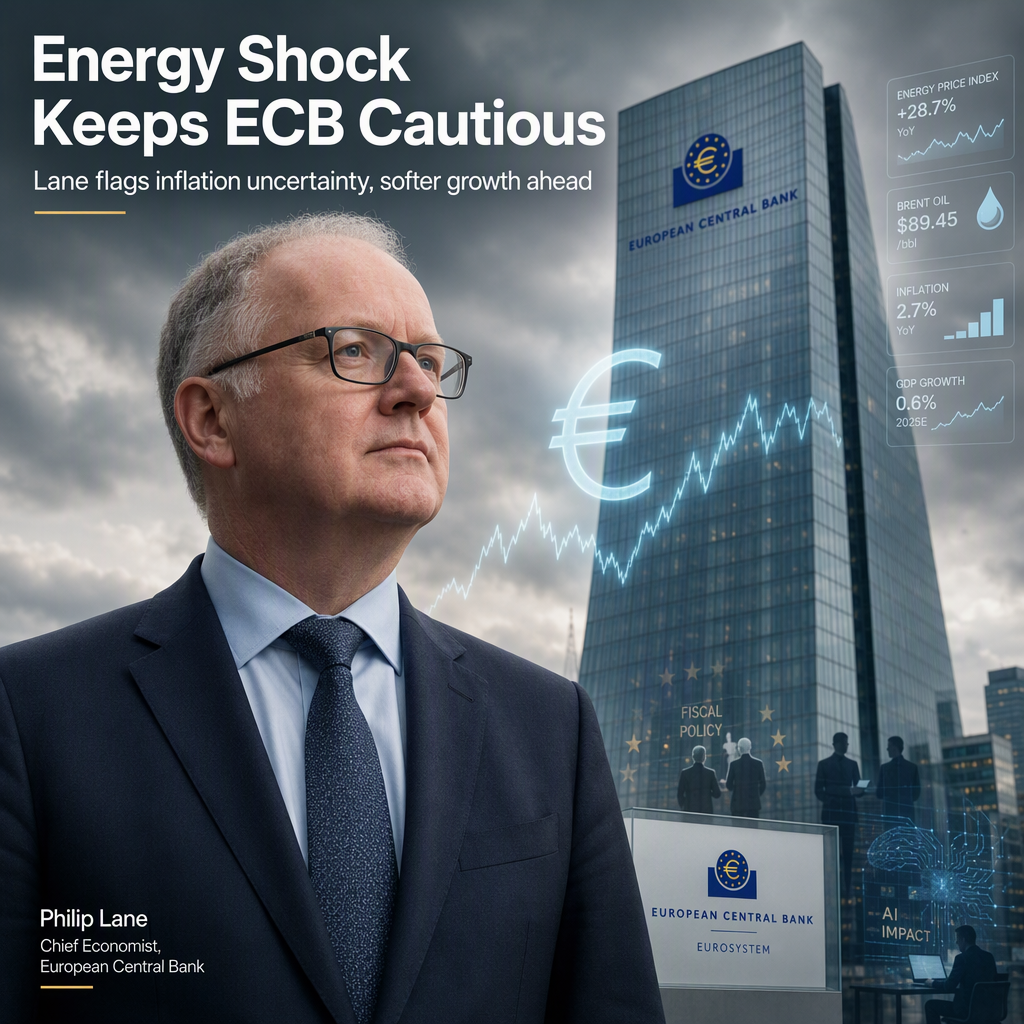
European Central Bank (ECB) Chief Economist Philip Lane stated in an interview with ANSA that high inflation, primarily driven by an energy shock, is the main factor influencing the ECB’s current hawkish stance on interest rates. Lane emphasized that while energy prices remain elevated, the extent to which these costs are being passed through to the broader economy is still uncertain, which tempers the urgency for aggressive rate hikes [1].
Lane noted that the ECB’s interest rate decisions are primarily guided by the inflationary effects of the energy shock. He also highlighted that fiscal policy support for the economy is expected to be different in 2027 and 2028 compared to 2026, suggesting a potential for softer economic growth in the later years. Additionally, Lane acknowledged that artificial intelligence (AI) is anticipated to provide support to the economy in the medium term [1].
During the release of Lane’s comments, the Euro (EUR) experienced a sharp upside move against the US Dollar (USD), although this was attributed to a simultaneous downside move in the USD. As of the report, EUR/USD stabilized near 1.1220 [1]. Lane’s remarks received a 5.4/10 score on the FXS Speechtracker, slightly below the historic average, indicating a broadly steady tone with a mild dovish tilt. The speech’s emphasis on uncertainty regarding inflation persistence and future fiscal support suggests a less aggressive stance on future rate hikes [1].
CONCLUSION
ECB Chief Economist Philip Lane’s comments reinforce the central bank’s focus on energy-driven inflation but highlight uncertainty about its broader economic impact. The overall tone was slightly dovish, with expectations of weaker fiscal support in the coming years and acknowledgment of AI as a growth factor. Market reaction was muted, with the Euro stabilizing after an initial move, reflecting cautious sentiment regarding future ECB policy.